Category Archives: Ages 4+ Years

At age four, children are becoming curious explorers and creative problem solvers. This section of the Toyroots blog focuses on toys for 4-year-olds that bridge the gap between play and preschool learning. As children develop better hand-eye coordination and longer attention spans, the right tools can make a significant difference in their developmental journey.

Our guides explore a wide range of categories, including STEM toys for 4-year-olds, cooperative board games that teach social skills, and complex building sets for fine motor mastery. Whether you are looking for outdoor active play ideas or quiet-time educational puzzles, our expert reviews help you find high-quality, durable options that grow with your child. Dive into our latest articles to discover how to support your 4-plus preschooler through purposeful play.

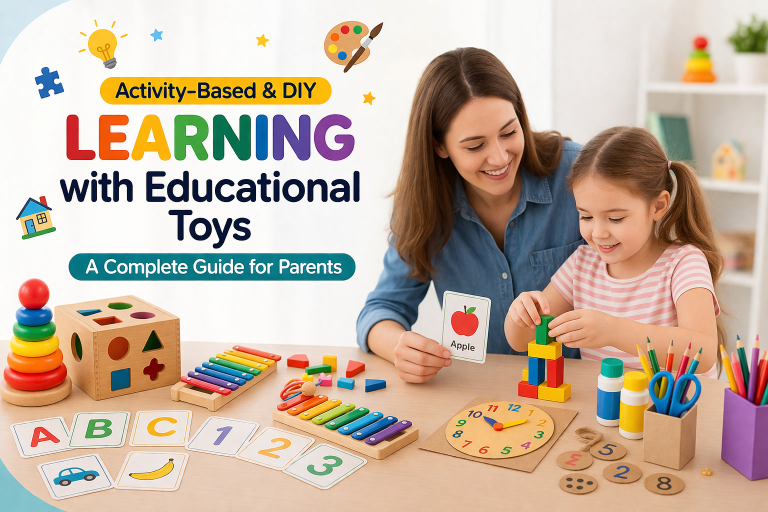
Activity-Based & DIY Learning with Educational Toys: A Complete Guide for Parents

In today’s fast-paced, technology-driven world, many parents struggle to find meaningful ways to engage their children beyond screens. While digital tools have their place, nothing replaces the value of hands-on, activity-based learning—especially when combined with educational toys.

Educational toys are more than just playthings; they are tools that help children explore, experiment, and understand the world around them. However, simply owning these toys is not enough. The real impact comes from how they are used. By integrating fun activities, creating a dedicated learning space, and even making your own DIY toys, you can transform ordinary playtime into a powerful learning experience.

This guide will walk you through practical ideas and strategies to help your child learn, grow, and thrive through creative play.


🎯 Why Activity-Based Learning is Important

Activity-based learning focuses on learning through doing. Instead of passively receiving information, children actively participate in the learning process. This method is especially effective for young learners because it aligns with their natural curiosity and energy.

When children engage in hands-on activities, they develop essential life skills such as problem-solving, critical thinking, and creativity. It also improves memory retention because kids are more likely to remember things they experience rather than things they are simply told.

Moreover, activity-based learning builds confidence. When a child successfully completes a puzzle, builds a structure, or solves a simple problem, they feel a sense of achievement that motivates them to keep learning.


🧩 Fun Learning Activities Using Educational Toys


Educational toys can be used in many creative ways to make learning exciting and interactive. For example, a simple set of blocks can be turned into a counting game where children stack and count each piece. Similarly, shape sorters can help kids recognize patterns and improve their cognitive skills.

Another engaging activity is a “color hunt,” where children are asked to find objects or toys of a specific color around the house. This not only reinforces color recognition but also keeps them physically active.

Storytelling is another powerful method. Using toy animals, dolls, or action figures, children can create their own stories. This enhances language development, imagination, and emotional expression.

Puzzles can also be turned into fun challenges by adding a time element, encouraging children to think quickly and strategically. These simple activities make learning enjoyable while building essential skills.


🏡 How to Create a Learning Corner at Home


Creating a dedicated learning space at home can significantly improve a child’s focus and interest in educational activities. A learning corner doesn’t need to be large or expensive—it just needs to be organized, inviting, and child-friendly.

Start by choosing a quiet and well-lit area in your home. Add a small table and chair suitable for your child’s height. Use colorful baskets or shelves to store toys neatly, making them easily accessible.

It’s also a good idea to rotate toys every week. This keeps the environment fresh and exciting, preventing boredom. You can decorate the space with educational posters, alphabet charts, or your child’s artwork to make it more engaging.

A well-designed learning corner helps children associate that space with focus, creativity, and fun learning.


🛠️ DIY Educational Toys You Can Make at Home

You don’t always need to buy expensive toys to support your child’s learning. Many effective educational tools can be made at home using simple, everyday materials.

  • Counting game using bottle caps
  • Cardboard puzzles
  • Alphabet box with objects
  • Sock matching game
  • Paper plate clock

DIY toys also give parents an opportunity to bond with their children while creating something meaningful together.


🎮 10 Indoor Learning Games for Kids


  • Memory card games to improve concentration
  • Alphabet treasure hunts to build language skills
  • Number hop games for active learning
  • Tower-building challenges using blocks
  • Word formation games for early readers
  • Matching pair activities
  • DIY bowling games using plastic bottles
  • Simon Says for listening skills
  • Story cube games for creativity
  • Sorting games based on size, shape, or color


🔤 How to Use Flashcards and Toys Together Effectively


Flashcards are a great learning tool, but they can sometimes feel repetitive or boring if used alone. Combining flashcards with toys makes learning more interactive and enjoyable.

For example, if you’re teaching the word “apple,” you can show the flashcard and then match it with a toy fruit. This creates a stronger connection in the child’s mind. You can also turn flashcard sessions into games by asking questions, giving rewards, or incorporating storytelling.

Using flashcards during playtime rather than as a separate activity helps children learn naturally without feeling pressured.


🌟 Conclusion


Educational toys have the potential to transform the way children learn—but their true value lies in how they are used. By incorporating activity-based learning, setting up a dedicated learning corner, and exploring DIY toy ideas, parents can create a rich and engaging learning environment at home.

Play is not just entertainment—it is the foundation of lifelong learning.


🧸 Top 7 Educational Toys That Boost Your Child’s Brain Development in 2026

Smart Educational Toys 2026

Choosing the right educational toys can shape your child’s future. In 2026, toys are smarter, interactive, and designed to build real-world skills while keeping kids engaged.


🧠 1. STEM Building Kits

STEM kits help children explore science, engineering, and technology by building robots, circuits, and mechanical models.

✨ Why they’re great:

  • Improve problem-solving skills
  • Encourage logical thinking
  • Develop engineering mindset early

👶 Best for: Ages 6+

🎨 2. Creative Art & Craft Kits

Art kits allow kids to express their imagination while improving creativity and emotional development.

  • Drawing tools
  • Clay modeling sets
  • DIY craft projects

👶 Best for: Ages 3+

🧩 3. Puzzle & Brain Teasers

Puzzles help kids think critically and improve focus.

  • Jigsaw puzzles
  • Sudoku for kids
  • 3D brain games

🤖 4. Coding Toys & Robots

Kids can learn programming through fun drag-and-drop coding games and smart robots.

  • Computational thinking
  • Sequencing and logic
  • Basic programming skills

📚 5. Interactive Learning Tablets

Educational tablets combine games, quizzes, and lessons in one device.

  • Parental controls
  • Curriculum-based apps
  • Voice interaction

🔤 6. Language Learning Toys

Language toys help kids learn through sound, visuals, and repetition.

  • Talking flashcards
  • Alphabet boards
  • Audio storytelling toys

🧮 7. Math Learning Toys

Math toys make numbers fun through games and puzzles.

  • Counting games
  • Abacus tools
  • Math puzzles

🎯 Final Thoughts

The best toys match your child’s interests and learning style.

  • ✔ Encourage active participation
  • ✔ Combine learning with fun
  • ✔ Grow with your child

💡 Pro Tip for Parents

Rotate toys every few weeks to keep kids engaged and curious.

Toddler playing with wooden number matching puzzle educational toy in Pakistan

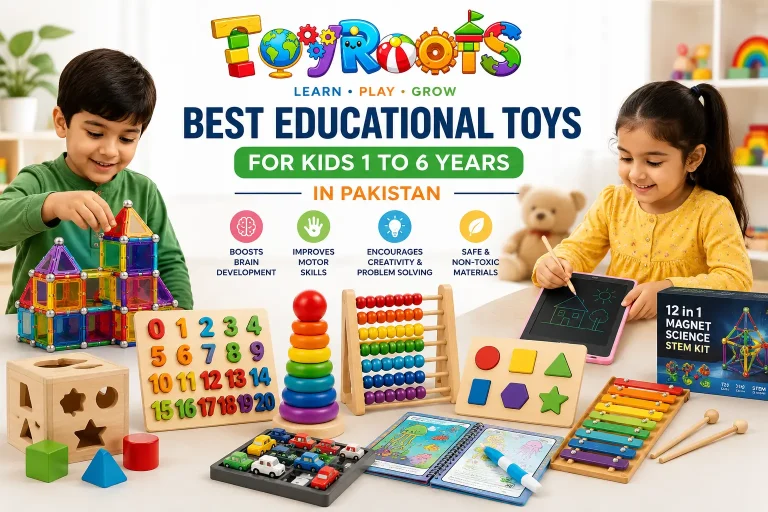
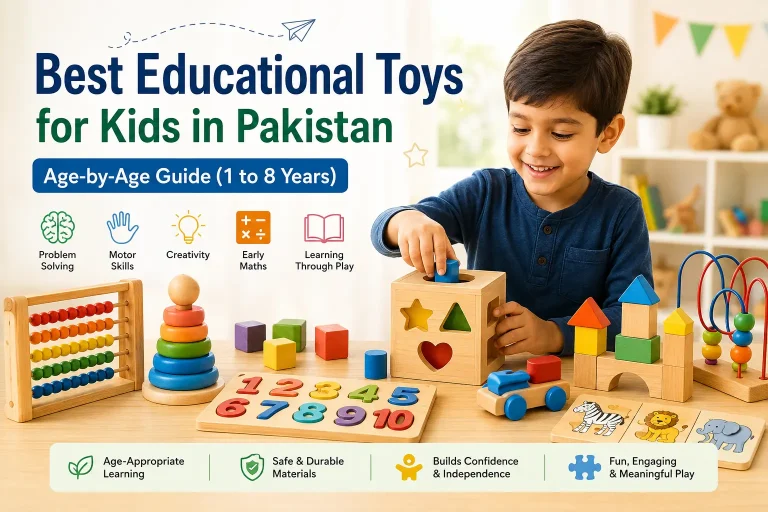
Best Educational Toys for Kids in Pakistan (Age-wise Guide for Parents)

Choosing the right toy for your child is not just about fun — it’s about shaping their learning, creativity, and confidence.

🎯 Why Educational Toys Matter

Educational toys are designed to do more than entertain.

  • 🧠 Improve problem-solving skills
  • ✋ Develop fine motor skills
  • 🎨 Enhance creativity
  • 🔤 Build early learning skills
wooden puzzle toy for kids

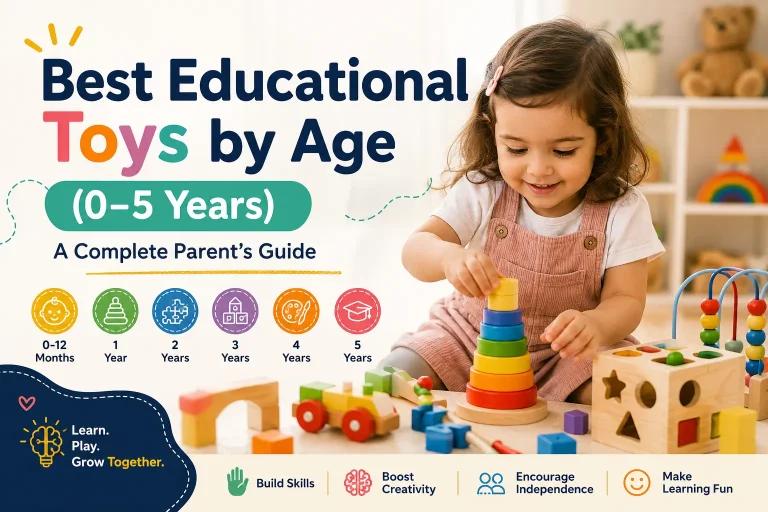
👶 Best Toys for Toddlers (1–3 Years)

Toddlers learn through touch and movement.

  • 🧩 Shape sorters
  • 🪵 Wooden puzzles
  • 🔵 Stacking rings
  • 🌈 Color toys
stacking rings toy for toddlers

🧒 Best Toys for Preschoolers (3–5 Years)

Preschoolers love exploring.

  • 🔤 Alphabet puzzles
  • 🔢 Abacus
  • 🧲 Magnetic tiles
  • 🧱 Blocks
magnetic tiles for kids learning

🧠 Best STEM Toys for Kids (5+ Years)

Structured learning meets fun.

  • 🧩 Logic puzzles
  • 🔧 Construction sets
  • 🤯 Brain games
  • 🛠️ DIY kits
STEM educational toy for kids

🪵 Why Wooden & Montessori Toys Are Better

They encourage focus, independence, and creativity.

montessori wooden toy for kids

🚫 Common Mistakes Parents Make

  • ❌ Too advanced toys
  • 🔊 Overstimulating toys
  • ⚠️ Ignoring safety
  • 💸 Choosing cheap over quality

💡 Final Thoughts

The best toy is the one that helps your child grow.

🛒 Explore Educational Toys

Browse our collection and find the perfect learning toy today.

Interactive packaging for the Rotate and Slide 3D puzzle tower, highlighting its portability as a travel-friendly fidget toy.

🧠 How to Solve a Cylinder Slide Puzzle – Step-by-Step Guide

How to Solve a Cylinder Slide Puzzle (Step-by-Step Guide for Beginners)

Cylinder slide puzzles are fun, challenging, and great for brain development — but they can feel confusing at first. If you’re wondering how to solve a cylinder slide puzzle quickly and efficiently, this step-by-step guide will help you master it.

Whether you bought it for your child or for yourself, this guide will make solving much easier.


🧩 What Is a Cylinder Slide Puzzle?

A cylinder slide puzzle is a 3D rotating brain teaser where colored pieces slide around a cylindrical body. The goal is to align the colors (or patterns) correctly by sliding and rotating the cylinder strategically.

Unlike flat puzzles, this one requires spatial thinking and forward planning.

Benefits of the puzzle:

  • Improves logical reasoning

  • Enhances problem-solving skills

  • Boosts focus and patience

  • Great for STEM learning


Close-up of the illustrated instruction manual for solving the 3D rotate and slide logic puzzle.

 Cylinder slide puzzle 3D logic toy


🎯 Step 1: Understand the Final Goal

Before making moves, check:

  • What pattern are you trying to achieve?

  • Do colors need to align vertically?

  • Should each row match?

Understanding the final goal prevents random movements.


🔄 Step 2: Focus on One Column First

Instead of solving everything at once:

  • Pick one color

  • Complete one vertical column

  • Try not to disturb it afterward

This builds structure and reduces chaos.


🧠 Step 3: Use Controlled Rotations

This is where most people make mistakes.

Avoid:
❌ Random spinning
❌ Fast rotations without thinking

Instead:
✔ Rotate slowly
✔ Observe how pieces shift
✔ Make small strategic adjustments


🔁 Step 4: Think Two Moves Ahead

Before sliding a piece, ask:

  • Where will it move after rotation?

  • Will this disturb completed sections?

Planning ahead saves time.


🚫 Common Mistakes to Avoid

  • Trying to solve all sides at once

  • Losing track of your solved section

  • Rushing

  • Restarting too quickly

Patience is key.


⏱ How Long Does It Take to Solve?

Beginners: 10–20 minutes
With practice: 3–5 minutes

Like all logic puzzles, speed improves with experience.


👶 Is This Puzzle Good for Kids?

Yes! The Cylinder Slide Puzzle is ideal for:

  • Ages 6+

  • Screen-free learning

  • Cognitive development

  • Improving concentration

It’s a perfect educational toy for home or classroom use.


🛍 Try the 3D Logic Puzzle Cylinder Slide from ToyRoots

If you're looking for a high-quality and durable version, explore the 3D Logic Puzzle Cylinder Slide available at ToyRoots.


FAQ Section

How do you solve a cylinder slide puzzle?

Focus on solving one column first, use controlled rotations, and plan moves in advance instead of spinning randomly.


Is a cylinder slide puzzle difficult?

It can be challenging at first, but once you understand the pattern strategy, it becomes much easier.


What age is suitable for cylinder slide puzzles?

Most cylinder slide puzzles are suitable for ages 6 and above.


How long does it take to solve?

It usually takes 10–20 minutes for beginners and much less with practice.

Muhammad Shafiq representing ToyRoots at DHA Phase 5 (Grand Fiasta 2026)

Bringing Learning to Life: ToyRoots at The Grand Fiesta in DHA Lahore!

What an incredible day of learning, discovery, and laughter! On Monday, February 2nd, ToyRoots had the privilege of exhibiting at the DHA Event Halls for The Grand Fiesta, a spectacular community event organized by Ms. Shanzay Irfan.


From 12:00 PM until 10:00 PM, our stall was a hub of excitement as parents and children explored our curated selection of tools designed to spark young imaginations.

Expert Guidance for Growing Minds


Represented by Asad Abdullah and Muhammad Shafiq, the ToyRoots team spent the day engaging with the Lahore community. We were thrilled to see parents so invested in finding high-quality Educational Toys that align with specific developmental milestones.


Visitors at the stall were particularly excited to explore our four main pillars of play:

  • Montessori Toys: Families loved our "unplugged" collection, designed to promote independent play and self-correction.

  • STEM Toys: Our building sets and logic puzzles were a hit, proving that engineering and math can be incredibly fun.

  • Science Kits: Young explorers were drawn to our hands-on kits that turn a living room into a laboratory.

  • Age-Appropriate Learning: Every toy on our table was carefully chosen to ensure it was the right fit for the child's age and stage.


A Community of Curious Learners

At ToyRoots, we believe that the best Educational Toys are the ones that children don’t want to put down. Seeing children test out our LCD Writing Tablets and tactile puzzles in person reminded us why we do what we do. It was a wonderful opportunity to show how Science Kits and STEM Toys can reduce screen time while building critical thinking skills.


Gratitude to the Organizers


We want to extend a heartfelt thank you to Ms. Shanzay of Amna’s Group for her incredible organization and for representing such a dynamic group of local brands. The energy at The Grand Fiesta was unmatched! You can see the event highlights on their Instagram Stories here.


To the families who visited us in DHA—thank you for your enthusiasm and for trusting ToyRoots to be a part of your child’s learning journey.

Take-apart construction toys assembly instructions diagram.

🧩 How Take-Apart Toys Spark Creativity, Problem-Solving, and Confident Kids

Have you ever noticed how children are naturally curious about how things work?
They open drawers, unscrew lids, and ask endless “why” questions. 🔍

This curiosity isn’t mischief — it’s learning in action.

🛠️ Take-apart (assemble & disassemble) toys tap directly into this instinct, turning everyday play into a powerful tool for creativity and brain development.


🤔 Why Kids Love Taking Things Apart

Children aren’t trying to break things — they’re trying to understand them.

When a child takes apart a toy and puts it back together, they are:

✔️ Exploring cause and effect
✔️ Testing ideas and learning from mistakes
✔️ Building confidence through hands-on success


This kind of play offers something screens never can:
✨ real-world feedback and discovery


🎨 1. Creativity Grows When There’s No “Right Way”

Unlike one-button or screen-based toys, take-apart toys don’t tell children how to play.

Kids decide:

  • 🔧 Which piece goes first

  • 🔄 What happens if parts are swapped

  • 🚜 Whether today’s truck becomes something entirely new

This freedom encourages imaginative thinking, not just instruction-following.

Creative play helps children:
🌱 Think independently
🌱 Experiment without fear of failure
🌱 Develop original ideas


🧠 2. Problem-Solving Becomes Natural, Not Forced

When something doesn’t fit right away, children don’t give up — they try again.

They learn to:

  • 👀 Observe what went wrong

  • 🔁 Adjust their approach

  • ⏳ Stay patient until it works

Over time, children begin to enjoy challenges instead of avoiding them, building a strong problem-solving mindset through play.


✋ 3. Fine Motor Skills Grow Through Hands-On Play

Turning screws, holding small tools, and fitting pieces together strengthens:

🖐️ Hand-eye coordination
✍️ Finger control
💪 Grip strength

These skills are essential for:

  • Writing and drawing

  • Buttoning clothes

  • Everyday independence

And because it feels like play, kids practice longer — without even realizing they’re learning.


🌟 4. Confidence Comes from “I Did It Myself”

There’s something powerful about completing a build on your own.

When a child finishes assembling a toy, they experience:
🎉 Pride
💛 Self-belief
🚀 Motivation to try harder things next

These small wins help build resilience and confidence that extend far beyond playtime.


📵 5. A Meaningful Screen-Free Learning Experience

In a world filled with screens, hands-on toys offer a refreshing balance.

Take-apart toys help children understand that:

  • 🔩 Things are built, not magical

  • 🧩 Problems can be solved with patience

  • 🎯 Learning can be active and fun

It’s learning by doing, not just watching.

🛒 Where Can You Buy a Take-Apart Construction Toy?


If your child enjoys building, taking things apart, and figuring out how objects work, choosing a well-designed take-apart toy makes a big difference.


When buying one, parents may want to look for:
✔️ Child-safe tools and rounded edges
✔️ Durable parts that can handle repeated play
✔️ Designs that encourage open-ended building
✔️ Toys that support STEM learning through hands-on play

At Toyroots, we curate toys that focus on learning through play.

You can explore our Take-Apart Construction Truck DIY STEM Toy here:


👉 Buy the Take-Apart Construction Truck STEM Toy
🔗 https://toyroots.com/product/take-apart-construction-truck-diy-stem-toy/


It’s designed to support creativity, problem-solving, and screen-free play — while still being fun and engaging for young builders.