No products in the cart.
Ages 1+ Year, Ages 2+ Years, Ages 3+ Years, Ages 4+ Years, Parenting Tips
School Readiness Activities for Preschoolers: 10 Skills to Build Through Play
Starting school is a big milestone—not just for children, but for parents too.
Many parents naturally focus on whether their child knows the alphabet, can count, recognise colours, or hold a pencil. These skills are useful, but being ready for school involves much more than knowing letters and numbers.
A child also needs to listen, communicate, follow simple instructions, solve small problems, use their hands confidently, wait for a turn, make choices, and manage everyday frustrations.
The good news? You don’t need to turn your home into a classroom. Simple play opportunities can help your child practise many of the skills they will use at school.
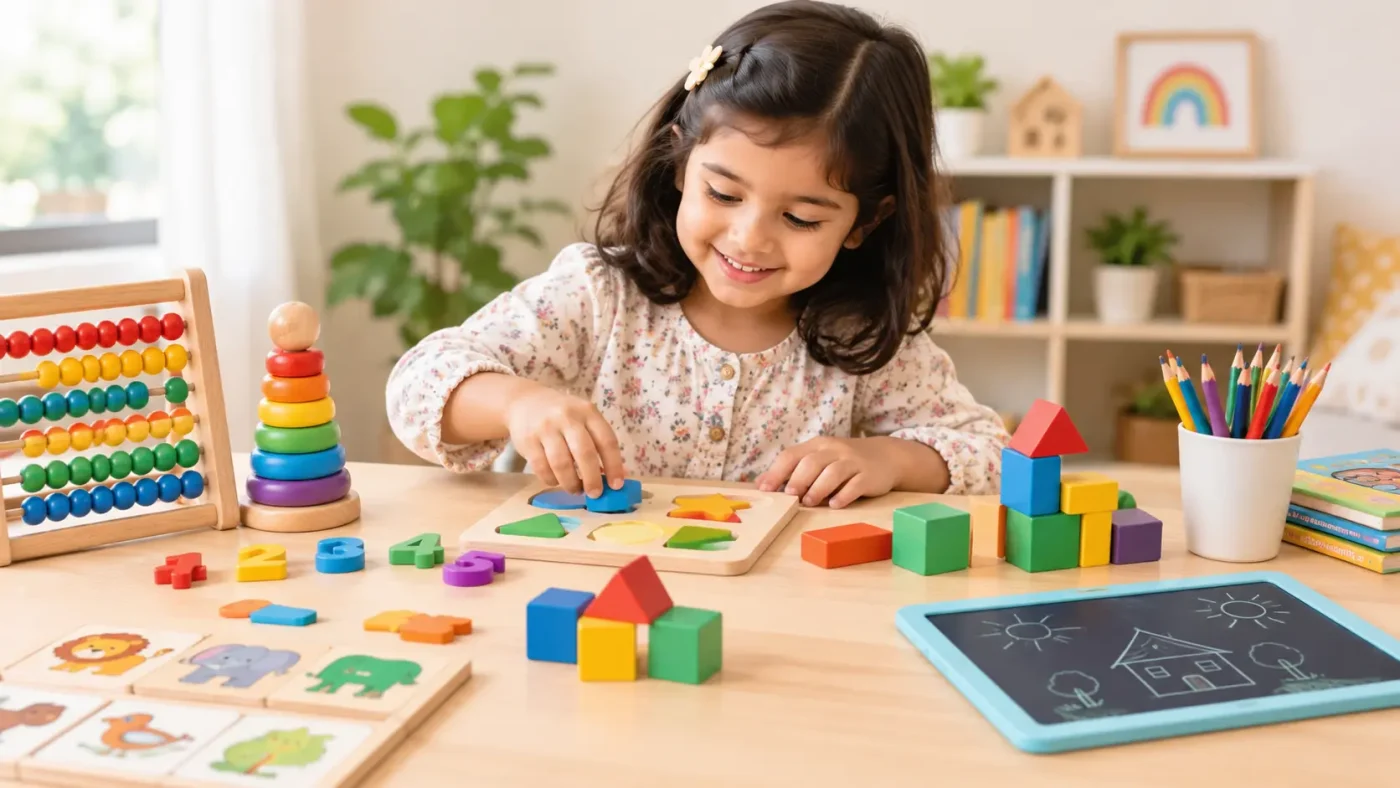
Simple school readiness activities for preschoolers can be built into everyday play using puzzles, blocks, drawing activities, sorting games, counting toys, pretend play and other hands-on activities.
The goal isn’t to make a preschooler study before school starts. It is to give them plenty of opportunities to practise the skills they will use when they enter the classroom.
What Does School Readiness Really Mean?
School readiness is often misunderstood as being able to read, write and count before the first day of school.
Those skills can certainly help, but readiness is broader. A child is also preparing for the social, emotional, physical and practical parts of classroom life.
| School-readiness area | What children can practise |
|---|---|
| Language | Listening, talking, storytelling and expressing ideas |
| Early maths | Counting, sorting, comparing and recognising patterns |
| Fine motor skills | Drawing, holding tools, picking up pieces and manipulating objects |
| Problem-solving | Trying different solutions and working things out independently |
| Social skills | Taking turns, sharing, listening and following simple rules |
| Independence | Cleaning up, making choices and managing simple everyday tasks |
This is why play is such a useful way to prepare. A child can practise several of these abilities without sitting at a desk or completing worksheets.
10 School Readiness Activities for Preschoolers
1. Practise Fine Motor Skills With Puzzles
Puzzles are one of the simplest ways to combine play with school-readiness practice.
Picking up a piece, turning it around, checking where it fits and trying again requires controlled hand movements and problem-solving.
Start with puzzles that your child can complete with some effort but without becoming overwhelmed.
For younger preschoolers, simple wooden shape, colour or picture puzzles can be a good starting point. As their confidence increases, move towards puzzles with more pieces or more complicated designs.
The important thing is not how quickly your child finishes.
Let them try.
If a piece doesn’t fit, ask:
“What could you try?”
That gives them an opportunity to think instead of immediately providing the answer.
ToyRoots tip: ToyRoots’ educational puzzle range can fit naturally into a preschool play routine while giving children opportunities to practise matching, problem-solving and fine motor control.
2. Use Counting Toys for Early Maths
Children don’t need worksheets to start developing early mathematical thinking. Counting real objects can be much more meaningful.
- Counting blocks
- Grouping objects by colour
- Comparing which group has more
- Counting steps
- Sorting objects from small to large
- Matching numbers with quantities
- Creating simple patterns
For example, give your child several blocks and ask, “Can you give me five?”
Then try, “Can you make two groups?” You can also introduce simple questions such as, “Which group has more?” or “What happens if we add one more?”
Counting toys and number activities can make these early maths experiences more hands-on and engaging.
The objective at preschool age isn’t to turn your child into a maths student. It is to help them become comfortable with numbers, quantities, patterns and comparisons.
3. Build With Blocks and Construction Toys
Building activities are excellent for children who enjoy creating things.
Give a preschooler a collection of building pieces and ask them to make:
- A tower
- A house
- A bridge
- A garage
- A road
- An animal
- Something completely imaginary
Construction play can encourage planning, spatial thinking, hand coordination and persistence. It also creates natural opportunities for conversation.
Ask questions such as:
- “What are you building?”
- “How can we make it taller?”
- “What happened when it fell?”
- “Can you make another one?”
ToyRoots’ building and construction toys are suitable for open-ended activities where children can create different structures rather than completing only one fixed design.
Remember: Don’t worry if the final construction looks nothing like what you expected. The thinking happens during the process.
4. Make Drawing Part of the Daily Routine
Many parents think school preparation means teaching children to write letters correctly. There is a more relaxed way to begin: let children draw.
Drawing gives preschoolers opportunities to practise controlling a pencil or drawing tool, making lines and shapes, and expressing ideas visually.
You can give them prompts such as:
- “Draw our house.”
- “Can you draw a person?”
- “Draw something you saw today.”
- “Can you make a road for your toy car?”
A drawing does not have to look realistic. Avoid correcting every line or asking your child to stay inside a particular shape. At this stage, the process of making marks, experimenting and communicating ideas is more important than producing perfect handwriting.
A reusable LCD writing tablet can also be useful for children who enjoy drawing repeatedly without going through stacks of paper.
5. Practise Listening Through Simple Games
Being able to listen and follow instructions is an important classroom skill. You can practise it without making the activity feel like a lesson.
Try simple games such as:
- “Touch your head, then touch your knees.”
- “Pick up the red block and put it beside the blue one.”
- “Bring me the puzzle, then choose one piece.”
As your child becomes more comfortable, make instructions slightly longer. For example: “Pick up the yellow block, put it on the table, and then bring me the puzzle.”
If your child forgets part of the instruction, repeat it calmly. The goal isn’t perfect performance. You’re giving them opportunities to listen, remember information and act on what they heard.
6. Play Matching and Sorting Games
Sorting is another easy school-readiness activity. Give your child objects that can be grouped by colour, shape, size, type, number or pattern.
For example, you might ask them to put all the red pieces together and all the blue pieces together. Later, change the rule: “Now let’s put the big pieces here and the small pieces there.”
This introduces children to classification and flexible thinking.
Wooden shape sorters, geometric puzzles and colour-matching activities can make this especially easy for younger preschoolers.
7. Encourage Pretend Play and Storytelling
School readiness isn’t only about cognitive skills. Communication matters too.
Pretend play gives children a natural reason to talk, explain, imagine and interact.
Your child might pretend to be a doctor, teacher, shopkeeper, chef, parent, driver or builder.
You don’t need a large collection of role-play toys. A few everyday objects can be enough. You can also let building blocks become houses or vehicles and turn puzzles or figures into characters in a story.
Follow your child’s lead. If they say, “This is my hospital,” you can respond, “Who is coming to the hospital?”
That encourages them to continue the story rather than simply answering a question with one word.
8. Play Simple Turn-Taking Games
A classroom is a social environment. Children need to learn that sometimes another person gets a turn first.
| Skill | How to practise it |
|---|---|
| Waiting | Take turns during a short game |
| Listening | Listen while another person takes a turn |
| Following rules | Use simple, consistent game rules |
| Handling disappointment | Practise winning and losing calmly |
| Asking for help | Encourage your child to ask instead of giving up |
You don’t need a complicated board game. A simple stacking game, matching activity or age-appropriate family game can create opportunities to practise these behaviours.
Keep the games short at first. If your preschooler struggles with waiting, start with very small turns and gradually increase the amount of time.
9. Give Children Small Problems to Solve
One of the most useful school readiness activities for preschoolers is simply allowing them to solve manageable problems.
For example:
- “How can we make this tower stand up?”
- “Which puzzle piece might fit here?”
- “We need three blocks but only have two. What could we do?”
- “How can we organise these pieces?”
Try not to solve every problem immediately. Give your child a little time to experiment. Sometimes they will find an answer you didn’t expect.
Why this matters: Children learn that problems don’t always need an adult to solve them. They can experiment, make mistakes and try another approach.
10. Practise Everyday Independence
Some of the most useful school-readiness activities don’t look like educational activities at all. Let your child practise doing simple things independently.
- Putting toys away
- Choosing between two activities
- Carrying their own water bottle
- Opening a simple container
- Putting books on a shelf
- Washing hands
- Helping tidy the play area
- Putting materials back after an activity
These small routines can build confidence and responsibility. Don’t expect your child to perform every task perfectly. The point is to give them repeated opportunities to participate.
A Simple School-Readiness Play Routine
You don’t need hours of structured activities every day. A short, flexible routine can give your child plenty of opportunities to practise different skills.
| Time | Activity | Skills practised |
|---|---|---|
| 10 minutes | Puzzle or sorting | Fine motor skills, matching and problem-solving |
| 10–15 minutes | Building | Creativity, planning and spatial thinking |
| 10 minutes | Drawing | Hand control and communication |
| 10 minutes | Story or pretend play | Language, imagination and social skills |
| 5 minutes | Clean-up | Independence, responsibility and following instructions |
That’s already a useful combination of fine motor practice, problem-solving, creativity, language, independence and routine.
And remember: it doesn’t have to happen exactly this way every day. Follow your child’s attention, energy and interests.
How to Choose Toys for School Readiness
When buying toys for a preschooler, don’t simply look for the words “educational” or “learning” on the packaging. Ask what the child actually does with the toy.
| What to look for | Why it matters |
|---|---|
| Active participation | The child builds, sorts, matches, counts, draws or solves |
| Age-appropriate challenge | The toy should encourage practice without overwhelming the child |
| Multiple uses | Open-ended toys can support different types of play |
| Hands-on learning | Children learn through doing and experimenting |
| Safe materials | Age and safety information should always be checked |
Look for Active Participation
A useful toy gives the child something to do. They might build, sort, match, draw, count, solve, create or experiment.
Choose the Right Level of Challenge
A toy that is too easy may quickly become boring. One that is far too difficult may lead to frustration. Look for something your child can partly understand while still having room to practise.
Prefer Toys With More Than One Use
A versatile toy can often provide better long-term play value. For example, building pieces can be used for construction, sorting, counting, patterns and pretend play.
Consider Your Home
Pakistani families may have limited storage space, particularly when toys are shared between bedrooms and common areas.
You don’t need dozens of toys. A small collection containing a puzzle, building activity, counting toy, creative activity and favourite free-play option can provide plenty of variety.
Always Check Age and Safety Information
A toy that is suitable for one preschooler may not be suitable for a younger sibling.
Check the manufacturer’s recommended age and the product’s individual safety information before buying.
Pay particular attention to small pieces, magnets and other components that may require supervision around younger children.
What If My Child Isn’t Interested in “Educational” Toys?
That’s completely fine.
Your child doesn’t need to know that an activity is educational. In fact, it may be better if they don’t.
A child building a bridge with blocks is learning through construction. A child making up a story about the bridge is practising language and imagination. A child counting the blocks is exploring numbers. A child trying to stop the bridge from falling is solving a problem.
Play doesn’t need to look like learning to be valuable. Sometimes the best approach is simply to provide good materials, observe what your child does and ask an occasional question.
School Readiness Is More Than Knowing the ABCs
If there is one thing parents should remember, it is this:
School readiness is not a race to teach everything before the first day of school.
A preschooler who can recognise every letter but becomes overwhelmed when a puzzle is difficult may still have skills to develop.
Likewise, a child who cannot yet read independently may already be building excellent foundations through drawing, storytelling, construction, counting and imaginative play.
Give children opportunities to practise different skills.
Let them make mistakes. Let them try again. Let them choose. And most importantly, let them enjoy playing.
The goal isn’t to create a miniature classroom at home. It is to help your child enter school with curiosity, confidence and the ability to participate.
Frequently Asked Questions
What are the best school readiness activities for preschoolers?
Good activities include puzzles, counting and sorting games, drawing, building blocks, pretend play, simple turn-taking games, storytelling and everyday tasks that encourage independence.
Does my child need to know the alphabet before starting school?
Not necessarily. Alphabet recognition can be useful, but school readiness involves many other areas, including communication, problem-solving, fine motor skills, independence, social interaction and the ability to follow simple instructions.
Are educational toys necessary for school readiness?
No. Toys are tools, not requirements. Everyday household activities, books, drawing, conversations, building with safe objects and pretend play can all support useful skills. The most important factor is meaningful interaction and opportunities for children to practise.
Which toys are good for preschool school readiness?
Puzzles, building toys, counting activities, shape sorters, drawing toys, matching games and simple logic activities can all be useful. Choose according to your child’s age, interests and current ability.
How long should a preschooler spend on school readiness activities?
There is no single amount of time that works for every child. Short, enjoyable activities are often easier to maintain than long structured sessions. Follow your child’s attention and interest rather than trying to recreate a school timetable at home.
Should school preparation involve worksheets?
Worksheets can have a place, but preschoolers can practise many foundational skills through hands-on play. Puzzles, blocks, counting toys, drawing, sorting, building and pretend play can all support the skills children use in the classroom.
Ready to make learning part of everyday play?
Explore ToyRoots’ educational toys and find hands-on activities that can help your little one build confidence through play.
Related reading
All in Ages 1+ Year →
Eidi Gift Ideas for Kids in Pakistan: Thoughtful Gifts Beyond Cash
Eid is a time for family gatherings, delicious food, new clothes, and the excitement of receiving Eidi. For children, opening an envelope…
How to Clean and Maintain Kids’ Toys: A Parent’s Guide for Pakistan
Children touch their toys throughout the day. They carry them around the house, play with them on the floor, take them outside,…
How to Choose Wooden Toys for Kids in Pakistan: A Parent’s Guide
Choosing a toy for your child is about more than finding something colourful or entertaining. You want something they will enjoy, use…
