
No products in the cart.
Parenting Tips
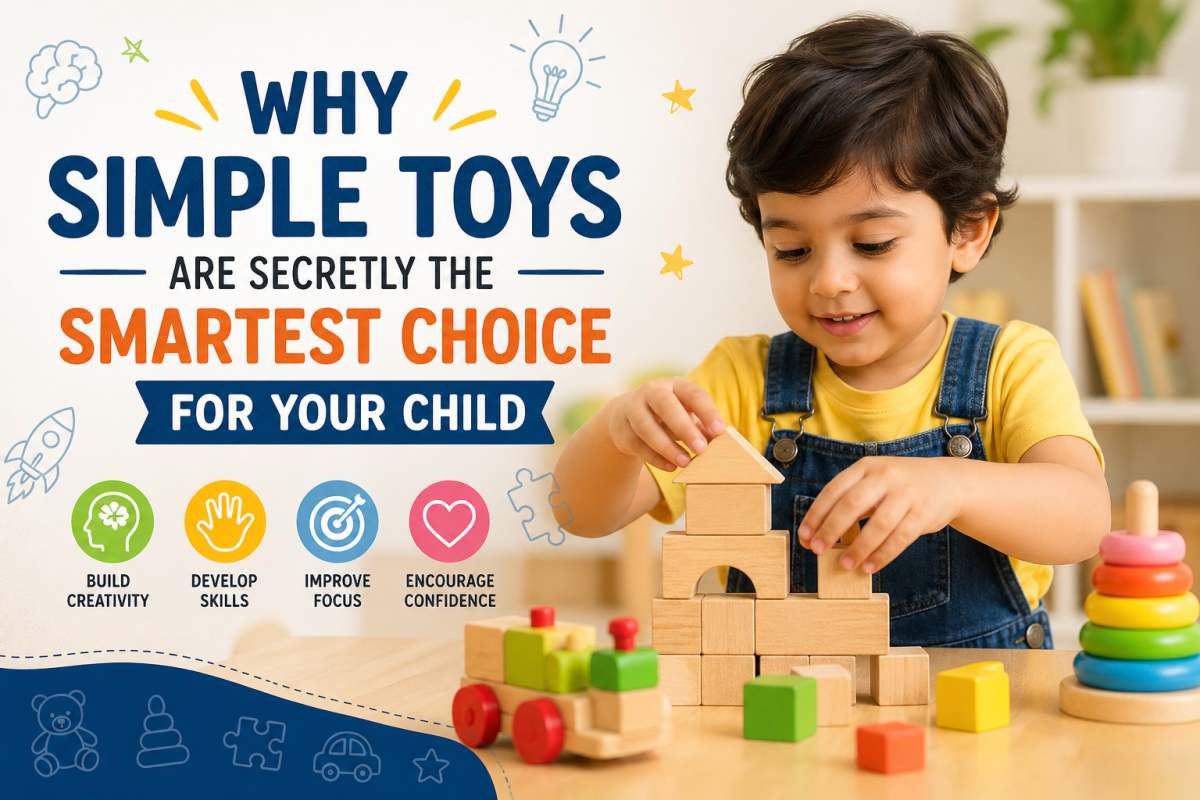
🧩 Why “Simple Toys” Are Secretly the Smartest Choice for Your Child
Have you ever bought a toy that your child played with for just one day… and then forgot? You’re not alone.
In today’s world of flashy lights and noisy gadgets, it’s easy to believe that more features mean better learning. But in reality, the opposite is often true. Sometimes, the simplest toys create the deepest and most meaningful learning experiences for children.
🤔 What Are “Simple Toys”?
Simple toys are those that do not do everything for the child. Instead of giving instructions or automatic responses, they encourage children to think, explore, and create on their own. Toys like wooden puzzles, building blocks, stacking toys, and basic STEM kits may look basic, but they open the door to imagination and creativity. These toys allow children to use their minds freely, making playtime more meaningful.
🧠 Kids Learn More When They Do the Thinking
When a toy lights up, talks, and tells a child exactly what to do, the child becomes more of a passive player. They follow instructions instead of thinking independently. On the other hand, simple toys require children to make decisions, solve problems, and experiment. This process helps build independent thinking, curiosity, and strong problem-solving skills, all while the child is simply playing.
🎨 Imagination Grows Without Limits
Most electronic or battery-powered toys are designed for one specific purpose, which limits how they can be used. Simple toys, however, have no fixed rules. A set of blocks can become a house one day and a rocket the next. A puzzle can turn into a storytelling activity. This freedom allows children to explore their creativity without restrictions, helping their imagination grow naturally.
✋ Hands-On Play Builds Real Skills
Simple toys encourage children to use their hands actively, which plays a vital role in their physical development. As children grasp, stack, sort, and build, they improve their hand-eye coordination, finger control, and grip strength. These skills are essential for everyday tasks such as writing, drawing, and even dressing themselves. The best part is that children develop these abilities naturally while enjoying their playtime.
⏳ Patience and Focus Naturally Improve
Unlike fast-paced digital toys that provide instant results, simple toys take time and effort to understand. Children need to focus, try different approaches, and sometimes make mistakes before succeeding. This process helps improve their attention span, patience, and ability to concentrate. Over time, it builds a calm and focused mindset that benefits them in learning and daily life.
🌱 Less Noise, More Meaningful Play
Many modern toys come with loud sounds, flashing lights, and constant stimulation, which can overwhelm children. Simple toys, in contrast, offer a quieter and more peaceful play experience. They encourage deep thinking, exploration, and meaningful engagement without unnecessary distractions. This type of play is especially important in today’s screen-heavy environment, where children already receive a lot of external stimulation.
💡 What Should Parents Look For?
When choosing a toy, it is important to consider whether it encourages thinking, creativity, and hands-on learning. A good toy should be versatile, allowing children to use it in different ways over time. It should also keep them engaged without relying on constant noise or instructions. Toys that meet these qualities are more likely to support long-term development and meaningful play.
🚀 Final Thoughts
Simple toys may not appear as exciting as high-tech gadgets at first glance, but they offer something far more valuable: real learning. They help children build creativity, confidence, and problem-solving skills in a natural and enjoyable way.
So the next time you are choosing a toy, remember that simple toys are not just basic — they are powerful tools for your child’s growth and development.
Related reading
All in Parenting Tips →
Eidi Gift Ideas for Kids in Pakistan: Thoughtful Gifts Beyond Cash
Eid is a time for family gatherings, delicious food, new clothes, and the excitement of receiving Eidi. For children, opening an envelope…
How to Clean and Maintain Kids’ Toys: A Parent’s Guide for Pakistan
Children touch their toys throughout the day. They carry them around the house, play with them on the floor, take them outside,…
How to Choose Wooden Toys for Kids in Pakistan: A Parent’s Guide
Choosing a toy for your child is about more than finding something colourful or entertaining. You want something they will enjoy, use…
