
No products in the cart.
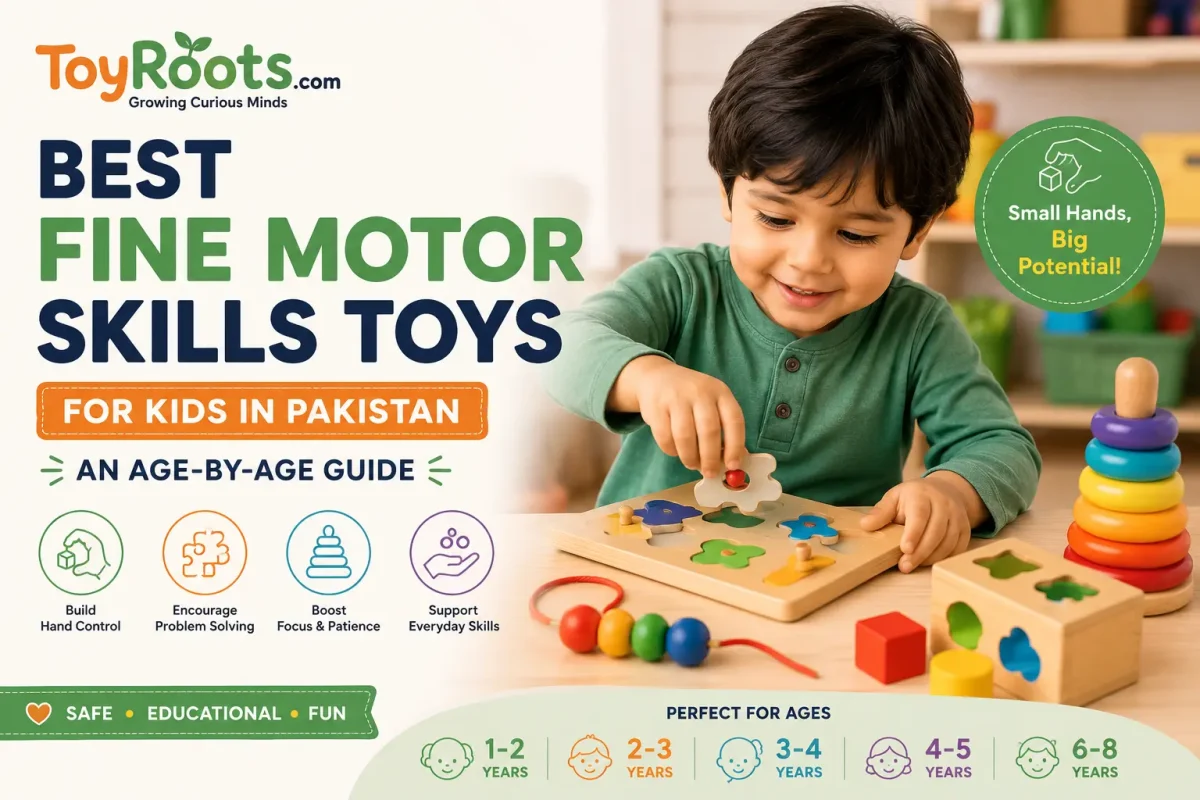
Children learn with their hands long before they learn with a pencil.
Picking up a puzzle piece, stacking blocks, turning a wooden shape, threading pieces, drawing a line, or moving beads from one side to another may look like simple play. But these activities give children opportunities to practise the small, controlled hand movements they use in everyday life.
For parents in Pakistan, choosing the right toy can be confusing. Toy shops are full of products labelled “educational,” “Montessori,” “STEM,” or “learning toy,” but those labels alone do not tell you whether a toy is appropriate for your child.
A better question is:
What kind of movement, challenge, and play does the toy encourage?
In this guide, we’ll look at the best fine motor skills toys for kids, how to choose them by age, which types of toys support different hand skills, and how Pakistani parents can build a useful toy collection without buying dozens of products.
What Are Fine Motor Skills?
Fine motor skills are the controlled movements children make using the smaller muscles of their hands and fingers.
These skills are involved in everyday activities such as:
- Picking up small objects
- Turning pages
- Holding crayons
- Drawing and colouring
- Building with blocks
- Using a spoon
- Opening simple containers
- Fastening buttons and zippers
- Manipulating puzzle pieces
- Eventually writing with a pencil
Children develop these abilities gradually. A one-year-old and a seven-year-old should not be expected to use the same type of toy or complete the same level of activity.
That is why age, difficulty and the child’s current ability all matter when choosing a fine motor toy.
Fine Motor Skills Development at a Glance
| Age Range | Typical Hand Skills | Suitable Toy Types |
|---|---|---|
| 1 year | Grasping, holding, dropping and stacking | Large-piece puzzles, stacking toys and large blocks |
| 2 years | Matching, sorting and simple problem-solving | Shape sorters, counting toys and simple wooden puzzles |
| 3 years | Connecting, threading, drawing and building | Construction toys, lacing activities and drawing boards |
| 4–5 years | Pattern-making, precision and structured problem-solving | Multi-piece puzzles, logic games and STEM construction toys |
| 6–8 years | Detailed manipulation, planning and spatial reasoning | 3D puzzles, model-building sets and advanced construction toys |
Why Fine Motor Skills Toys Matter
A good fine motor toy gives children a reason to use their hands deliberately.
For example, when a child works on a wooden puzzle, they may need to:
- Pick up a piece.
- Look at its shape.
- Rotate it.
- Compare it with the available space.
- Try placing it.
- Adjust it when it doesn’t fit.
The toy is simple, but the child is actively observing, deciding and controlling their movements.
Similarly, stacking, sorting, threading and building activities can combine hand movements with concentration, visual recognition and problem-solving.
The goal isn’t to turn playtime into a lesson.
The best fine motor activities feel like play first and practice second.
How Different Toys Support Fine Motor Development
| Toy Type | Main Hand Movement | Additional Skills |
|---|---|---|
| Wooden puzzles | Picking up, rotating and fitting | Visual matching and problem-solving |
| Stacking toys | Grasping, positioning and releasing | Balance, order and sequencing |
| Sorting toys | Picking up and placing | Colour, shape and size recognition |
| Building blocks | Connecting, separating and positioning | Creativity and spatial thinking |
| Counting toys | Moving beads or counting pieces | Early maths and concentration |
| Drawing toys | Holding and controlling a drawing tool | Pre-writing and visual expression |
| Logic games | Moving small pieces carefully | Planning and strategic thinking |
Best Fine Motor Skills Toys for Kids by Age
There is no single “best” fine motor toy for every child. A useful starting point is to match the toy to the child’s age and current ability.
Fine Motor Toys for 1-Year-Olds
At around one year, children are exploring objects through grabbing, holding, dropping, stacking and moving.
Simple toys are usually the better choice at this stage.
- Large-piece wooden puzzles
- Stacking toys
- Simple shape sorters
- Large building blocks
- Easy colour-matching activities
- Suitable sensory and manipulation toys
The activity should be easy enough for the child to explore without becoming immediately frustrated.
Parents can also sit nearby and demonstrate once, then allow the child to experiment.
For babies and very young toddlers, always check the manufacturer’s age recommendation and keep small detachable pieces away from children who may put objects in their mouths.
Fine Motor Toys for 2-Year-Olds
Two-year-olds are becoming more confident with their hands and increasingly interested in matching, sorting, building and solving simple problems.
- Wooden puzzles
- Shape and colour sorting toys
- Stacking activities
- Simple counting toys
- Matching games
- Large-piece construction toys
- Montessori-inspired manipulation activities
ToyRoots’ collection for educational toys for 2-year-olds includes puzzles, building blocks, sorting and matching activities, counting toys and geometric-shape options.
Educational Toys for 2 Year Olds
Fine Motor Toys for 3-Year-Olds
By three, many children are ready for slightly more complicated activities.
- More detailed wooden puzzles
- Building blocks
- Sorting games
- Threading or lacing activities
- Drawing and writing boards
- Counting toys
- Simple logic games
- Creative construction toys
At this age, open-ended building toys can be especially useful. A child might start by simply connecting pieces. Later, they may begin creating houses, towers, vehicles or completely imaginary designs.
For example, ToyRoots’ Magnetic Building Blocks are designed for children aged 3+ and allow children to create different 2D and 3D structures through hands-on construction play.
Fine Motor Toys for 4–5-Year-Olds
Preschool children can often handle more structured challenges.
- Multi-piece puzzles
- Advanced sorting activities
- Construction sets
- Wooden logic games
- Drawing tablets
- Number puzzles
- Pattern activities
- Strategy-based stacking games
- STEM construction toys
The key is to increase difficulty gradually. If a child solves a simple puzzle immediately every time, it may be time to introduce a slightly more challenging version. On the other hand, if they repeatedly become frustrated, the activity may currently be too difficult.
The sweet spot is a challenge that requires effort without feeling impossible.
Fine Motor Toys for 6–8-Year-Olds
Older children can use fine motor activities alongside more advanced reasoning and construction challenges.
- 3D puzzles
- Detailed construction sets
- Logic puzzles
- Model-building activities
- Strategy games
- Number puzzles
- STEM kits
- Drawing and creative activities
- More complex building challenges
For this age group, the toy does not necessarily need to be marketed as a “fine motor toy.” A challenging construction set or logic puzzle can naturally require precise hand movements while also encouraging planning and problem-solving.
For children ready for more advanced hands-on challenges, parents can also explore STEM toys at ToyRoots.
Age-Based Toy Progression Graph
The following visual shows how toy complexity can gradually increase as children develop stronger hand control and problem-solving skills.
This graph is a general guide, not a developmental test. Children develop at different rates, so choose toys according to ability and interest as well as age.
7 Types of Fine Motor Skills Toys to Consider
Instead of shopping only by age, parents can also shop by the particular hand skill they want to practise.
1. Wooden Puzzles
Puzzles are one of the simplest ways to combine hand control with thinking. Children need to pick up, rotate and position pieces while comparing shapes and images.
For younger children, start with large and easy-to-handle pieces. Older children can move towards more complex puzzles.
ToyRoots has a dedicated Educational Puzzles for Kids collection containing wooden puzzles, shape activities, logic games and more challenging options.
2. Stacking Toys
Stacking activities require children to control how they grasp, position and release objects. They can also introduce ideas such as size, balance, order, colour and sequencing.
A simple stacking game can therefore become more challenging as the child develops.
For older children, a product such as the Wooden Stacking Tower Game adds a more challenging combination of hand control, balance and strategic thinking.
3. Shape and Colour Sorting Toys
Sorting toys require children to pick up pieces and place them according to a particular characteristic, such as shape, colour, size or pattern.
This combines hand movements with visual discrimination and early logical thinking.
ToyRoots’ educational range includes wooden shape and colour sorting activities that can be useful for younger children. The Educational Geometric Shapes Toy is one relevant option for hands-on shape, colour and sorting play.
4. Building Blocks and Construction Toys
Building toys are particularly versatile. Children have to connect, separate, position and manipulate individual pieces. At the same time, they decide what they want to build.
For younger children, this may mean stacking a few pieces. For older children, it can become a more complicated construction challenge.
ToyRoots’ Magnetic Building Blocks are one example of an open-ended construction activity for children aged 3+.
5. Counting and Number Toys
Fine motor development doesn’t have to be separated from early maths. Counting toys allow children to physically move objects while exploring numbers and quantities.
An abacus or counting-stick activity, for example, combines hand manipulation with early mathematical thinking.
ToyRoots’ Counting & Number Learning Toys collection includes hands-on options such as an abacus and counting sticks.
Counting & Number Learning Toys
For example, the Classic Wooden Abacus & 100 Counting Sticks Set gives children a hands-on way to move beads and counting pieces while exploring early numbers.
6. Drawing and Writing Toys
Drawing is another natural way for children to practise controlled hand movements. Young children can start with free drawing and simple lines. As they become more confident, they may practise shapes, letters, numbers and more detailed pictures.
For parents looking for reusable screen-free creative activities, ToyRoots also carries drawing and writing products within its educational toy collection.
7. Logic and Strategy Toys
Some of the best fine motor activities don’t look like traditional “learning toys.” A logic puzzle or strategy game may require a child to move small pieces carefully while thinking several steps ahead.
ToyRoots’ puzzle collection includes products such as logic games, 3D puzzles and number challenges for children ready for more advanced activities.
For example, older children can explore products such as the Soma Cube 3D Wooden Puzzle for a more challenging combination of spatial thinking and hands-on problem-solving.
Fine Motor Skills Toys: What Should You Choose?
A useful way to choose a toy is to ask four questions:
| Question | What to Consider |
|---|---|
| Age | Is it suitable for the child’s age? |
| Movement | What will the child actually do with their hands? |
| Challenge | Is it easy, manageable or frustratingly difficult? |
| Interest | Does the child actually enjoy the activity? |
A Simple Toy Selection Scorecard
Use this quick scorecard when comparing two or more toys. Give each category a score from 1 to 5.
| Category | 1 Point | 3 Points | 5 Points |
|---|---|---|---|
| Age fit | Too easy or too difficult | Mostly suitable | Matches the child’s current ability |
| Hand movement | Very little manipulation | Some hands-on activity | Frequent controlled hand movements |
| Interest | Child shows no interest | Child plays occasionally | Child returns to it willingly |
| Challenge | Frustrating or boring | Manageable with help | Challenging but enjoyable |
| Play value | One short activity | Some repeat use | Open-ended or reusable play |
A toy with a higher overall score is not automatically the best choice. The scorecard is simply a helpful way to think about age, interest, movement and long-term use.
How Parents Can Make Fine Motor Play More Effective
Buying the right toy is only part of the process.
Let Children Try First
If your child cannot immediately solve a puzzle, resist the temptation to do it for them. Give them time to experiment. Trying, making a mistake and trying again is part of the activity.
Don’t Turn Every Activity Into Testing
You don’t need to constantly ask, “What colour is this?”, “What number is this?” or “What shape is this?” Sometimes children simply need to enjoy manipulating the toy. Learning can happen naturally through exploration.
Increase Difficulty Gradually
Once an activity becomes very easy, introduce a slightly more challenging version.
Simple shape sorter → more complex shape puzzle → geometric puzzle → 3D puzzle
The exact progression will differ from child to child.
Follow the Child’s Interests
A child who loves cars may be more interested in a vehicle-themed puzzle than a generic puzzle. A child who loves building may spend much longer with construction pieces.
Interest creates motivation, and motivated children are more likely to practise.
Rotate Toys Instead of Buying More
You don’t need a huge collection. Keep a few different activities available and rotate them occasionally.
| Rotation Slot | Example Activity | Skill Focus |
|---|---|---|
| 1 | One puzzle | Matching and hand-eye coordination |
| 2 | One building activity | Grasping, connecting and spatial thinking |
| 3 | One sorting or counting activity | Classification and early maths |
| 4 | One creative activity | Grip control and visual expression |
| 5 | One logic game | Precision and problem-solving |
A toy that has been stored away for a while can feel surprisingly interesting when it returns.
ToyRoots has also covered the idea of creating a simple toy rotation system at home, which can help parents make better use of the toys they already own.
How to Create a Toy Rotation System at Home
How Much Should You Spend on Fine Motor Toys in Pakistan?
A useful fine motor toy does not necessarily need to be expensive.
| Budget Range | Suitable Options | Best For |
|---|---|---|
| Under Rs. 1,000 | Simple puzzles, shape sorters and stacking toys | Basic hand control and early exploration |
| Rs. 1,000–2,500 | Larger puzzles, construction toys and drawing activities | Regular practice and growing independence |
| Above Rs. 2,500 | Advanced logic games, STEM kits and larger construction sets | Complex problem-solving and long-term play |
The important point is to consider how often the child can use the toy, not simply its price. A moderately priced toy that your child returns to repeatedly can be more useful than an expensive toy that is interesting for one afternoon.
Safety Tips When Buying Fine Motor Toys
Because many fine motor activities involve manipulating individual pieces, safety deserves particular attention.
| Safety Check | What Parents Should Look For |
|---|---|
| Age recommendation | Follow the manufacturer’s recommended age range. |
| Small parts | Keep detachable pieces away from babies and young toddlers. |
| Materials | Review the product description for materials and construction details. |
| Supervision | Stay nearby when an activity requires adult guidance. |
| Difficulty | Choose a challenge that matches the child’s current ability. |
Check the individual ToyRoots product page for the available age guidance and product information before ordering.
Recommended ToyRoots Categories for Fine Motor Play
If you’re building a small collection of fine motor activities, you don’t need to buy everything at once.
| Child’s Stage | Recommended Combination | Primary Benefits |
|---|---|---|
| Toddlers | Shape sorting + stacking + simple puzzles | Grasping, matching and basic coordination |
| Preschoolers | Puzzles + building + counting + creative activities | Precision, early maths and problem-solving |
| Older children | Logic puzzles + construction + STEM + strategy games | Planning, spatial reasoning and detailed control |
You can explore ToyRoots’ broader Educational Toys collection for Montessori-inspired puzzles, building activities, counting toys and STEM learning options.
ToyRoots Educational Toys Collection
Parents interested specifically in Montessori-inspired hands-on activities can also explore ToyRoots’ Montessori-related products and collections.
Frequently Asked Questions
What are the best fine motor skills toys for kids?
Good options include wooden puzzles, stacking toys, shape sorters, building blocks, counting toys, threading activities, drawing tools and age-appropriate logic games. The best choice depends on the child’s age, ability and interests.
What toys help improve hand-eye coordination?
Puzzles, shape sorters, stacking toys, construction sets, bead activities and drawing activities all require children to coordinate what they see with how they move their hands.
Are Montessori toys good for fine motor skills?
Many Montessori-inspired toys involve hands-on activities such as sorting, stacking, matching, transferring or manipulating objects. These activities can provide opportunities for children to practise controlled hand movements and independent play.
Are wooden puzzles good for toddlers?
Age-appropriate wooden puzzles can be useful for toddlers because they combine physical manipulation with matching and problem-solving. Choose puzzles with pieces suitable for the child’s age and ability.
What are good fine motor toys for a 2-year-old?
Two-year-olds may enjoy simple wooden puzzles, shape sorters, stacking toys, matching activities, counting toys and other hands-on Montessori-inspired activities. Always check the recommended age and piece size.
What toys are good for fine motor skills in 3–5-year-olds?
Children aged 3–5 may enjoy more detailed puzzles, construction toys, sorting games, drawing activities, counting toys, logic games and creative building activities.
Can building blocks help fine motor skills?
Yes. Building requires children to grasp, position, connect and sometimes separate individual pieces. Construction also adds opportunities for creativity, spatial thinking and planning.
How many fine motor toys does a child need?
There is no fixed number. A small selection of complementary toys can be enough. For example, one puzzle, one construction activity, one sorting or counting toy and one creative activity can provide several different types of hands-on play.
Final Thoughts
The best fine motor skills toys for kids are not necessarily the most complicated or expensive ones.
A simple wooden puzzle can encourage careful hand movements. A stacking toy can introduce balance and control. Building blocks can combine manipulation with creativity. Counting toys can turn early maths into a hands-on activity.
The most important thing is to choose a toy that matches the child’s age, ability, interests and level of challenge.
Instead of asking, “Which toy is the most educational?” try asking:
“What will my child actually do with this toy?”
If the answer is pick up, move, match, build, solve, draw, sort, create and try again, you are already looking at the kind of active play that makes a toy worth bringing into your child’s routine.