
No products in the cart.
Parenting Tips, ToyRoots Life
How to Choose Wooden Toys for Kids in Pakistan: A Parent’s Guide
Choosing a toy for your child is about more than finding something colourful or entertaining. You want something they will enjoy, use repeatedly, and learn from. Wooden educational toys are one option worth considering because they can offer hands-on play without needing batteries, screens, or complicated instructions.
However, not every wooden toy is automatically safe, durable, or educational. The quality of its construction, the finish, the size of its parts, and the activities it encourages all matter.
For parents in Pakistan, buying online adds another consideration: you may not be able to inspect the toy before ordering. Product descriptions, photographs, age recommendations, and return policies therefore become especially important.
In this guide, you will learn how to choose wooden toys for kids based on age, safety, quality, learning value, budget, and everyday practicality. You will also discover which types of wooden toys may suit different interests and what to check before placing an order.
Why Consider Wooden Toys for Children?
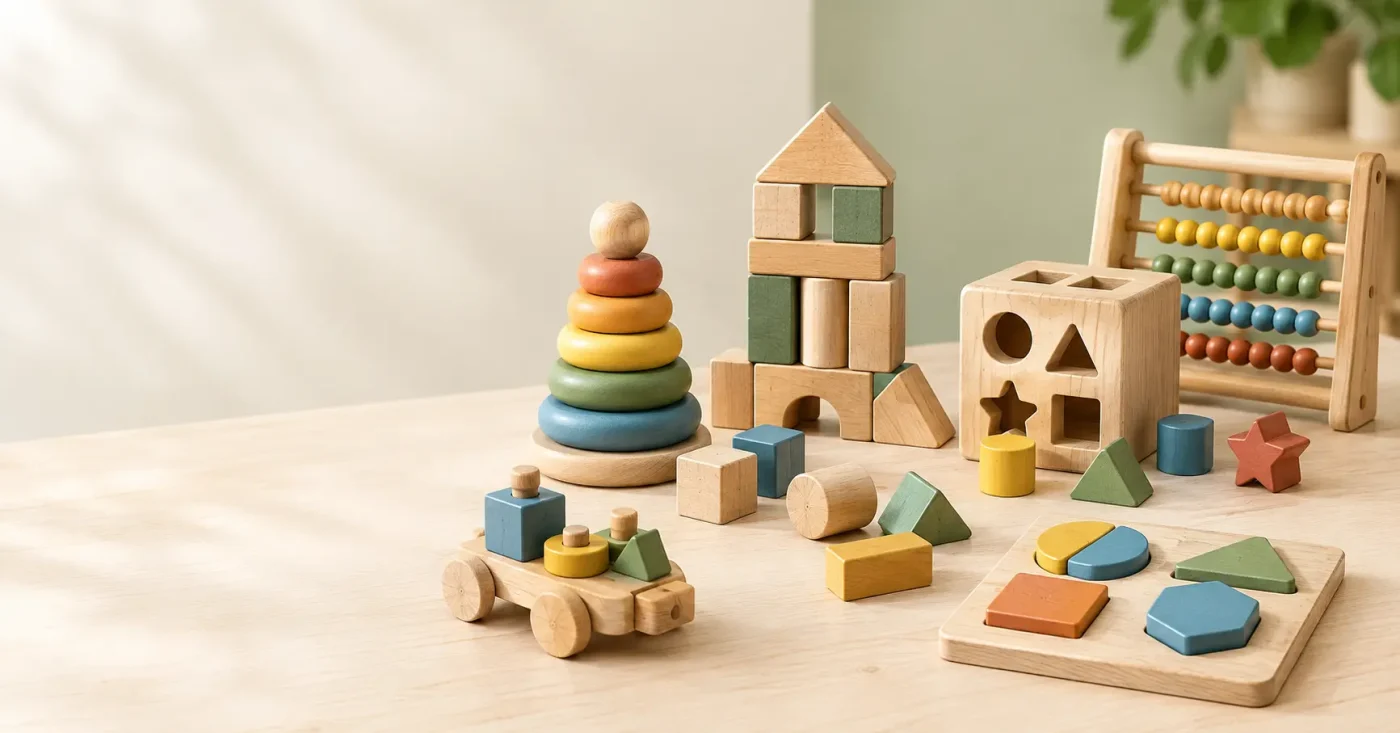
Wooden toys have a long history in children’s play, from simple stacking blocks to puzzles, counting boards, and construction sets. Their main appeal is not simply the material. It is the kind of interaction they can encourage.
1. They encourage hands-on play
A child using a wooden puzzle must pick up pieces, examine their shapes, rotate them, and work out where they fit. A child building with blocks experiments with balance, height, and stability.
These activities give children opportunities to practise coordination, spatial awareness, and problem-solving through play. Explore our educational puzzles for kids to discover hands-on activities for different ages.
2. They can support open-ended play
Some toys have one intended outcome, while others can be used in several ways. A set of wooden blocks, for example, might become a tower, a bridge, a pretend shop, or a small animal enclosure.
This flexibility can make a toy useful across different play sessions as a child’s ideas change.
For more construction-based activities, explore ToyRoots’ educational toys, which include building sets and other hands-on learning options.
3. They can be used without batteries
Many wooden puzzles, stacking sets, and counting toys do not require batteries or electronic features. Parents looking for hands-on activities can use them during quiet play, family time, or short learning sessions at home.
4. They offer different learning activities
Wooden toys are available for many purposes, including shape recognition, early counting, pattern matching, construction, and logical thinking.
However, wood alone does not make a toy educational. The important question is what the child can do with it.
How to Choose Wooden Toys for Kids by Age
A toy should match the child’s current abilities while offering an appropriate level of challenge. Age guidance is a useful starting point, but individual interests and development also matter. You can also browse toys for babies under one year or educational toys for two-year-olds to explore age-focused options.
Wooden toys for babies under one year
Babies explore objects by looking, reaching, grasping, and mouthing them. Toys for this stage must be designed specifically for infants.
Look for age-appropriate, easy-to-hold toys with secure construction and no accessible small parts. Follow the manufacturer’s safety guidance and supervise play.
Do not assume that a wooden toy is suitable for a baby simply because it looks simple or natural.
Wooden toys for children aged 1–2 years
At this stage, children may enjoy placing objects into containers, stacking large pieces, matching simple shapes, and exploring how objects fit together.
Suitable options may include:
- Large stacking toys designed for the child’s age.
- Simple shape-sorting activities.
- Large-piece puzzles.
- Age-appropriate matching toys.
Choose products with clear age guidance and avoid toys containing small pieces that could pose a choking risk.
Wooden toys for children aged 3–4 years
Preschoolers may be ready for more involved puzzles, pattern activities, building challenges, and pretend play.
Consider:
- Wooden puzzles with manageable numbers of pieces.
- Coloured blocks for building and sorting.
- Simple counting and matching sets.
- Construction toys designed for preschoolers.
For more ideas, read our guide to preschool toys in Pakistan, which explores hands-on learning activities for young children.
Observe how your child responds to the challenge. If a toy is consistently frustrating, try a simpler activity before increasing the difficulty.
Wooden toys for children aged 5 years and older
Older children may enjoy more complex puzzles, construction challenges, strategy games, and counting activities that introduce more advanced concepts.
Look for toys that encourage planning, experimentation, and independent problem-solving. Check the manufacturer’s age recommendation and any specific supervision requirements before purchasing.
Remember: These are general starting points, not strict developmental rules. Always follow the product’s safety age and instructions.
For a more detailed age-by-age overview, read our guide to the best educational toys for kids in Pakistan.
What Makes a Wooden Toy Good Quality?
When buying wooden educational toys online, photographs can tell you something about appearance, but they cannot prove every aspect of quality.
Use the following checklist to evaluate the information available.
Check the surface and finish
Look for clear information about the finish and construction. Surfaces should be smooth, without visible splinters, sharp edges, or loose decorative components.
If the product description does not explain the finish, contact the seller rather than assuming that the toy is untreated or safe for mouthing.
Check how the pieces are assembled
Inspect photographs for loose-fitting parts, exposed fasteners, detachable decorations, and components that appear poorly secured.
For a delivered product, check the construction before giving it to your child. Stop using it if pieces break, splinter, or become loose.
Ask about materials and coatings
Terms such as “natural wood” and “non-toxic” should not replace specific product information.
Where available, look for details about the wood, paint or coating, and relevant safety testing or certifications. Do not assume that a toy is certified simply because the seller describes it as safe.
Consider durability and maintenance
A well-constructed wooden toy may be suitable for repeated use, but durability depends on its design, materials, construction, and care.
Check the cleaning instructions. Unless the manufacturer specifically permits it, avoid soaking wooden toys or placing them in a dishwasher, as moisture can damage the material or finish.
Which Wooden Toys Are Worth Considering?
The best choice depends on the activity your child enjoys and the skill you want to encourage.
Wooden puzzles
Puzzles invite children to compare shapes, identify patterns, and work through a problem. Simpler puzzles may suit younger children, while more complex designs can challenge older ones.
Explore ToyRoots’ educational puzzles for kids for examples of puzzle-based activities.
Wooden stacking toys and blocks
Stacking and building activities allow children to experiment with balance, height, arrangement, and structure.
Children can start by making simple towers and later create their own designs. Always choose piece sizes and construction sets appropriate for the child’s age, particularly in homes with younger siblings.
For more building and construction activities, browse ToyRoots’ educational toy collection.
Wooden counting toys
Counting boards, beads, and number-based activities can make early mathematics more concrete. Children can move objects, group quantities, compare amounts, and practise counting.
Explore ToyRoots’ counting and number toys for hands-on number activities.
Wooden shape and colour sorters
Sorting toys invite children to compare shapes, match colours, and discover how pieces fit into different spaces. They can be useful for short, repeatable play sessions.
Choose an activity that is not so difficult that the child needs an adult to solve every step. You can explore shape-sorting and geometric puzzle options to compare different activities.
Wooden strategy and logic games
Some wooden games introduce turn-taking, planning, pattern recognition, and logical thinking. They may suit older children who enjoy challenges or playing with family members.
Check the rules and recommended age before buying so that the game matches your child’s interests and abilities. For additional ideas, browse educational and Montessori-inspired toys at ToyRoots.
Wooden Toys vs Plastic Toys: Which Should You Choose?
There is no universal winner. Both wooden and plastic toys can offer valuable play experiences, and the material alone does not determine educational value.
| What to compare | Wooden toys | Plastic toys |
|---|---|---|
| Play possibilities | Often useful for puzzles, stacking, and construction | Can support the same activities, as well as many other types of play |
| Weight | May be heavier, depending on design | Often lighter, depending on design |
| Cleaning | May require careful, limited-moisture cleaning | Some designs may be easier to wash; follow instructions |
| Durability | Depends on wood, finish, and construction | Depends on plastic, design, and construction |
| Educational value | Depends on the activity | Depends on the activity |
Instead of choosing based on material alone, compare the actual toy, its construction, safety information, ease of use, and the child’s likely interest.
A well-designed plastic puzzle may be a better choice than a poorly finished wooden one. Likewise, a simple wooden construction set may be more suitable than an electronic toy for a child who enjoys building.
How Much Should You Spend on Wooden Toys in Pakistan?
The right budget depends on the type of toy, its construction, the number of pieces, and your family’s needs. There is no single price that guarantees quality or educational value.
Before buying, compare several products within your budget and ask:
- Does the toy suit my child’s age?
- What can my child actually do with it?
- Are the materials and finish described clearly?
- Is the toy likely to be used repeatedly?
- Are delivery charges included in the total?
- What happens if the item arrives damaged or incomplete?
A simple puzzle that your child enjoys using regularly may be a better purchase than a large set that remains untouched.
When comparing prices online, check the final checkout amount rather than relying only on the displayed product price. Delivery charges, available payment methods, stock status, and return conditions can affect the overall purchase decision. You can review ToyRoots’ frequently asked questions for additional store information.
What Should You Check Before Ordering Wooden Toys Online in Pakistan?
When shopping online, use this practical checklist before confirming your order.
1. Read the age recommendation. Confirm that the toy is appropriate for the child and check any warnings about small parts or supervision.
2. Review the product photographs. Look at the size and shape of the pieces, the construction, and what is included in the set.
3. Read the description carefully. Check materials, dimensions, piece count, included accessories, and cleaning instructions where provided.
4. Ask questions when information is missing. If the finish, dimensions, or age suitability is unclear, contact the seller before purchasing.
5. Check delivery and payment terms. Confirm the shipping charges, estimated delivery timeframe, available payment methods, and return or damage-reporting process. Visit the ToyRoots FAQ page to review store-related information.
6. Inspect the toy when it arrives. Before play begins, check for damage, loose parts, splinters, sharp edges, and missing components. Follow the instructions and report problems according to the seller’s policy.
For children who share a play area with younger siblings, consider the entire household. A toy appropriate for a five-year-old may still contain pieces that are unsafe for a toddler.
You can start exploring educational toys through ToyRoots and compare the available options before deciding which product fits your child’s needs.
Frequently Asked Questions
Are wooden toys better than plastic toys?
Not automatically. Both can support learning and creative play. The best choice depends on the toy’s design, quality, safety, and how the child uses it.
Are wooden toys safe for toddlers?
Some are suitable when specifically designed for the child’s age, but others may contain small parts, detachable components, or unsuitable finishes. Always check age guidance, product details, and safety instructions, and supervise children appropriately.
Do wooden toys help children learn?
They can provide opportunities to practise skills such as coordination, sorting, counting, construction, and problem-solving. The specific activity matters more than the material itself. Explore our age-by-age educational toy guide for more ideas.
How do I clean wooden educational toys?
Follow the manufacturer’s cleaning instructions. Many wooden toys should be wiped with a suitable cloth and dried promptly rather than soaked. Avoid using cleaning products that could damage the finish or leave unsuitable residues.
What are the best wooden toys for a two-year-old?
Depending on the child’s abilities, suitable options may include large-piece puzzles, stacking toys, simple shape sorters, and matching activities. Follow the product’s age guidance and avoid small parts that could pose a choking risk. You can explore educational toys for two-year-olds for suitable ideas.
Are wooden Montessori toys worth buying?
They can be useful when the activity matches the child’s interests and abilities. Look beyond the Montessori label and consider what the toy encourages the child to practise, how well it is constructed, and whether it is age-appropriate.
Where can I buy educational wooden toys in Pakistan?
You can explore ToyRoots for educational puzzles, counting activities, building toys, and other hands-on learning products. You can also browse the educational puzzles collection and counting and number toys. Check each product’s current details, price, availability, and delivery terms before ordering.
Final Thoughts
Choosing wooden toys for kids is not simply about buying something made from wood. It is about finding a suitable, well-constructed toy that encourages the kind of play your child enjoys.
Start with the child’s age and interests. Check the finish, construction, piece sizes, and safety guidance. Consider what the toy actually teaches through play, and compare the total cost before ordering.
Whether you choose a wooden puzzle, a stacking set, a counting activity, or a logic game, the best option is one that fits your child’s needs and gives them opportunities to explore, experiment, and try again.
Take time to compare the available choices, read product descriptions carefully, and choose thoughtfully. A useful toy does not need to be complicated or expensive; it needs to be appropriate, engaging, and suitable for repeated play.
Ready to explore? Visit ToyRoots to discover educational toys that encourage children to learn through play.
Related reading
All in Parenting Tips →
Eidi Gift Ideas for Kids in Pakistan: Thoughtful Gifts Beyond Cash
Eid is a time for family gatherings, delicious food, new clothes, and the excitement of receiving Eidi. For children, opening an envelope…
How to Clean and Maintain Kids’ Toys: A Parent’s Guide for Pakistan
Children touch their toys throughout the day. They carry them around the house, play with them on the floor, take them outside,…
Magnetic Building Blocks vs Wooden Blocks vs Construction Toys: Which Is Best for Kids in Pakistan?
Choosing the right building toy for your child can be challenging. Magnetic building blocks, traditional wooden blocks, and construction toys all encourage…
