Children Learn Better When They Participate
Many modern toys are designed to entertain children instantly. A button is pressed, lights appear, sounds begin, and the toy performs automatically. The child watches and reacts, but does very little active thinking.
Educational toys work differently because they require participation. A child must figure things out, test ideas, and sometimes even fail before succeeding. That process is extremely important for brain development.
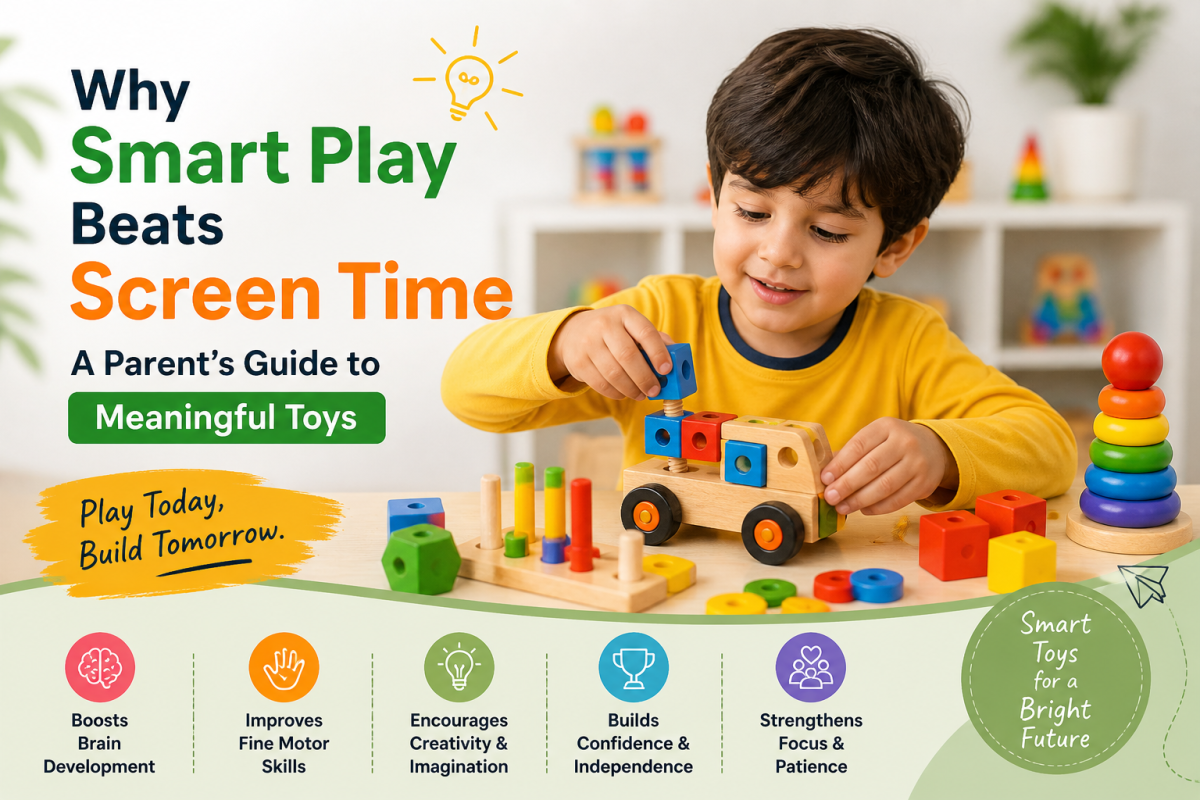
When children solve puzzles, stack blocks, or match shapes, they are building neural connections that improve memory, concentration, and logical thinking. These activities may look simple from the outside, but they teach children how to think independently instead of depending on constant stimulation.
Why Montessori Toys Look Simple — But Work So Well
Parents often wonder why Montessori toys appear so basic compared to electronic toys available in the market. The answer lies in intentional design.
Montessori toys are created to help children focus on one skill at a time without unnecessary distractions. Bright flashing lights and excessive sounds can overwhelm young minds, while simple educational toys encourage calm concentration and deeper engagement.
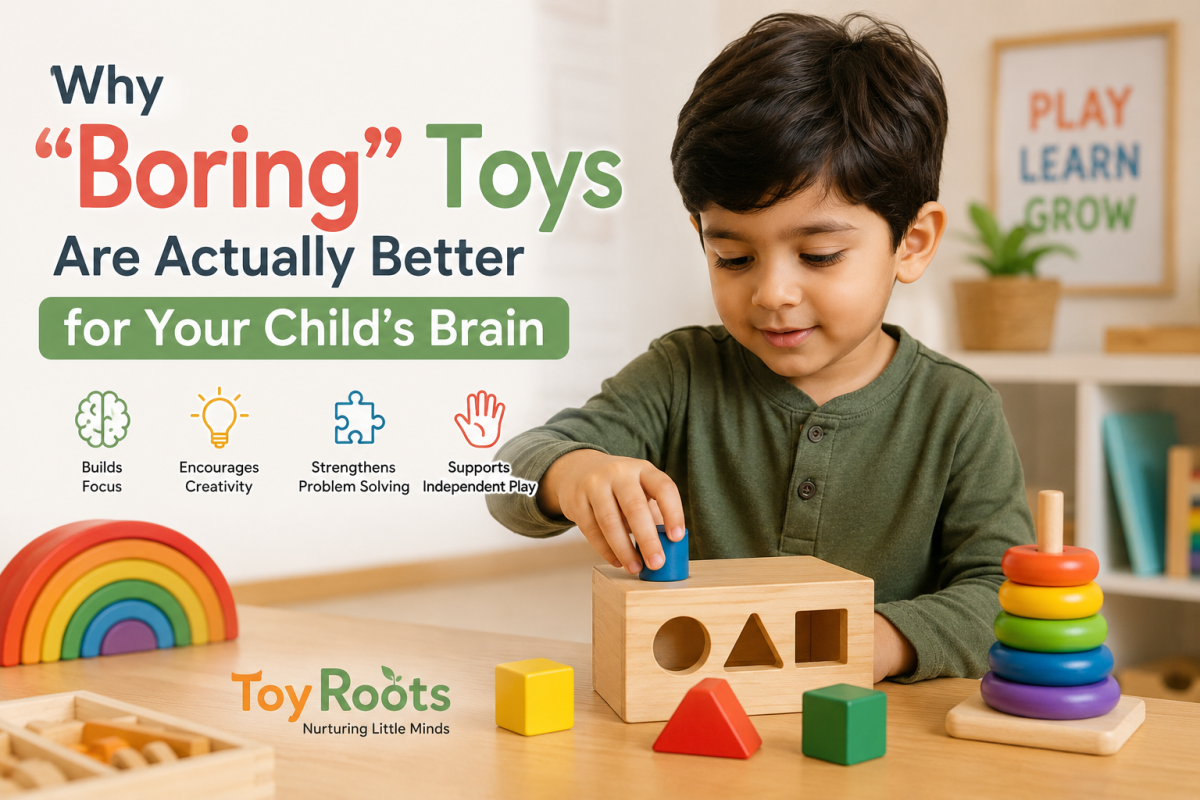
For example, a shape sorter may appear like a very ordinary toy, but it teaches important developmental skills. While playing, children improve hand-eye coordination, learn shape recognition, develop patience, and begin understanding spatial relationships.
Because these toys encourage repetition and independent discovery, children often continue using them for much longer than electronic toys that lose excitement quickly.
The Hidden Problem With Overstimulating Toys
Many battery-operated toys create excitement within seconds, but that excitement usually fades just as quickly. Children become used to fast entertainment, constant movement, and instant rewards.
Over time, this can make slower activities feel uninteresting. Some children begin struggling to sit calmly with books, puzzles, or independent play because their brains become accustomed to high levels of stimulation.
Educational toys help balance this by slowing things down in a healthy way. They encourage children to focus, think patiently, and stay engaged without depending on flashing lights or screens for entertainment.
This kind of focused play is extremely valuable during early childhood because it builds attention span and emotional patience — two skills that help children throughout school and life.
Open-Ended Play Encourages Creativity
One of the biggest advantages of educational toys is that they allow children to use imagination freely. Unlike toys with fixed actions, open-ended toys can be used in many different ways.
A child may build a tower one day, create a bridge the next day, and invent an entirely new game after that. There is no single correct outcome, which encourages experimentation and creativity.
This style of play helps children become more confident decision-makers. They learn how to solve problems independently, test ideas, and adapt when something does not work as expected.
Building blocks, magnetic tiles, logic games, and STEM activities are especially powerful because they combine fun with learning naturally.
Why More Pakistani Parents Are Choosing Screen-Free Play
Across Pakistan, many parents are becoming increasingly concerned about excessive screen time among children. Mobile phones and tablets are now part of everyday life, but too much screen exposure can affect focus, sleep, physical activity, and social interaction.
Because of this, families are actively searching for healthier alternatives that keep children engaged without relying on screens.
Educational toys provide a more balanced experience because they involve real-world interaction. Children touch, move, build, sort, and experiment with physical objects, which activates multiple parts of the brain at the same time.
Screen-free play also creates opportunities for family bonding. Parents can participate in games, puzzles, and building activities together, making learning more interactive and meaningful.
What Actually Makes a Toy Educational?
Not every toy labeled “educational” truly supports development. A good educational toy should encourage children to think, explore, and participate actively rather than simply watch or repeat actions mindlessly.
The best learning toys are designed according to a child’s age and developmental stage. They should be safe, durable, engaging, and flexible enough to allow repeated play.
Most importantly, educational toys should inspire curiosity. Children naturally love discovering how things work, and the right toys help nurture that curiosity in a healthy and productive way.
At ToyRoots, educational, Montessori, and STEM toys are carefully selected to support meaningful learning while still keeping play fun and enjoyable for children of different age groups.
Small Play Moments Create Big Skills
Some of the most important learning moments in childhood appear very small from the outside.
A toddler quietly stacking rings, a child retrying a difficult puzzle, or a young builder creating something from blocks may seem like ordinary play activities. In reality, these moments are developing resilience, focus, patience, creativity, and confidence.
The value of these experiences lasts far longer than the temporary excitement of electronic entertainment.
Because the best toys are not simply designed to keep children busy for a few minutes. They help shape how children think, learn, and grow for years to come.
Final Thoughts
Children do not need constant stimulation to stay engaged. What they truly need are opportunities to explore, experiment, and learn independently.
Simple educational toys may appear “boring” at first glance, but they often provide the richest learning experiences for young minds.
That is the reason Montessori and STEM learning continue to become more popular among parents worldwide. In a fast-moving digital world, hands-on, screen-free play is becoming more valuable than ever.