
No products in the cart.
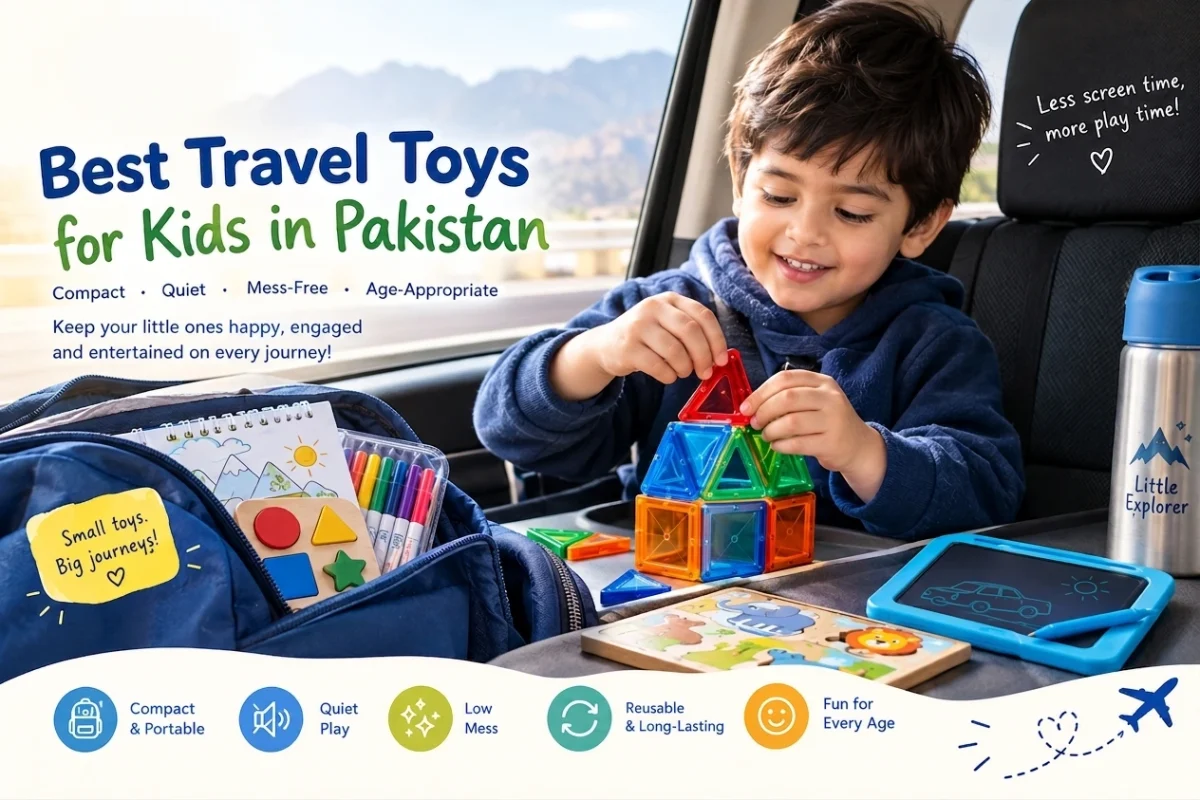
Travelling with children can be exciting, but anyone who has taken a long car ride or flight with a young child knows how quickly “Are we there yet?” can begin.
The good news is that you do not need to pack a suitcase full of toys.
The best travel toys for kids in Pakistan are usually compact, quiet, easy to pack and interesting enough to keep a child engaged without creating another problem for parents. A good travel toy should work in the real conditions of travelling: limited space, waiting around, tired children, lost pieces and the occasional spilled drink.
Whether you are driving from Lahore to Islamabad, taking a family trip to Murree, visiting relatives in Karachi, or flying with children, choosing the right toys can make the journey considerably easier.
Here is how to build a practical travel-toy kit that works for different ages and situations.
What Makes a Good Travel Toy?
Not every favourite toy belongs in a travel bag.
A large construction set may be fantastic at home but frustrating when its pieces are scattered across a car seat. A noisy electronic toy might keep one child entertained while making an entire waiting area uncomfortable.
Before packing a toy, ask five simple questions.
1. Is It Compact?
Travel space is limited.
Look for toys that fit comfortably inside a small backpack, handbag, car organiser or carry-on bag.
2. Is It Quiet?
Quiet toys are especially useful on aeroplanes, buses, trains, restaurants and waiting areas.
Puzzles, drawing activities, magnetic games and small construction toys can provide plenty of engagement without requiring batteries or loud sounds.
3. Is It Low-Mess?
Travelling is not the ideal time for activities that involve dozens of loose materials.
Choose toys that are easy to pack away and clean.
4. Can a Child Use It More Than Once?
A good travel toy should not be interesting for only five minutes.
Open-ended building toys, puzzles and reusable drawing activities can be used repeatedly throughout a journey.
5. Is It Appropriate for the Child?
Always check the manufacturer’s age recommendation and any warnings about small parts, magnets or required supervision.
A toy that works well for a six-year-old may not be appropriate for a toddler.
Best Travel Toys for Kids by Travel Situation
The best toy depends partly on where your child will use it.
A toy that works beautifully in a car may not be practical on an aeroplane tray table.
For Long Car Journeys
Road trips give children more space than aeroplanes, but there is still a limit to what can comfortably be used inside a vehicle.
Good options include:
- Small puzzles
- Magnetic games
- Compact building sets
- Drawing tablets
- Wooden logic games
- Small sorting or matching activities
For longer journeys, pack several different types of activities rather than giving everything to your child at once.
For example:
Start: Drawing activity
Middle: Puzzle
Later: Building activity
Waiting/rest stop: Family game
Changing activities can make the journey feel less repetitive.
For Flights
Air travel creates a different challenge.
There may be very little space, and pieces that fall on the floor can be difficult to retrieve.
For flights, prioritise:
- Quiet toys
- Compact puzzles
- Magnetic activities
- Drawing tablets
- Small construction sets
- Reusable activity books
- Compact travel games
Avoid packing something simply because it is educational. If it takes a large amount of space or requires constant adult assistance, it may not be a practical travel toy.
For Restaurants and Waiting Rooms
Sometimes the difficult part of travelling is not the journey itself.
It is the waiting.
A child may become restless while waiting for food, an appointment, a train, a flight or another family member.
This is where a small “waiting toy” can be particularly useful.
Good choices include:
- Small puzzles
- Number games
- Matching activities
- Drawing tablets
- Compact logic games
- Small magnetic construction toys
The advantage of these toys is that they can be brought out quickly and packed away just as easily.
Best Travel Toys by Age
Age should always be considered alongside the child’s individual abilities and interests.
Travel Toys for Toddlers
Toddlers generally benefit from simple activities they can understand quickly.
Consider:
- Chunky wooden puzzles
- Shape-sorting activities
- Stacking toys
- Simple matching toys
- Large-piece activities
- Reusable drawing activities
The toy should be easy enough for the child to begin exploring without requiring a long explanation.
For younger children, parents should also pay close attention to small parts and manufacturer safety recommendations.
Travel Toys for Preschoolers
Children around the preschool years can usually handle a wider variety of activities.
Good choices may include:
- Wooden puzzles
- Building blocks
- Magnetic construction toys
- Sorting games
- Simple logic puzzles
- Drawing activities
- Matching and counting toys
This is also a useful age for introducing open-ended toys.
Instead of a toy having only one correct outcome, a child can build, experiment and create different things.
Travel Toys for School-Age Children
Older children can usually handle more challenging activities.
Depending on their interests, consider:
- Logic puzzles
- Strategy games
- Magnetic chess
- Advanced construction sets
- STEM activities
- Number puzzles
- 3D puzzles
- Compact family games
The key is to choose something that provides enough challenge without becoming frustrating.
Why Open-Ended Toys Work Well for Travel
One of the biggest advantages of an open-ended toy is that there is no single way to use it.
A child with a small building set might create:
- A tower
- A house
- A vehicle
- A bridge
- An animal
- A completely imaginary creation
That gives the toy more longevity than an activity that can only be completed once.
This is especially useful during travel because children can return to the same toy several times.
ToyRoots’ Magnetic Building Blocks are one example of a compact construction-style activity that can provide different building possibilities rather than one fixed activity.
Parents can also look at the Educational Puzzles collection for compact activities suited to children who enjoy matching, solving and problem-solving.
How to Build a Simple Travel Toy Bag
You do not need 15 toys.
A better approach is to create a small selection with different types of play.
Try packing:
One Creative Toy
For example, a drawing tablet or another low-mess creative activity.
One Puzzle
Choose something appropriate for the child’s age and ability. ToyRoots’ educational puzzle collection includes options for different ages and types of play.
One Building Toy
A compact construction set can provide open-ended play. For children aged 3 and above, Magnetic Building Blocks are one option for creative construction play.
One Logic or Thinking Game
This gives your child something more challenging when they are ready for it.
One Favourite Toy
Always include something familiar.
A favourite toy can be useful when the child becomes tired or overwhelmed by a new environment.
The exact combination depends on your child’s age.
The important principle is variety without overpacking.
Don’t Give Everything to Your Child at Once
This is one of the simplest travel tricks parents can use.
If you hand over the entire toy bag at the beginning of a six-hour journey, your child may quickly move from one activity to another.
Instead, keep most of the toys packed away.
Bring out one activity at a time.
When your child has finished with it, put it away and introduce another.
This also makes each toy feel more interesting because the child is not looking at the entire collection simultaneously.
Choose Toys That Are Easy to Store
Lost pieces are one of the biggest problems with travel toys.
A simple storage pouch or small box can make a significant difference.
Before travelling, make sure:
- Small pieces are kept together.
- The container closes securely.
- The toy can be packed quickly.
- You know how many important pieces belong to the set.
- The child can help put the toy away.
For magnetic or multi-piece activities, a dedicated storage case can be particularly useful.
ToyRoots’ Magnetic Tiles Travel Set, for example, is designed around portability and comes with a compact storage tin, making this type of construction toy more practical for travel than a large loose set.
What About Screen-Free Travel?
Long journeys often lead parents to reach for a phone or tablet.
There is nothing wrong with wanting an easier journey, but toys can give children another option.
A travel bag containing puzzles, drawing activities, construction toys and games can provide opportunities for hands-on play without requiring a screen.
The goal does not have to be “no screens ever”.
Instead, think about creating a balance.
For example:
Puzzle → snack → drawing → screen → building → rest
A flexible approach is usually more realistic during a long family journey.
Travel Toy Safety Tips for Parents
Travel can make ordinary safety considerations more important.
Before packing a toy:
Check the Age Recommendation
Always follow the manufacturer’s recommended age.
Watch Small Parts
Small pieces may be unsuitable for younger children and can also become choking hazards if used by children who are not ready for them.
Be Careful With Magnets
Magnetic toys require particular attention to age guidance and supervision. Keep magnetic pieces away from children who are too young to use them safely.
Consider the Environment
A toy suitable for supervised play at home may not be practical in a moving vehicle.
Avoid activities that require a child to move around, reach awkwardly or use tools while travelling.
Keep the Bag Organised
A simple pouch can prevent pieces from disappearing under car seats or inside luggage.
ToyRoots Picks for a Travel-Friendly Toy Collection
ToyRoots already has several categories and products that naturally fit a travel-focused collection.
For younger children, Educational Puzzles offer compact, hands-on activities that can be easier to manage than large toys.
For children who enjoy construction, Magnetic Building Blocks can provide open-ended building play.
For children who enjoy strategy, the Magnetic Chess Board Game offers a foldable, portable format.
For children who enjoy numbers and thinking challenges, IQ Digits can provide a more structured puzzle activity.
For younger children who enjoy movement and physical play, the Kids Wooden Bowling Game is another portable option, although it is better suited to a destination or larger play area than an aeroplane seat.
Parents can also explore ToyRoots’ wider range of educational and travel-friendly toys and choose according to age, space and the type of journey.
A Practical Travel Toy Checklist
Before leaving home, run through this quick checklist:
Age: Is every toy appropriate for my child’s age?
Size: Will everything fit comfortably in our travel bag?
Noise: Can my child use it quietly?
Mess: Will it create a difficult cleanup?
Pieces: Can we keep all the pieces together?
Interest: Does my child actually enjoy this type of activity?
Challenge: Is it interesting without being too difficult?
Safety: Have I checked the manufacturer’s recommendations?
If the answer is yes to most of these questions, the toy is probably worth packing.
Frequently Asked Questions
What are the best travel toys for kids in Pakistan?
The best travel toys depend on the child’s age and the type of journey. Compact puzzles, drawing activities, magnetic games, small building sets, logic games and portable family games are practical options for many trips.
What are good travel toys for toddlers?
Toddlers generally need simple, sturdy and age-appropriate activities. Chunky puzzles, stacking toys, shape sorters and simple matching activities can be useful choices. Always follow the manufacturer’s age and safety guidance.
What toys are good for a long car journey?
Choose toys that can be used while seated and do not create excessive mess. Puzzles, drawing activities, magnetic games and compact building toys can work well, depending on the child’s age.
What should I pack for a flight with kids?
Prioritise quiet, compact activities. A small puzzle, drawing activity, magnetic game, compact construction toy and one favourite familiar item can make a useful starting kit.
How many travel toys should I take?
You do not need to pack a large collection. A few different activities are often more practical than bringing every toy your child owns. Rotate them throughout the journey.
Are Montessori toys good for travel?
Some Montessori-inspired toys can work very well for travel because they often involve hands-on, focused activities. However, portability, size, loose pieces and age suitability matter more than the Montessori label alone.
Are wooden toys suitable for travelling?
Some wooden toys are excellent travel choices, particularly when they are compact and contain relatively few pieces. Large wooden sets may be better suited to home or a destination rather than a car or aeroplane.
Final Thoughts
The best travel toys for kids are not necessarily the most expensive or the most complicated.
They are the toys that fit the situation.
For a toddler, that might be a simple wooden puzzle. For a preschooler, it could be a compact construction set or drawing activity. For an older child, a logic puzzle, strategy game or STEM activity may provide a better challenge.
When packing for a family trip, think beyond entertainment.
Choose toys that are compact, quiet, reusable, age-appropriate and easy to store.
Most importantly, do not feel that you need to pack everything.
A small, thoughtfully chosen travel toy bag can be more useful than a suitcase full of toys.
Whether you are heading out for a short drive, a long road trip, a flight or a family visit, the right activities can give children something meaningful to do while making the journey a little easier for everyone.
For Pakistani parents looking for portable, hands-on options, ToyRoots’ travel-friendly puzzles, building toys, logic games and other educational activities provide a useful place to start.