Monthly Archives: August 2026

Best toys for 6–8 year olds in Pakistan including building, puzzle and STEM toys

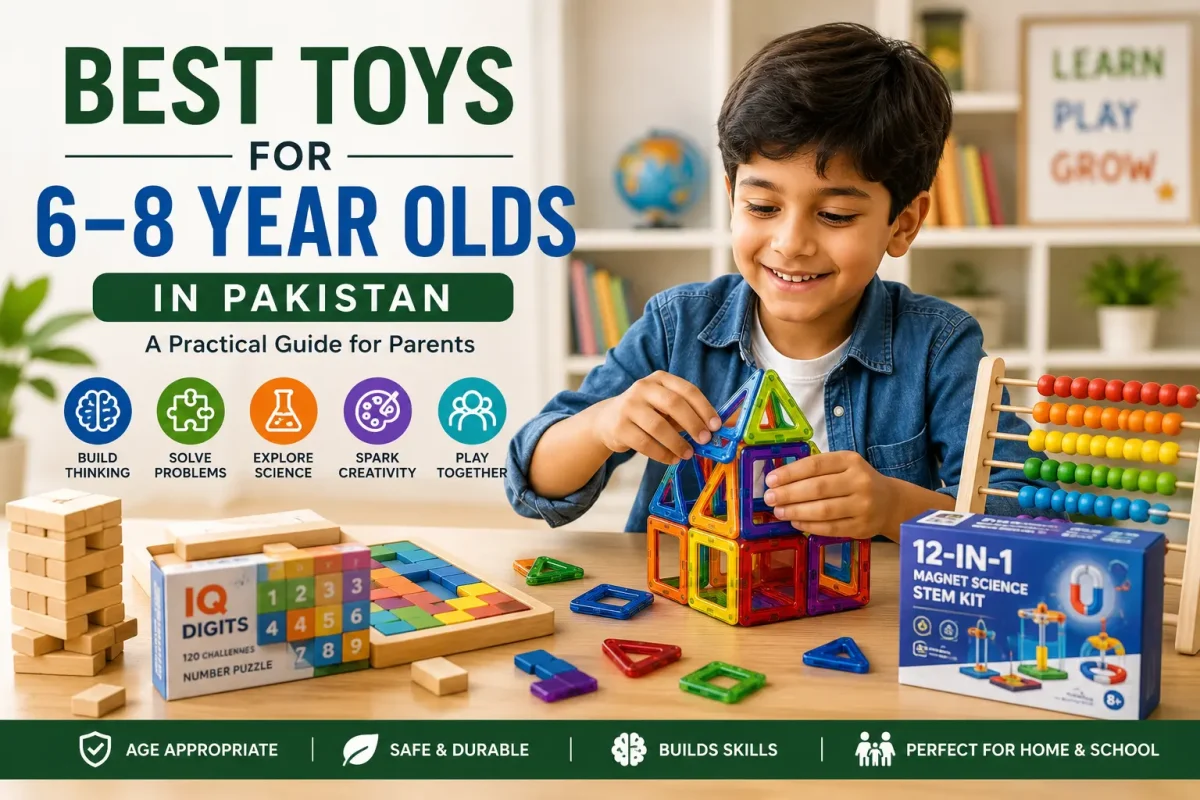
Best Toys for 6–8 Year Olds in Pakistan: A Practical Guide for Parents

Children between 6 and 8 are at an interesting stage. They are old enough to understand rules, follow multi-step activities and solve more challenging problems, but they still learn best when they are actively doing something.

That makes choosing toys a little different from choosing toys for toddlers or preschoolers.

At this age, the best toys for 6–8 year olds are not necessarily the ones with the most lights, sounds or features. A good toy can be surprisingly simple: building pieces, a challenging puzzle, a science activity, a strategy game or a creative project can keep a child engaged while giving them opportunities to think, experiment and make decisions.

For parents and gift buyers in Pakistan, there is another question: Which toy is actually worth buying?

This guide explains what to look for, which types of toys work well for ages 6–8, how to choose according to a child’s interests, and how to make a sensible choice at different budgets.

Why Toys for 6–8 Year Olds Are Different

By the early school years, children are becoming more independent in the way they play.

A six-year-old may enjoy building something by following instructions, while an eight-year-old may want to modify the design or create something completely different.

Children at this age can often enjoy activities involving:

  • Problem-solving
  • Construction and building
  • Basic science concepts
  • Numbers and logic
  • Strategy
  • Creativity
  • Reading and language
  • Imaginative play
  • Family games
  • Hands-on experiments

The important thing is not to treat age as a strict formula.

Two children who are both seven may have completely different interests. One may love puzzles, another may spend hours building things, while another may prefer drawing, music or pretend play.

The best toy is usually one that sits at the right level of challenge while matching the child’s interests.

7 Best Types of Toys for 6–8 Year Olds

Instead of looking for one “perfect” toy, it is more useful to understand the different types of play that children at this age can enjoy.

1. Building and Construction Toys

Building toys are a strong choice for children who enjoy making things.

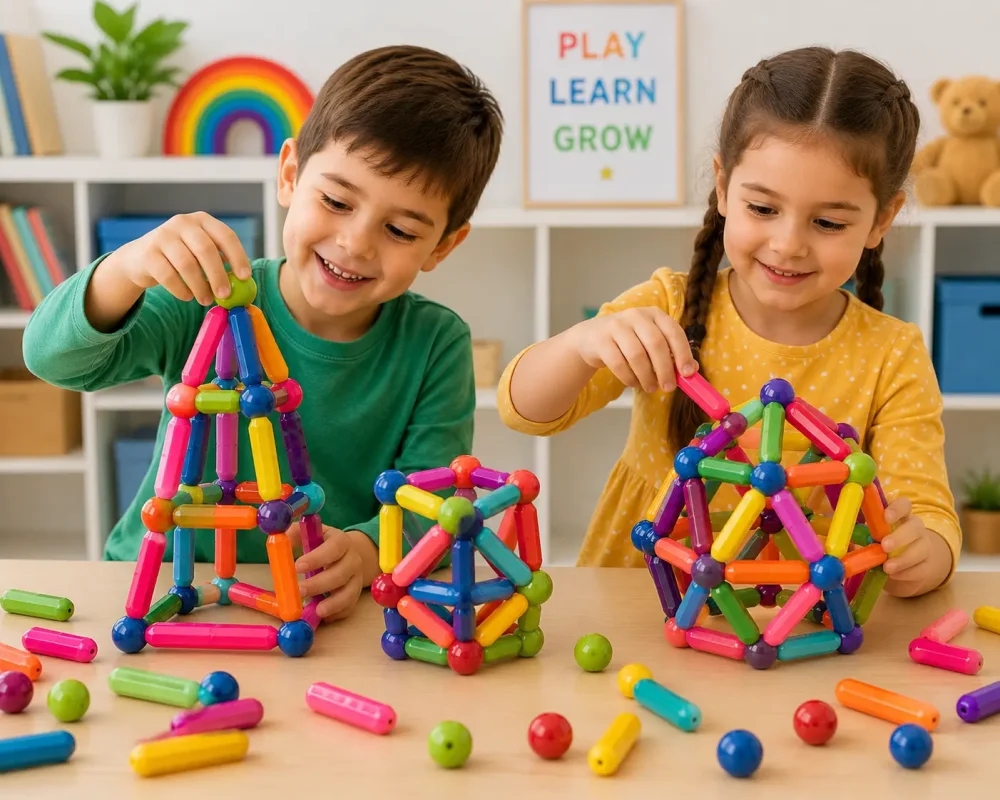
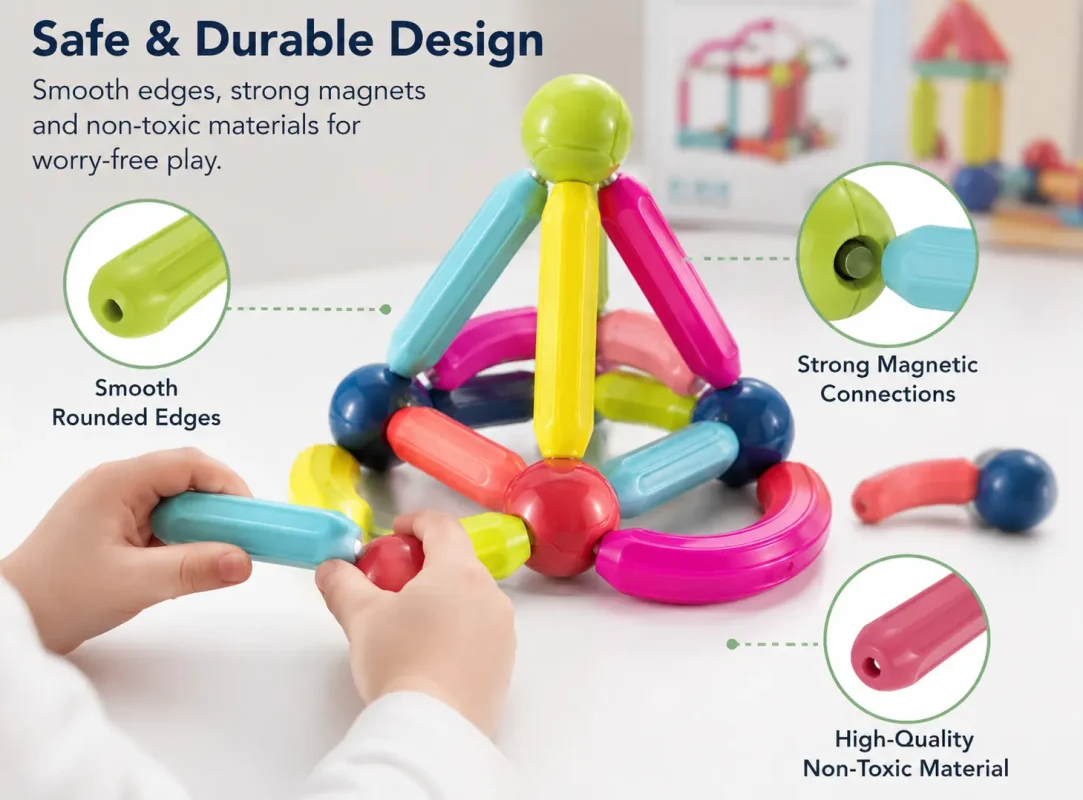
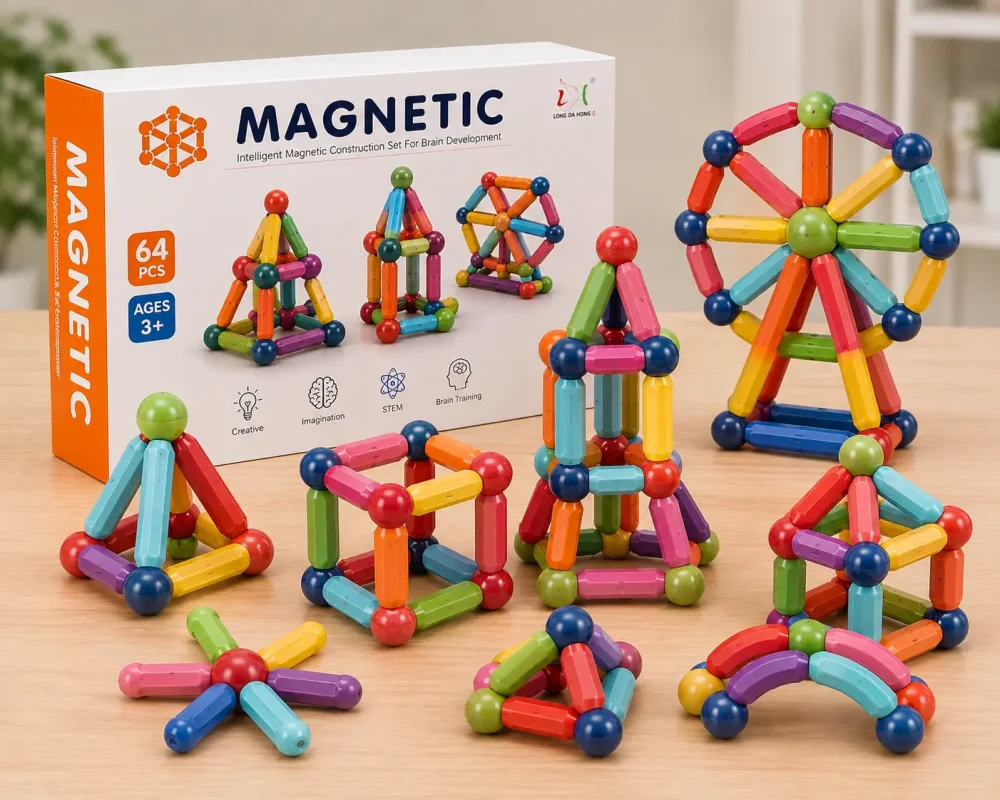
Magnetic construction sets, blocks and model-building kits allow children to turn individual pieces into structures, vehicles or other creations.

They can encourage children to think about:

  • Balance
  • Shape
  • Structure
  • Planning
  • Spatial relationships
  • Trial and error

One advantage of construction toys is that there is rarely only one way to play.

A child might build a tower today, a vehicle tomorrow and an imaginary city the next day.

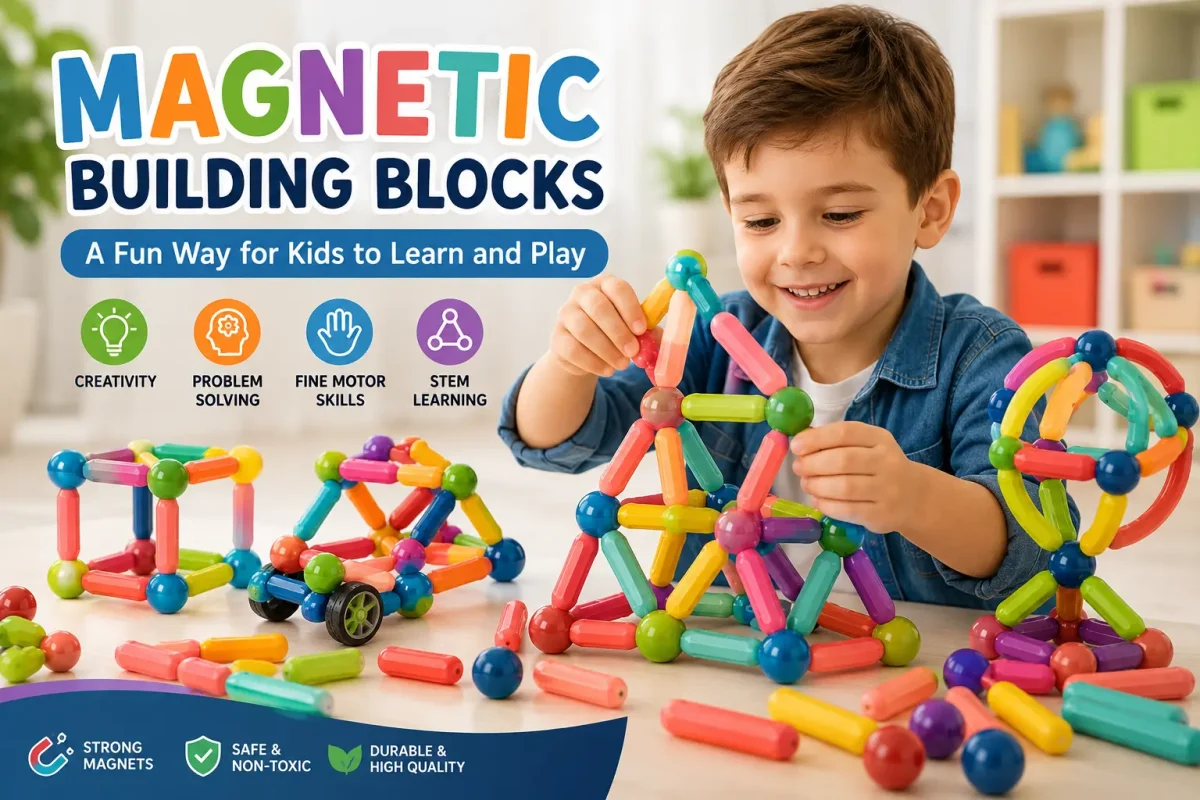
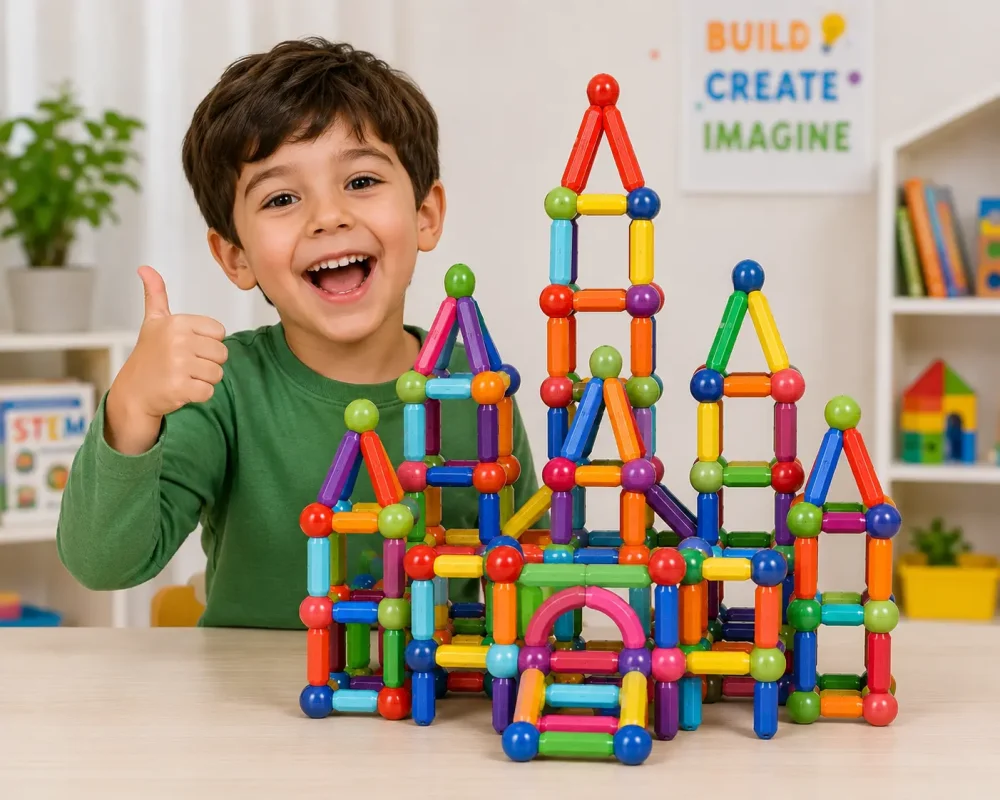
ToyRoots’ Magnetic Building Blocks for Kids – 3D STEM Construction Set is a useful option for children who enjoy construction and open-ended building.

For older children who enjoy more detailed construction, the 5-in-1 Metal Aircraft Building Kit offers a more structured model-building activity and is listed by ToyRoots for ages 8+.

2. Logic Puzzles and Brain Games

Some children would rather solve a problem than build a tower.

For them, logic puzzles and brain games can be excellent choices.

A good puzzle gives a child a clear challenge without immediately showing them the answer. They have to test ideas, notice patterns and sometimes start again after a mistake.

Look for puzzles involving:

  • Spatial reasoning
  • Patterns
  • Number challenges
  • Matching
  • Strategy
  • Sequencing
  • Problem-solving

ToyRoots has a dedicated Educational Puzzles for Kids collection with options ranging from simple wooden puzzles to more challenging logic and number-based activities.

For a child who enjoys numbers, the IQ Digits: 120 Challenges Brain-Boosting Number Puzzle can be a particularly relevant option.

The goal is not to make every play session educational in a school-like sense. The child should still experience the satisfaction of solving a challenge for themselves.

3. STEM and Science Toys

STEM toys can become especially interesting as children get older because they can handle more detailed instructions and multi-step activities.

For ages 6–8, consider activities involving:

  • Magnets
  • Engineering
  • Construction
  • Simple machines
  • Logic
  • Measurement
  • Experimentation
  • Cause and effect

The important thing is to look beyond the word “STEM” on the packaging.

Ask:

What does the child actually do?

Do they build something?

Do they test an idea?

Do they predict what will happen?

Do they have to solve a problem?

Do they get different results when they change something?

Those questions are more useful than simply choosing a toy because it has “STEM” written on the box.

You can also explore ToyRoots’ STEM Toys collection for building, logic and hands-on science activities.

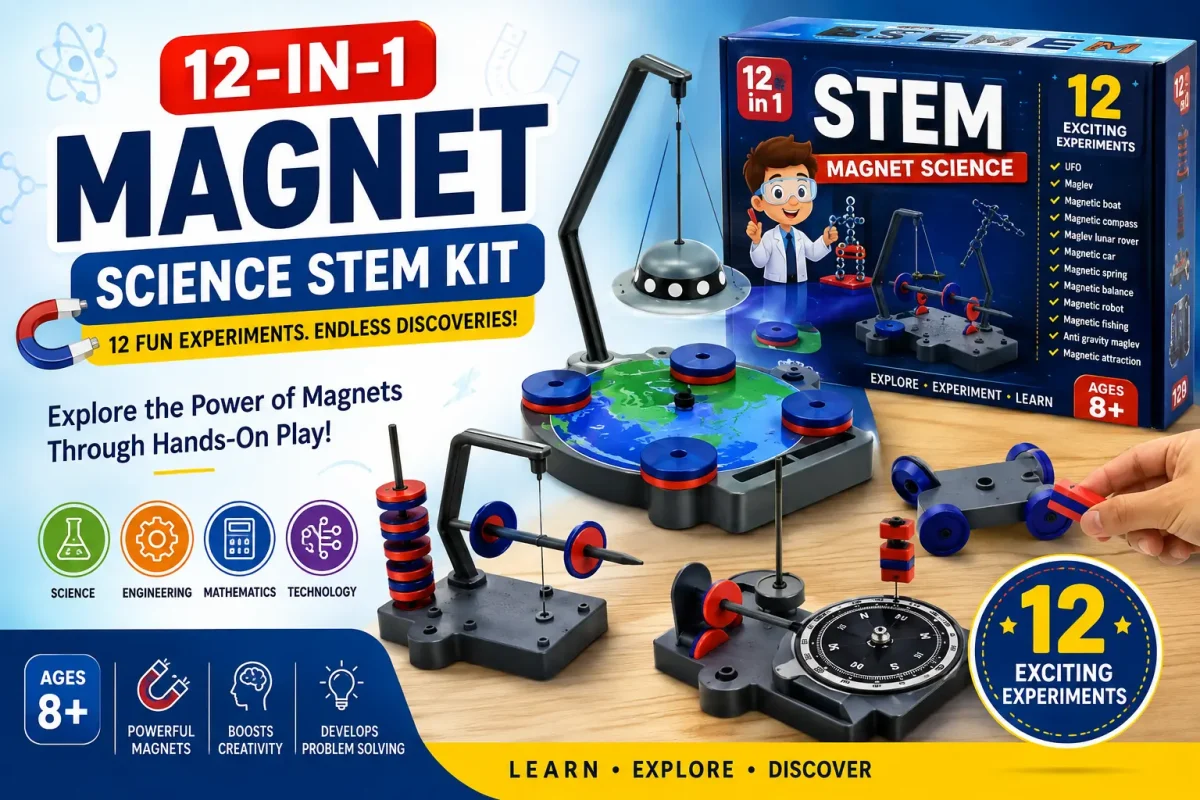
For an eight-year-old who is particularly interested in science, the 12-in-1 Magnet Science STEM Kit is a more advanced option and is listed for ages 8+.

4. Creative and Art-Based Toys

Not every six- to eight-year-old wants a puzzle or construction set.

Creative toys can be a better match for children who enjoy drawing, designing, making and decorating.

Consider:

  • Drawing activities
  • Craft kits
  • Creative construction
  • Model-making
  • Writing activities
  • Design projects

Creative play gives children an opportunity to make decisions without necessarily having one correct answer.

For example, there is a big difference between asking a child to copy a particular drawing and giving them materials to design their own vehicle, house, character or imaginary world.

The second activity gives them much more ownership over the result.

5. Strategy and Family Games

By age 6–8, many children are ready for games with clearer rules and simple strategy.

These can be especially useful for family play because the activity does not have to be limited to the child.

Depending on the child’s ability, consider:

  • Strategy games
  • Matching games
  • Number games
  • Board games
  • Building challenges
  • Turn-based games

A family game can also introduce concepts such as taking turns, following rules, planning ahead and handling both winning and losing.

ToyRoots’ Wooden Stacking Tower Game is one example of a simple hands-on game that can be played as a challenge rather than simply as a building activity.

6. Number and Maths Toys

Some children naturally enjoy numbers and patterns.

For these children, maths-related toys can make abstract concepts more tangible.

A wooden abacus, for example, allows children to physically move objects while counting and comparing quantities.

ToyRoots’ Classic Wooden Abacus & 100 Counting Sticks Set is an affordable hands-on maths activity, although parents should consider whether its difficulty level matches the individual child.

For a 6–8-year-old, the important thing is not necessarily whether a toy is labelled as a “maths toy.” What matters is whether it gives the child interesting problems to solve.

You can turn a simple counting activity into questions such as:

  • Which group has more?
  • How many are left?
  • Can you make two groups with the same number?
  • Can you find another way to make 10?
  • What happens if we add three more?

That makes the toy a starting point for conversation and exploration.

7. Toys Connected to the Child’s Interests

Sometimes the smartest buying decision is simply to follow the child.

If a child loves:

Cars and vehicles:
Look for construction sets, vehicle puzzles or model-building activities.

Science:
Consider experiment kits, magnets and STEM activities.

Numbers:
Try logic puzzles, number challenges and counting games.

Building:
Choose magnetic construction sets, blocks or model kits.

Animals and dinosaurs:
Consider themed puzzles, models and educational activities.

Art:
Look for drawing and craft-based activities.

Games:
Choose strategy, logic or family games.

A toy becomes much more valuable when the child actually wants to use it.

How to Choose the Right Toy for a 6-, 7- or 8-Year-Old

Age should be your starting pointβ€”not your only criterion.

Before buying, use this simple five-question test.

1. Is It Appropriate for the Child’s Age?

Always check the manufacturer’s recommended age.

A toy that is too difficult can frustrate a child, while one that is far too easy may lose their interest quickly.

Also pay attention to small parts, magnets, tools and any supervision requirements.

2. Is the Difficulty Level Right?

A good toy should provide a challenge without becoming impossible.

Ask yourself:

Can the child understand the basic activity, but still have something to figure out?

That is often the sweet spot.

3. Can the Toy Be Used More Than Once?

A toy that provides only one short activity may have limited long-term appeal.

Open-ended building sets, puzzles, strategy games and creative activities can often be revisited in different ways.

That makes them particularly useful for families trying to avoid buying toys that are exciting for one day and forgotten the next.

4. Does It Match the Child’s Personality?

Think about how the child naturally spends their time.

Do they:

  • Sit quietly and solve puzzles?
  • Build things?
  • Ask questions about how things work?
  • Draw constantly?
  • Prefer physical activities?
  • Like competing?
  • Enjoy playing with siblings?

Choose the toy around the childβ€”not simply around the age printed on the box.

5. Will It Fit Your Home and Routine?

This is an underrated consideration for Pakistani families.

Before buying a large toy, think about:

  • Storage space
  • Number of pieces
  • Whether it can be packed away easily
  • Whether siblings can use it
  • Whether parents need to supervise it
  • Whether it is practical for indoor play

A compact puzzle can sometimes get far more use than a large toy that is difficult to store.

Best Toys for 6–8 Year Olds by Budget in Pakistan

Your budget does not have to determine whether a toy is meaningful.

Instead, think about the type of activity you are buying.

Under Rs. 1,000

At this level, look for:

  • Simple wooden puzzles
  • Small logic games
  • Number activities
  • Compact strategy games
  • Basic creative activities

The important thing is to focus on the quality of the activity rather than the size of the box.

Rs. 1,000–2,500

This range can open up more substantial options such as:

  • Building sets
  • More advanced puzzles
  • Creative learning activities
  • Number and logic games
  • Smaller STEM toys

For example, ToyRoots currently offers educational puzzles and logic products across a range of prices, including number puzzles, wooden logic games and spatial challenges. Prices and availability can change, so check the individual product page before ordering.

Rs. 2,500 and Above

At a higher budget, you can consider:

  • Larger construction sets
  • Advanced STEM kits
  • Detailed model-building kits
  • More challenging logic toys
  • Multi-activity science kits

The 12-in-1 Magnet Science STEM Kit is one example of a more structured activity aimed at older children. Always check the current product page for the latest price and age recommendation before purchasing.

Educational Toys vs. “Just Fun” Toys

Parents sometimes feel that a toy must teach letters, numbers or science to be worthwhile.

It does not.

A game that teaches a child to take turns can be valuable.

A building set that encourages creativity can be valuable.

A puzzle that teaches persistence can be valuable.

A pretend-play activity that helps a child create stories can be valuable.

The best toys often combine fun and active thinking rather than looking like schoolwork.

The goal should not be to turn every minute of play into a lesson.

Children need opportunities to explore, make mistakes, invent games and simply enjoy themselves.

How Parents Can Make Toy Time More Valuable

You do not need to constantly teach your child while they play.

Instead, occasionally join them and ask open-ended questions.

During building:

“What are you trying to make?”

During a puzzle:

“Which piece could work here?”

During an experiment:

“What do you think will happen if we change this?”

During creative play:

“What happens next in your story?”

These questions encourage children to explain their thinking instead of simply looking for an adult to provide the answer.

And sometimes, the best thing a parent can do is step back and let the child figure it out.

Common Mistakes When Buying Toys for 6–8 Year Olds

Buying for the Parent Instead of the Child

A toy may look impressive to an adult but hold little interest for the child.

Think about what the child actually enjoys.

Choosing the Most Complicated Toy

More pieces and more features do not automatically mean a better toy.

The child should be able to understand the basic activity and gradually become more skilled at it.

Ignoring the Recommended Age

Always check the individual product’s age recommendation, particularly for toys containing small parts, magnets, tools or advanced components.

Buying Too Many Toys

Children do not necessarily need a large number of toys.

A smaller collection of varied, reusable activities can be easier to manage and may give each toy more attention.

Forgetting About Storage

Before ordering, consider where the toy and its pieces will live after playtime.

This matters particularly with construction sets and multi-piece games.

ToyRoots Picks to Consider

If you are shopping for a child in the 6–8 age range, these ToyRoots options may be worth exploring depending on the child’s interests:

For builders:
Magnetic Building Blocks for Kids – 3D STEM Construction Set

For an older child interested in engineering:
5-in-1 Metal Aircraft Building Kit

For science lovers aged 8+:
12-in-1 Magnet Science STEM Kit

For puzzle lovers:
Educational Puzzles for Kids

For families looking for more learning options:
Educational & Montessori Toys

Product availability, pricing and age guidance can change, so parents should always check the individual product page before ordering.

Frequently Asked Questions

What are the best toys for 6–8 year olds in Pakistan?

The best choice depends on the child’s interests. Building sets, logic puzzles, STEM activities, creative toys, strategy games and number-based activities are all useful options for this age group.

What is a good educational toy for a 6-year-old?

A six-year-old may enjoy building sets, age-appropriate puzzles, creative activities, simple strategy games and hands-on STEM toys. Choose something that provides a manageable challenge rather than something far beyond the child’s current ability.

What should I buy for a 7-year-old who gets bored easily?

Look for open-ended toys that can be used in different ways. Building sets, challenging puzzles, construction kits and strategy games can offer more replay value than toys with only one function.

What is a good STEM gift for an 8-year-old?

A science experiment kit, construction set, engineering activity or challenging logic puzzle can make a good STEM gift. ToyRoots’ 12-in-1 Magnet Science STEM Kit is specifically listed for ages 8+.

Are wooden toys still suitable for older children?

Yes. Wooden toys are not limited to toddlers. More challenging wooden puzzles, stacking games, strategy games and construction activities can also appeal to older children.

How much should I spend on a toy for a 6–8-year-old in Pakistan?

There is no single amount you need to spend. A simple puzzle or logic activity can provide meaningful play at a lower price, while larger construction sets and science kits may cost more. Choose according to the child’s interest, expected use and your budget rather than price alone.

Final Thoughts

Finding the best toys for 6–8 year olds does not mean finding the most expensive or most technologically advanced product.

Start with the child.

What do they enjoy? What challenges them? What do they keep asking questions about? What kind of play makes them lose track of time?

Then look for a toy that gives them something to build, solve, create, experiment with or imagine.

For Pakistani parents, a good toy should also make practical sense: check the recommended age, consider the available space at home, think about how often the toy can be reused and choose something that genuinely matches the child’s interests.

The right toy does more than occupy a child for an afternoon. It can give them a reason to think, try again, create something new and discover what they can do for themselves.

Mother and child playing with STEM toys in Pakistan

How to Choose STEM Toys for Kids in Pakistan: A Parent’s Guide by Age, Skill & Budget

Choosing a STEM toy for a child can be surprisingly difficult.

Walk into an online toy store and you may see magnetic building sets, logic puzzles, science kits, construction toys, number games and dozens of products labelled β€œSTEM.” But a colourful box and the word STEM do not automatically mean the toy is the right choice for your child.

The better question is: What will my child actually enjoy using, and what will they learn while playing with it?

For Pakistani parents, there is another practical consideration: budget. A good educational toy does not necessarily need to be expensive. The right puzzle, building set or hands-on activity can provide meaningful play without turning into a costly one-time purchase.

This guide explains how to choose STEM toys for kids in Pakistan based on age, interests, skills, difficulty, budget and safety β€” so you can make a more confident decision before buying.

What Are STEM Toys?

STEM stands for Science, Technology, Engineering and Mathematics.

STEM toys introduce these ideas through hands-on play rather than simply asking children to read or memorise information. A child might build a structure, solve a puzzle, experiment with balance, work with numbers or take apart and rebuild a model.

Importantly, a STEM toy does not have to be electronic.

A wooden geometry puzzle can involve mathematical thinking. Building blocks can introduce basic engineering concepts. A logic game can develop planning and problem-solving. A construction set can encourage children to test, adjust and rebuild their ideas.

That is why ToyRoots’ STEM toy collection includes different types of hands-on toys, from construction sets and logic puzzles to number-based and creative learning activities.

Why Choosing the Right STEM Toy Matters

The most expensive or complicated toy is not automatically the most educational.

A toy can be perfectly good but still be a poor choice for a particular child if it is:

  • Too difficult to use independently
  • Too simple for the child’s current ability
  • Unrelated to the child’s interests
  • Dependent on constant adult help
  • Designed for only one short activity
  • Difficult to store or use regularly

The goal is to find a toy that creates the right level of challenge.

Ideally, your child should be able to understand the basic activity while still having room to experiment, make mistakes and discover new solutions.

1. Start With Your Child’s Interest

Before looking at the product description, think about what your child already enjoys.

Does your child love building?

Look for:

  • Magnetic construction sets
  • Building blocks
  • Construction toys
  • Geometric building activities

Children who naturally enjoy stacking, connecting and creating may stay engaged with open-ended construction toys for much longer.

ToyRoots’ Magnetic Construction Building Blocks Set is one example. It is designed for 3D construction and can be used for different structures rather than only one finished model. The current collection offers several piece-count options.

Does your child enjoy puzzles?

Consider:

  • Logic puzzles
  • Shape puzzles
  • Number puzzles
  • 3D puzzles
  • Strategy games

Puzzle-loving children often enjoy activities where they have to figure out what comes next or find a solution.

For example, ToyRoots’ Soma Cube 3D Wooden Puzzle combines geometric pieces with spatial problem-solving.

You can also explore the wider educational puzzles collection for different difficulty levels and types of challenges.

Does your child like taking things apart?

That curiosity can be useful.

A take-apart construction toy can turn β€œI want to open this” into a structured learning activity. ToyRoots’ DIY Take-Apart Construction Truck Set is designed around building and taking apart a construction vehicle.

The key is to work with your child’s natural curiosity rather than forcing them into a particular type of STEM activity.

2. Choose the Skill You Want to Practise

Instead of asking, β€œWhich STEM toy is best?”, ask:

β€œWhich skill would I like my child to practise?”

Different toys support different kinds of play.

If your child needs more practice with…Consider…
Fine motor controlBuilding, stacking and manipulation toys
Spatial thinkingGeometric and 3D puzzles
Problem-solvingLogic games and puzzles
Early mathsCounting, number and matching toys
CreativityOpen-ended construction sets
PlanningStrategy and logic games
Cause and effectBuilding, mechanical and experiment-based toys
PatienceMulti-step puzzles and construction activities

This approach is more useful than simply choosing a toy because its packaging says β€œeducational.”

For early maths activities, parents can also explore ToyRoots’ counting and number learning toys, which include hands-on options such as abacus and number puzzles.

3. Match the Toy to Ability β€” Not Just Age

Age recommendations are important, but they should not be the only factor.

Two children of the same age can have very different interests, attention spans and abilities.

For younger children, start with simple activities involving:

  • Sorting
  • Matching
  • Stacking
  • Large building pieces
  • Basic shapes
  • Simple cause-and-effect play

As children become more confident, you can introduce:

  • More complex puzzles
  • Multi-step construction
  • Strategy games
  • Number challenges
  • Engineering-style activities
  • More structured STEM kits

ToyRoots currently organises products by age groups including under 1, 1+, 2+, 3+ and 4+ years, which can be a useful starting point when narrowing your options.

For example, parents can browse educational toys for 2 year olds when looking for age-appropriate puzzles, counting toys, building activities and sorting games.

But always read the individual product’s age recommendation before purchasing.

4. Open-Ended Toys Often Offer More Ways to Play

One useful question before buying is:

β€œAfter my child finishes the instructions, can they do something else with this toy?”

Open-ended toys have more than one possible outcome.

Building pieces might become:

  • A house today
  • A bridge tomorrow
  • A tower next week
  • An imaginary vehicle later

This type of play gives children opportunities to experiment and change their ideas.

That does not mean structured toys are bad. A puzzle with a correct solution can be excellent for logical thinking. The point is simply to balance structured problem-solving with opportunities for creativity.

ToyRoots’ Magnetic Construction Building Blocks Set is one example of a toy that can support open-ended construction, allowing children to experiment with different structures rather than following only one finished design.

5. Think About Your Budget Before You Shop

STEM toys are available across a wide range of prices in Pakistan.

At ToyRoots, for example, current products include lower-cost logic and number activities as well as larger construction and science sets. Prices can change, so use the product page for the latest amount.

Around Rs. 500–1,000

This range can work well for simple learning activities such as:

  • Small logic puzzles
  • Basic geometric puzzles
  • Counting activities
  • Simple wooden learning toys
  • Smaller construction or strategy games

ToyRoots currently lists products such as the Montessori Geometric Stacking & Logic Puzzle Collection from Rs. 600–950 and several other lower-priced learning toys.

Around Rs. 1,000–2,000

This is a useful range for parents looking for a more substantial activity.

Possible choices include:

  • Larger puzzles
  • Take-apart construction toys
  • Number challenges
  • More versatile building sets
  • Creative STEM activities

For example, ToyRoots currently lists the DIY Take-Apart Construction Truck at Rs. 1,400 and IQ Digits at Rs. 1,350.

Rs. 2,000 and above

Higher-priced options may offer:

  • More pieces
  • Multiple activities
  • Larger construction sets
  • Advanced logic challenges
  • Science or STEM experiment kits

The important thing is not to assume that a higher price automatically means greater educational value.

A Rs. 1,000 puzzle that your child solves repeatedly may provide more useful play than a Rs. 4,000 kit that is opened once and forgotten.

6. Check Whether the Toy Can Grow With Your Child

A good question for parents is:

β€œWill my child still be interested in this after the first week?”

Look for toys with increasing possibilities.

For example, a building set might begin with simple towers. Later, your child may start making bridges, vehicles or more complicated structures.

Similarly, a puzzle collection can introduce simple challenges before moving toward more complex ones.

ToyRoots’ STEM collection includes products ranging from basic wooden puzzles and number activities to more advanced logic and construction toys, giving parents different levels of challenge to consider.

7. Don’t Ignore Safety

Safety should come before educational value.

Before buying a STEM toy, check:

  • Recommended age
  • Small parts
  • Magnets
  • Sharp edges
  • Batteries
  • Material information
  • Whether adult supervision is recommended
  • Whether the child can use the toy safely without putting pieces in their mouth

This is particularly important for toddlers.

For older children using construction or science kits, read the instructions and decide whether an adult should supervise the activity.

Never choose a toy simply because it looks advanced or impressive.

8. Look Beyond the Word β€œSTEM” on the Box

β€œSTEM” is useful as a category, but it should not be your only buying criterion.

Ask what the child actually does with the toy.

Does the child:

  • Build something?
  • Compare shapes?
  • Count?
  • Solve a problem?
  • Test an idea?
  • Make predictions?
  • Change a design?
  • Find different solutions?
  • Create something independently?

If the answer is yes to several of these questions, the toy is more likely to provide meaningful hands-on learning.

A simple wooden puzzle can sometimes create more active thinking than a complicated electronic toy if the child is actually solving, experimenting and making decisions.

STEM Toy Ideas for Different Types of Children

For the little builder

Choose magnetic construction sets, blocks or take-apart construction toys.

These are particularly useful for children who enjoy creating things with their hands.

A good place to start is the Magnetic Construction Building Blocks Set, which offers multiple piece-count options for different levels of building.

For the puzzle lover

Try geometric puzzles, logic games, number challenges or 3D puzzles.

ToyRoots’ educational puzzle collection includes options ranging from simple shape activities to more challenging logic and spatial puzzles.

For the numbers-loving child

Counting and number toys can turn early maths into hands-on play.

ToyRoots’ counting and number collection includes a wooden abacus, quantity matching puzzle and wooden number puzzle board.

For a specific early maths option, the Classic Wooden Abacus & 100 Counting Sticks Set provides hands-on practice with counting, grouping and basic arithmetic.

For the creative child

Choose open-ended building or creative activities that allow the child to make their own designs.

The goal is not always to produce a perfect final object. Sometimes the learning happens while the child is trying, changing and rebuilding.

For the strategy-minded child

Logic and strategy games can provide a different kind of STEM experience.

Games require children to think ahead, make decisions and respond to changing situations.

A Simple 5-Question STEM Toy Checklist

Before buying any STEM toy, ask these five questions:

1. Is it suitable for my child’s age?

Check the manufacturer’s or seller’s recommended age.

2. Does it match my child’s interests?

A child who loves vehicles may engage more with construction toys than a science kit.

3. What specific skill does it practise?

Look beyond vague claims and identify the actual activity.

4. Can my child use it more than once?

Reusable play usually gives better long-term value.

5. Is it safe and practical for our home?

Think about small parts, storage, supervision and how often your family is realistically going to use it.

If a toy passes these five questions, it is much easier to justify the purchase.

How Parents Can Make STEM Play More Valuable

You do not need to turn playtime into a classroom.

Instead, ask simple questions.

While your child is building, ask:

  • β€œWhat are you trying to make?”
  • β€œWhy did it fall?”
  • β€œWhat could make it stronger?”
  • β€œWhat happens if we change this?”
  • β€œCan you make another version?”

During a puzzle, try:

  • β€œWhich piece could fit here?”
  • β€œWhat have you already tried?”
  • β€œIs there another way?”

These small conversations encourage children to explain their thinking rather than simply searching for the correct answer.

The toy provides the activity. Your questions help turn that activity into a richer learning experience.

Recommended ToyRoots Picks

If you are looking for STEM toys in Pakistan, several ToyRoots products fit naturally into this approach:

Magnetic Construction Building Blocks Set β€” a flexible choice for children who enjoy building, creating and experimenting with structures. Current options range from 25 to 64 pieces.

DIY Take-Apart Construction Truck Set β€” suitable for hands-on building and taking apart, especially for children fascinated by vehicles and how things work.

Soma Cube 3D Wooden Puzzle β€” a compact option for children who enjoy spatial puzzles and challenging themselves to create different structures.

IQ Digits Number Puzzle β€” a number-focused option for children who enjoy logical challenges. It is currently listed at Rs. 1,350 on ToyRoots.

12-in-1 Magnet Science STEM Kit β€” a more advanced option currently listed for ages 8+ and priced at Rs. 2,800 on ToyRoots.

For the latest availability and pricing, always check the individual product page before ordering.

Frequently Asked Questions

What are the best STEM toys for kids in Pakistan?

The best STEM toy depends on the child’s age, interests and current ability. Building sets are useful for young creators, puzzles work well for children who enjoy problem-solving, while number and science activities suit children interested in maths or experiments. You can explore the ToyRoots STEM toy collection to compare different types.

Are STEM toys only for older children?

No. STEM-style learning can begin with simple age-appropriate activities such as stacking, sorting, matching, shapes and basic construction. More complex science, engineering and technology activities can be introduced as children develop.

Are wooden toys STEM toys?

Some wooden toys can support STEM learning. Building blocks, geometric puzzles, counting toys and logic games can involve mathematics, spatial reasoning, engineering concepts or problem-solving. ToyRoots also offers a broader range of educational toys for parents who want to compare different learning approaches.

How much should I spend on a STEM toy?

There is no single amount you need to spend. Start with your budget and look for a toy that offers repeated, meaningful play. A versatile lower-cost puzzle may provide excellent value compared with an expensive toy that is used only once.

Should I choose a STEM toy based only on age?

No. Age is an important safety and suitability guide, but your child’s interests and abilities also matter. A toy should be challenging enough to hold attention without being so difficult that the child immediately needs an adult to complete it.

Can STEM toys replace screen time?

STEM toys can provide an engaging screen-free alternative, particularly when children are given open-ended activities that encourage building, solving and experimenting. However, the goal should be balanced play rather than treating one toy as a complete replacement for every form of entertainment.

Final Thoughts

The best STEM toy is not necessarily the biggest, most expensive or most technologically advanced one.

It is the toy that makes a child want to try, think, build, solve, test and try again.

For Pakistani parents, a simple buying process can make the choice much easier: start with the child’s interests, identify the skill you want to encourage, check the age and difficulty level, consider your budget, and make safety a priority.

Whether your child enjoys magnetic construction, wooden puzzles, numbers, strategy games or taking things apart, there are plenty of ways to introduce STEM learning through everyday play.

The right toy does not need to feel like homework.

It should feel like play β€” with learning happening naturally along the way.

Best birthday gifts for kids in Pakistan with age-wise, budget-friendly and educational toy ideas

Best Birthday Gifts for Kids in Pakistan: An Age & Budget Guide for Parents

Finding the right birthday gift for a child sounds easyβ€”until you start thinking about their age, interests, safety, budget, and whether they will actually play with it after the birthday party is over.

A good children’s gift should do more than look exciting when the wrapping paper comes off. The best birthday gifts for kids in Pakistan are often toys that encourage children to build, solve, create, imagine, count, explore, or play with family.

That is especially useful when you are buying for a child who is not your own. You may know their age but not their favorite cartoon, current toy collection, or exact interests.

This guide will help you choose birthday gifts for kids in Pakistan by age, budget, and type of playβ€”with practical ideas for toddlers, preschoolers, and young children.


What Makes a Good Birthday Gift for a Child?

Before choosing a toy, think beyond appearance.

A good birthday gift should ideally meet four simple criteria:

1. It Is Suitable for the Child’s Age

Age matters because a toy that is perfect for a four-year-old may be frustratingβ€”or unsafeβ€”for a much younger child.

Always check the manufacturer’s recommended age and consider the child’s current abilities.

For easier age-based browsing, explore ToyRoots’ educational toys for kids and choose products according to the child’s developmental stage.

2. It Encourages Active Play

Toys are more useful when children have to do something with them.

Building, sorting, drawing, stacking, matching, solving and experimenting all give children opportunities to participate rather than simply watch.

Hands-on options such as educational puzzles and STEM toys can make active play part of the birthday gift.

3. It Can Be Used More Than Once

A birthday present becomes much better value when a child can return to it repeatedly.

Building blocks, puzzles, wooden games, construction sets and open-ended toys can often be played with in different ways as a child’s skills develop.

For example, magnetic building blocks allow children to create different structures rather than completing the same activity every time.

4. It Matches the Child’s Interests

A technically excellent educational toy may still end up unused if it does not appeal to the child.

Think about what they already enjoy:

  • Building and construction
  • Animals and vehicles
  • Numbers and puzzles
  • Drawing and creativity
  • Music
  • Science and experiments
  • Imaginative play
  • Family games

The goal is not to make a birthday gift feel like homework. It should still feel like a present.


Best Birthday Gifts for Kids in Pakistan by Age

The easiest way to narrow down your choices is to start with age.

ToyRoots offers age-based toy options for different stages of early childhood, making it easier for parents and gift buyers to find age-appropriate products.

Birthday Gifts for 1-Year-Olds

At around one year, children are discovering movement, textures, shapes, sounds and cause-and-effect relationships.

Good gift choices include:

  • Stacking toys
  • Simple shape and colour toys
  • Large-piece puzzles
  • Sensory toys
  • Simple wooden activity toys
  • Age-appropriate musical toys

The important thing is simplicity. A one-year-old does not need a complicated toy with dozens of functions.

Look for toys that are easy to grasp and explore. Avoid products with small detachable pieces that could create a choking risk.

For younger children, explore the Toys for Babies Under 1 collection and other age-appropriate options for toddlers.

Birthday Gifts for 2-Year-Olds

Two-year-olds are becoming more independent and are beginning to sort, match, build, count and pretend.

Good birthday gifts include:

  • Wooden puzzles
  • Shape sorters
  • Stacking and sorting toys
  • Building blocks
  • Early counting toys
  • Simple musical instruments

A particularly useful choice is a toy that offers several ways to play.

For example, a building set can initially be used for stacking and later for creating simple structures. Similarly, a sorting toy can introduce colours and shapes while also developing hand coordination.

For more ideas, explore ToyRoots’ Educational Toys for 2 Year Olds collection. You can also browse Counting & Numbers Toys for early maths activities.

Birthday Gifts for 3-Year-Olds

Around three, children become increasingly interested in imagination, construction, problem-solving and storytelling.

Consider:

  • Building blocks
  • Magnetic construction toys
  • Wooden puzzles
  • Matching and sorting games
  • Pretend-play toys
  • Creative activity toys
  • Simple logic games

This is also a good age to introduce open-ended toys.

Instead of a toy with only one correct way to use it, choose something that allows the child to create their own structures, stories or challenges.

A magnetic construction set can be a good example of this type of open-ended play, while puzzle and logic products offer more structured challenges.

Birthday Gifts for 4-Year-Olds and Up

By four, many children are ready for more challenging puzzles, strategy-based games, construction activities and early STEM experiences.

Good options include:

  • Logic puzzles
  • Construction sets
  • Strategy games
  • Counting and maths toys
  • STEM activity kits
  • Building challenges
  • Family games

For a child who enjoys solving problems, something like the Traffic Jam Rescue Logic Game can be more memorable than another conventional toy.

Children interested in science and construction can also explore ToyRoots’ STEM Toys collection.


Best Birthday Gifts for Kids by Budget

Your budget does not have to determine whether a gift is meaningful.

A smaller toy that matches the child’s age and interests can be a better present than a large, expensive toy that is difficult to use.

Birthday Gifts Under Rs. 1,000

If you want an affordable but useful birthday present, consider:

  • Small wooden puzzles
  • Shape and colour sorting toys
  • Simple counting toys
  • Wooden strategy games
  • Basic musical toys
  • Small educational activity sets

These are especially useful for school friends, cousins, neighbours and children’s birthday parties where you may be buying several gifts throughout the year.

For number-based activities, explore the Counting & Numbers Toys category. For puzzle lovers, the Educational Puzzles for Kids collection includes options at different price points.

Birthday Gifts Around Rs. 1,000–2,500

This budget opens up more versatile choices.

You can consider:

  • Larger building sets
  • Magnetic construction toys
  • Advanced wooden puzzles
  • Educational games
  • Creative learning sets
  • Family-friendly strategy games

Construction toys can be particularly useful because children can create different structures instead of following only one way to play. ToyRoots’ Magnetic Building Blocks are one example of an open-ended construction gift for children aged 3+.

Birthday Gifts Above Rs. 2,500

For a larger birthday present, consider a toy that offers a deeper challenge.

Options may include:

  • Advanced STEM kits
  • Larger construction sets
  • More complex logic games
  • Multi-activity learning kits
  • Premium wooden games

Always check the recommended age before buying a more advanced STEM or logic toy. For older children who enjoy spatial challenges, the Soma Cube 3D Wooden Puzzle is another example of a problem-solving toy.


Educational Birthday Gifts vs. Traditional Toys

Does a birthday gift have to be educational?

Not necessarily.

Children need opportunities for imagination, movement, creativity, social interaction and independent play. A good toy can support one or several of these areas without feeling like a lesson.

Educational toys are particularly useful when they make learning part of the play.

Type of ToyWhat It Can Encourage
PuzzlesProblem-solving, concentration and visual thinking
Building ToysCreativity, planning and construction skills
Counting ToysEarly number recognition and counting practice
Wooden GamesHand-eye coordination and interactive play
STEM ToysExperimentation, curiosity and logical thinking

For example:

  • A puzzle can become a problem-solving challenge.
  • Building blocks can become an engineering activity.
  • A counting toy can become a pretend shop game.
  • A wooden game can become family competition.
  • A STEM kit can turn curiosity into experimentation.

This is why choosing a toy based only on the word “educational” is not enough.

Ask yourself: β€œWhat will the child actually do with this toy?”

That question often leads to a better gift.

If you are specifically looking for learning-focused gifts, you can browse ToyRoots’ Educational Toys collection for Montessori, STEM and hands-on learning options.


What If You Don’t Know the Child Very Well?

This is one of the most common birthday-gift problems.

Perhaps it is your child’s classmate, your cousin’s child, a neighbour, or a friend’s son or daughter.

In that situation, avoid highly specific character toys unless you know the child’s preferences.

Instead, choose something broadly appealing.

Good Choices Include:

  • Building toys
  • Simple puzzles
  • Wooden games
  • Drawing or creative activities
  • Counting and sorting toys
  • Age-appropriate STEM toys
  • Family games

An open-ended toy is particularly useful because the child can decide how to play with it.

If you know only the child’s age, start there. If you also know one interestβ€”such as cars, animals, building or scienceβ€”use that information to narrow the choice.

When you are unsure, ToyRoots’ educational puzzle collection is a useful place to explore broadly appealing gifts.


Birthday Gift Buying Tips for Pakistani Parents and Families

Check the Age Recommendation

Don’t choose a toy simply because it looks fun.

Check the recommended age, especially when the product contains multiple pieces, magnets, small components or more advanced challenges.

Think About Storage

A huge toy may look impressive but can quickly become difficult to store.

Compact puzzles, building sets and wooden games can be easier to organise in homes where storage space is limited.

Consider How Often the Toy Can Be Reused

Ask whether the child can play with the toy repeatedly.

A toy that supports different challenges or creative possibilities can offer more long-term value than one that performs the same action every time.

Check the Material and Construction

Parents should pay attention to the material, finish, durability and condition of the toy.

For children’s toys, always follow the manufacturer’s age guidance and safety instructions. Young children should also be supervised when using toys with multiple pieces or components.

Order With Delivery Time in Mind

If you are sending a birthday gift to another city, do not wait until the day before the party.

For important birthdays, ordering early gives you some room in case there is a delivery delay.


A Simple Birthday Gift Decision Formula

If you’re still unsure, use this four-step method:

StepQuestion to Ask
1. AgeHow old is the child?
2. InterestWhat does the child enjoy?
3. SkillWhat type of play or challenge suits them?
4. BudgetHow much do you want to spend?

Example:

Age: 4 years
Interest: Cars
Skill: Problem-solving
Budget: Rs. 3,000+

That combination points you toward a vehicle-themed puzzle or STEM/logic toy rather than a random toy car.

For example, ToyRoots’ Traffic Jam Rescue Logic Game combines a vehicle theme with logic-based problem-solving.

Another example:

Age: 2 years
Interest: Colours
Skill: Fine motor development
Budget: Under Rs. 1,000

A shape-and-colour sorting toy or wooden puzzle would make more sense.

This approach helps you choose a gift with a reason behind it rather than simply buying the most colourful product on the page.


ToyRoots Gift Ideas Worth Considering

ToyRoots offers several categories that can help Pakistani parents and gift buyers find age-appropriate toys for birthdays.

For Toddlers

For younger children, explore the Educational Toys for 2 Year Olds collection, which includes counting, sorting, puzzle and Montessori-inspired options.

You can also browse the Montessori Toys collection for hands-on activities designed around independent and purposeful play.

For Numbers and Early Maths

For children who enjoy numbers and early maths, explore the Counting & Numbers Toys category.

For example, the Wooden Number Puzzle Board can be considered for children who are beginning to recognise and work with numbers.

For STEM and Construction

For children who enjoy construction and experimentation, explore ToyRoots’ STEM Toys collection.

For hands-on construction play, the Magnetic Building Blocks are another option for children aged 3+.

For Montessori-Inspired Play

For a more specific Montessori option, the Montessori Geometric Stacking & Logic Puzzle Collection can suit children who enjoy sorting, stacking and pattern-based play.

For Active Play

For a child who likes active games, the Kids Wooden Bowling Game combines movement with counting, colour recognition and hand-eye coordination.

These recommendations are examples rather than a ranking. The right choice depends on the child’s age, interests and the type of play they enjoy.


Frequently Asked Questions

What Are the Best Birthday Gifts for Kids in Pakistan?

The best gift depends on the child’s age and interests. Building toys, puzzles, Montessori-inspired activities, wooden games and STEM toys are strong options when you want a present that combines fun with meaningful play.

What Is a Good Birthday Gift for a 2-Year-Old?

Wooden puzzles, shape sorters, counting toys, stacking activities and building blocks are good starting points. Choose large, age-appropriate pieces and follow the manufacturer’s safety guidance. You can explore ToyRoots’ toys for 2-year-olds for suitable options.

What Should I Gift a 3-Year-Old Child?

Consider building blocks, magnetic construction toys, puzzles, sorting games, creative activities and simple logic toys. Open-ended products are particularly useful because they allow children to invent different ways to play. ToyRoots’ Magnetic Building Blocks are one example of this type of play.

What Are Good Birthday Gifts for Kids Under Rs. 1,000?

Small wooden puzzles, sorting toys, counting activities and simple educational games can make useful gifts within this budget. The key is to prioritise age suitability and play value rather than size. The Counting & Numbers Toys category can be a useful starting point.

Are Educational Toys Suitable as Birthday Gifts?

Yes, as long as the toy is enjoyable and age-appropriate. The best educational gifts allow children to learn naturally while building, solving, creating or exploring. ToyRoots’ Educational Toys collection is designed around hands-on learning.

How Do I Choose a Birthday Gift When I Don’t Know the Child’s Interests?

Start with their age and choose an open-ended toy such as a puzzle, building set, sorting activity or simple game. Avoid highly specific characters or themes unless you know what the child likes.


Final Thoughts

The best birthday gifts for kids in Pakistan are not necessarily the biggest, loudest or most expensive ones.

A thoughtful gift is one that fits the child’s age, interests and abilitiesβ€”and gives them something enjoyable to do after the birthday celebration is over.

For toddlers, simple puzzles, sorting activities and building toys can encourage exploration. For preschoolers, construction sets, logic games and creative activities offer more challenge. Older children may enjoy STEM kits, strategy games and problem-solving toys.

Age β†’ Interest β†’ Skill β†’ Budget

Choose for the child, not for the packaging.

Look at age first, consider what the child enjoys, think about the skills the toy encourages, and then choose something that fits your budget.

At ToyRoots, parents can explore age-based educational toys, Montessori-inspired activities, wooden puzzles, building sets and STEM products designed around meaningful, hands-on play.

A birthday gift doesn’t have to be complicated to be memorable. Sometimes, the best present is simply a toy that makes a child curious enough to say, “Can we play again?”

Explore ToyRoots Toys & Educational Products β†’

Toy rotation system at home with organized educational toys for children

How to Create a Toy Rotation System at Home: A Simple Guide for Parents

Does your child have a room full of toys but still say, β€œI’m bored”?

Many parents experience the same problem. Toys gradually pile up from birthdays, gifts, shopping trips, and special occasions. Before long, there may be puzzles, blocks, drawing toys, games, and learning activities scattered everywhere.

Yet having more toys does not always mean better play.

Sometimes, children simply need fewer choices and a more organized play environment.

One simple approach parents can try is a toy rotation system. Instead of keeping every toy available all the time, you select a smaller group of toys for your child to use and store the rest. After some time, you switch the selection.

This can make an old toy feel interesting again while also making the play area easier to manage.

In this guide, we’ll explain what toy rotation is, how to create one at home, how often to rotate toys, and how to build balanced toy selections using different types of educational play.

What Is a Toy Rotation System?

A toy rotation system is a simple way of organizing your child’s toys by keeping only a selected number available at one time.

The remaining toys are stored somewhere your child cannot see them easily. After a week, two weeks, or whenever your child starts losing interest, you can replace some of the available toys with stored ones.

For example, instead of putting 20 different toys on a shelf, you might display:

  • One building toy
  • One puzzle
  • One counting activity
  • One sorting activity
  • One creative activity
  • One logic game

The remaining toys stay stored until the next rotation.

The goal is not to take toys away from your child. The goal is to create a more manageable selection that encourages meaningful play.

Why Do Parents Use Toy Rotation?

Toy rotation can solve a surprisingly common parenting problem: too many toys and not enough meaningful play.

When everything is available at once, children may move quickly from one toy to another without spending much time exploring any of them.

A smaller selection can make it easier for children to decide what they want to play with.

Toy rotation can also help parents keep the play area organized and make better use of toys they already own.

1. It Reduces Toy Clutter

A smaller number of toys on display means fewer things scattered around the room.

Instead of cleaning up dozens of toys every evening, parents only need to organize the current selection.

2. It Can Make Old Toys Feel New Again

A toy that has been sitting on a shelf for several weeks may no longer attract much attention.

Put it away for a while and bring it back later, and your child may approach it with renewed curiosity.

You don’t necessarily need to buy something new every time your child becomes bored.

3. It Gives Children Fewer Choices

A large toy collection can make choosing difficult.

A carefully selected group gives children a clearer starting point.

Instead of seeing an entire room full of possibilities, they can immediately see a few activities they can explore.

4. It Encourages More Intentional Play

The purpose of toy rotation isn’t simply to make the room look cleaner.

A good rotation gives children access to different kinds of play, such as building, solving, sorting, counting, drawing, and creating.

This variety can make the play environment more balanced.

How to Set Up a Toy Rotation System

You don’t need expensive storage boxes, special furniture, or a complicated schedule.

You can start with toys you already have at home.

Step 1: Collect Your Child’s Toys

Start by gathering the toys that your child currently uses.

Put them in one place so you can see what you actually have.

This is also a good opportunity to identify toys that are:

  • Broken
  • Missing important pieces
  • Too difficult for your child’s current stage
  • No longer interesting
  • No longer age-appropriate

You don’t need to rotate everything.

Some favorite toys can remain available all the time.

Step 2: Group Toys by Type of Play

Instead of randomly dividing toys into boxes, think about what type of play each toy encourages.

For example:

Building and construction

  • Building blocks
  • Magnetic construction sets
  • Construction kits

Explore the ToyRoots Building Blocks collection for construction and hands-on building activities.

Puzzles and problem-solving

  • Wooden puzzles
  • Logic games
  • Brain teasers

You can also browse the ToyRoots educational puzzles collection for different puzzle-based activities.

Early mathematics

For hands-on number learning, explore the ToyRoots Counting & Numbers collection.

  • Abacus
  • Counting toys
  • Number puzzles

Sorting and visual learning

Parents can explore Geometric Shapes and Colors & Sorting toys for matching, sorting, and shape-based play.

  • Shape sorters
  • Color-matching activities
  • Geometric shape toys

Creative play

For screen-free creative activities, browse the ToyRoots educational toys collection.

  • Drawing tablets
  • Water drawing books
  • Dough and modeling activities

Step 3: Create a Small Selection

You don’t need to put every type of toy out at once.

Start with a manageable selection.

For example, a rotation for a preschooler could include:

  1. A building activity
  2. A puzzle
  3. A counting activity
  4. A sorting or shape activity
  5. A creative activity
  6. A simple strategy or logic game

The exact number is not important.

What matters is whether your child actually engages with the available toys.

Step 4: Keep the Toys Easy to See and Reach

If possible, keep the current toys somewhere your child can easily see them.

Open shelves, baskets, or simple trays can work well.

Try not to pile everything into one large box.

When toys are visible and organized, children can more easily understand their choices and begin activities independently.

Step 5: Store the Other Toys

Put the remaining toys somewhere separate.

You can use:

  • Storage boxes
  • Baskets
  • Cupboards
  • Closet shelves
  • Under-bed storage

Labeling boxes can also make rotations easier for parents.

For example:

  • Rotation A: Building & Puzzles
  • Rotation B: Math & Sorting
  • Rotation C: Creative & Logic & Games

Step 6: Rotate When Your Child Needs Something Fresh

There is no universal rule that says every family must rotate toys every seven days.

Some children may enjoy the same selection for several weeks.

Others may need more variety.

Pay attention to your child’s behavior.

It may be time to rotate when:

  • Your child repeatedly ignores the available toys
  • Play becomes shorter or less focused
  • Your child starts asking for different activities
  • The same toys are no longer being used
  • You want to introduce a different type of challenge

If your child is still deeply engaged with a particular toy, there is no need to remove it simply because the calendar says it’s rotation day.

How to Build a Balanced Toy Rotation

One of the best ways to make toy rotation useful is to avoid filling the entire selection with toys that develop the same type of skill.

For example, you don’t necessarily need five different puzzles available at once.

Instead, combine different forms of play.

Building + Problem Solving

A construction toy can give children opportunities to create structures while thinking about how different pieces fit together.

The ToyRoots Magnetic Construction Building Blocks Set is a 3D STEM and Montessori-style construction toy that encourages open-ended building and hands-on exploration.

Shapes + Sorting

Shape activities can introduce children to matching, visual discrimination, colors, and basic geometric concepts.

The Educational Geometric Shapes Wooden Sorter is designed around shapes, colors, sorting, and hands-on problem solving. You can also explore more geometric shape toys for different levels of play.

It is available in different complexity levels, allowing parents to choose an option that matches the child’s stage.

Fine Motor + Strategy

A stacking activity can add a different kind of challenge to the rotation.

The ToyRoots Wooden Stacking Tower Game combines balance, coordination, concentration, and strategic play in a screen-free activity.

Quiet Logic Play

For quieter periods, a logic puzzle can provide focused hands-on activity.

The Sliding Bead Puzzle is a wooden logic activity designed around color matching, hand-eye coordination, fine motor skills, and logical reasoning.

ToyRoots lists this product for ages 4+ because it contains small parts.

Creative Play

Not every toy in a rotation needs to have one obvious right answer.

Creative activities can give children space to draw, experiment, and make their own choices.

ToyRoots also offers creative options such as drawing tablets, water drawing activities, and dough-based play sets. For example, the educational toy collection includes creative and hands-on learning options such as the Premium LCD Writing Tablet and Magic Water Drawing Book.

Example Toy Rotation for a Preschooler

Here is a simple example parents can adapt:

Rotation A

Rotation B

After a period of use, replace some of the activities.

  • Building: Another construction activity
  • Puzzle: Sliding Bead Puzzle
  • Math: Number or counting puzzle
  • Creative: Drawing activity
  • Logic: Another brain or strategy game
  • Hands-on Activity: Color Dough Play Set

The objective isn’t to create a perfect system.

The objective is to give your child a fresh, balanced selection without constantly buying new toys.

Should Every Toy Be Rotated?

No.

Some toys can stay available.

For example, you may choose to keep:

  • A child’s favorite comfort toy
  • Frequently used books
  • A toy your child is currently learning to use
  • A simple everyday activity
  • A favorite creative tool

Toy rotation should make family life easier, not create another parenting rule you have to follow perfectly.

Common Toy Rotation Mistakes

Rotating Too Many Toys

If you put 15 or 20 activities out at once, you may end up recreating the same problem.

Start small.

Rotating Too Frequently

Changing toys every few days can become unnecessary work.

Give your child enough time to explore the current selection.

Removing a Favorite Toy

If your child is deeply interested in something, you don’t have to take it away just because it’s time for a rotation.

Follow the child rather than following a rigid schedule.

Making Every Toy β€œEducational”

Children also need open-ended and enjoyable play.

A good toy rotation can include toys that encourage creativity, imagination, strategy, movement, and exploration.

Play does not need to feel like a lesson.

Buying More Toys Instead of Using What You Have

One of the biggest advantages of toy rotation is that it can help you rediscover toys that have been forgotten.

Before buying another toy, look at what is already stored away.

You may already have something your child will enjoy again.

How Toy Rotation Can Work With Montessori-Inspired Play

Toy rotation is often associated with Montessori-inspired home environments because both approaches emphasize a more intentional play space. Parents interested in this approach can also explore ToyRoots Montessori and educational toys.

Instead of overwhelming children with a huge selection, parents can prepare a smaller environment where activities are visible, accessible, and appropriate for the child’s current abilities.

However, you do not need to follow Montessori education formally to use toy rotation.

It is simply a practical way to organize play.

The most important thing is observing your child and choosing activities that match their interests and current abilities.

A Simple Toy Rotation Schedule

If you want a starting point, try this:

Week 1: Put out a small selection of toys.

Week 2: Keep the toys that are still being used and replace one or two that are being ignored.

Week 3: Introduce another selection from storage.

Week 4: Review which toys your child consistently chooses.

After a few weeks, you’ll begin to understand your child’s preferences.

You may discover that your child repeatedly chooses construction activities, while another child prefers puzzles, drawing, or sorting.

Use that information to create better rotations.

Final Thoughts

A successful toy rotation system doesn’t need to be complicated.

You don’t need a perfectly organized playroom or a strict weekly schedule.

Start by putting away some toys, keeping a smaller selection visible, and observing how your child plays.

Then make small changes based on what you notice.

The goal isn’t simply to have fewer toys.

It’s to create an environment where the toys you already have are easier to discover, easier to use, and more likely to encourage meaningful play.

From building blocks and puzzles to counting and number toys, geometric shapes, logic and problem-solving toys, and colors and sorting activities, a balanced selection can give children different ways to explore and learn.

And sometimes, the best way to make a child’s old toy exciting again isn’t to buy something new.

It’s simply to put it away for a while.

Frequently Asked Questions

How often should I rotate my child’s toys?

There is no fixed schedule that works for every child. Many families start by changing some toys every one to three weeks, then adjust according to the child’s interest.

How many toys should I keep out during a rotation?

Start with a small, manageable selection rather than putting everything out. You can increase or decrease the number depending on your child’s age, interests, and available space.

Does toy rotation mean I should hide all my child’s toys?

No. Favorite toys, books, comfort items, or toys your child is actively learning can remain available. Rotation is flexible.

Is toy rotation only for toddlers?

No. It can be adapted for toddlers, preschoolers, and older children. The type and complexity of toys should change as the child grows.

Can educational toys be included in a toy rotation?

Absolutely. Puzzles, building toys, counting activities, shape sorters, logic games, drawing tools, and STEM activities can all be part of a balanced rotation.

Do I need to buy new toys for every rotation?

No. The purpose of rotation is partly to make better use of toys you already own. Stored toys can feel interesting again when they return to the play area.

Create a More Meaningful Play Space With ToyRoots

At ToyRoots, we focus on Montessori, STEM, wooden, and educational toys designed for purposeful, hands-on play.

Explore our collections of building blocks, educational puzzles, counting and numbers toys, geometric shapes, logic and problem-solving toys, colors and sorting toys, and travel toys to create a play environment that matches your child’s age, interests, and stage of learning.

Ready to create a better toy rotation? Browse the ToyRoots collection and discover educational toys for meaningful, screen-free play.

Interactive Intelligence Study Book educational STEM toy for kids

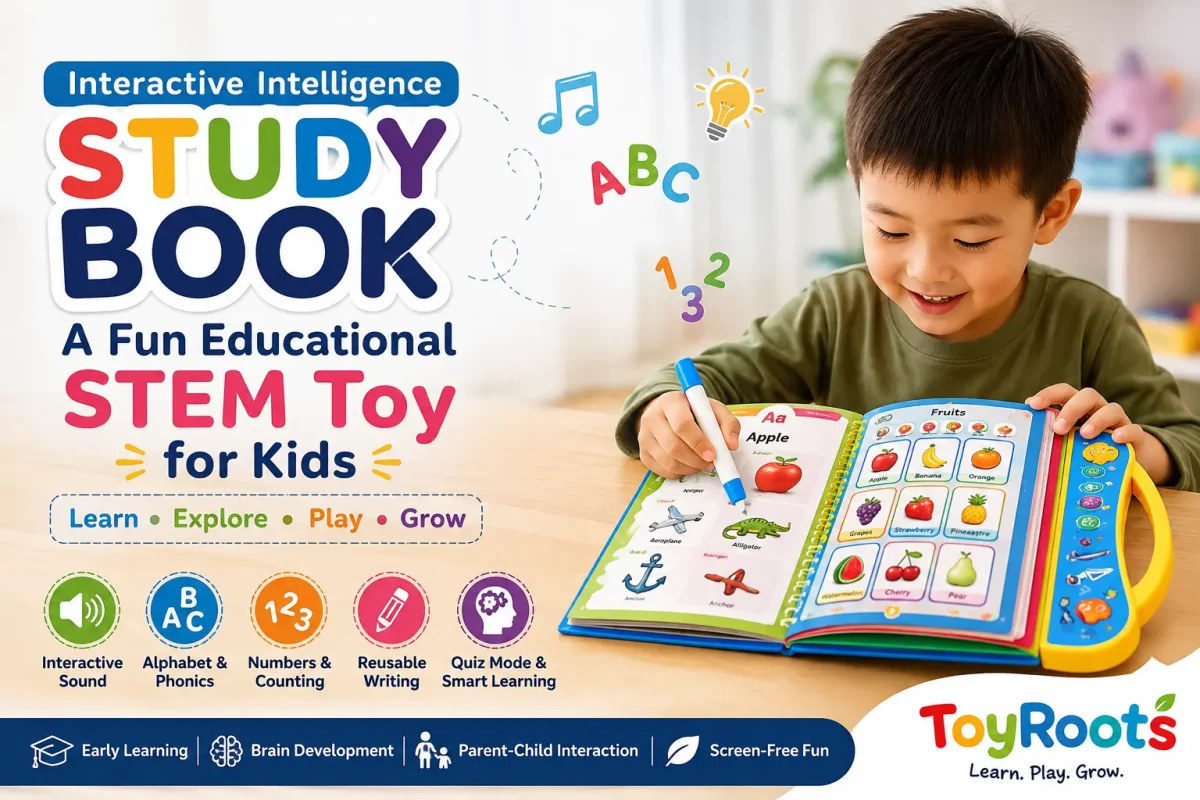
Interactive Intelligence Study Book: A Fun Educational STEM Toy for Kids

In today’s digital world, parents are constantly looking for ways to make learning more interesting without relying too heavily on screens. Children naturally learn through touching, listening, observing, asking questions, and trying things for themselves. That is why interactive educational toys can be such a valuable addition to everyday play.

The Interactive Intelligence Study Book combines early learning activities with interactive sound, writing practice, quizzes, colourful illustrations, and hands-on exploration. Instead of simply reading a book, children can interact with different learning activities and discover letters, numbers, animals, vehicles, colours, shapes, fruits, and more.

For parents searching for an educational STEM toy for kids that can combine learning and play, this interactive study book offers a practical screen-free learning option.

An Interactive Intelligence Study Book is a hands-on learning toy designed to introduce children to important early-learning concepts through interactive activities. It combines a learning book format with an electronic sound panel, writing practice, and quiz-style activities.

The goal is simple: make learning feel more like play.

Children can explore different pages, listen to sounds and pronunciations, practise writing and tracing, answer interactive questions, and learn about familiar objects and concepts. This type of active participation can make learning more engaging than passive observation.

Children are naturally curious. When they can touch something, hear a response, make a choice, and immediately see what happens, they become active participants in the learning process.

Interactive toys can encourage children to:

  • Explore new concepts independently
  • Practise recognition and recall
  • Develop hand-eye coordination
  • Strengthen early vocabulary
  • Improve concentration and observation
  • Practise letters, numbers, shapes, colours, and other basic concepts
  • Build confidence through repeated practice

This approach fits naturally with the idea of learning through play, where children develop skills while enjoying an activity rather than feeling as though they are completing formal schoolwork. Parents can also explore ToyRoots’ guide to educational toys for kids in Pakistan for more age-appropriate ideas.

1. Interactive Sound Panel

One of the most engaging features of the study book is its interactive sound functionality. Children can interact with different learning areas and hear pronunciations, phonetic sounds, and other audio effects.

This creates a multi-sensory learning experience where children can see and hear information at the same time.

2. Alphabet Learning

Early alphabet recognition is an important part of language development. The book introduces children to A–Z through colourful illustrations and interactive learning.

Parents can use the alphabet pages to practise letter recognition, pronunciation, and simple vocabulary with their children. For another hands-on option, explore the educational puzzles collection, which includes alphabet and phonics learning puzzles.

3. Numbers and Early Learning Concepts

The study book also introduces numbers and other basic concepts that children encounter during their early learning years.

Instead of memorising information from a traditional worksheet, children can interact with the pages and practise recognition in a more playful environment. Parents looking for additional hands-on maths activities can also explore ToyRoots’ counting and number learning toys.

4. Animals and Vehicles

Children are naturally fascinated by animals and vehicles. Familiar subjects can make learning more engaging and give parents an easy way to start conversations.

For example, parents can ask questions such as:

  • Which animal is this?
  • What sound does it make?
  • Which vehicle travels on the road?
  • Can you find the red vehicle?

Simple questions like these turn a toy into an opportunity for parent-child interaction.

5. Fruits, Colours and Shapes

The study book introduces familiar objects such as fruits while also helping children explore colours and shapes.

Parents can make these activities even more useful by connecting them with everyday life. For example, after learning a fruit from the book, parents can ask children to identify the same fruit at home or at the grocery store.

For more hands-on shape and colour activities, parents can also explore ToyRoots’ educational puzzle collection, which includes shape-matching and sorting activities.

6. Reusable Writing and Tracing Practice

Writing practice is another useful part of the book. The reusable writing surface allows children to practise letters, drawing, and tracing and then use the surface again.

Repeated practice can help children become more comfortable with basic writing movements while developing fine motor control and hand-eye coordination.

7. Quiz Mode

Learning becomes more engaging when children get the opportunity to test what they remember.

The interactive quiz mode turns learning into a simple game-like activity. Children can use what they have learned to identify answers and practise recall.

Quiz-based play can also give parents a simple way to observe which concepts their child understands and which areas may need more practice. For children who enjoy puzzles and challenges, the educational puzzles and logic toys at ToyRoots can provide additional problem-solving practice.

A good educational toy should do more than keep a child busy. It should encourage children to think, explore, practise, and interact.

The Interactive Intelligence Study Book can support several areas of early development through hands-on learning.

Language and Vocabulary Development

Alphabet activities, phonetic sounds, objects, animals, fruits, and everyday vocabulary give children opportunities to hear and recognise new words.

Parents can make this even more effective by repeating words, asking questions, and encouraging children to use new vocabulary in everyday conversations.

Fine Motor Skills

Touching interactive areas, holding the stylus or marker, tracing letters, and drawing all involve controlled hand movements.

These activities can provide useful practice for children who are developing the coordination needed for writing and other everyday tasks. For more hands-on activities, see ToyRoots’ educational toys for 2 year olds, including puzzles, stacking and sorting toys.

Memory and Recall

Interactive quizzes and repeated exposure to letters, numbers, colours, shapes, and objects can encourage children to remember and recall information.

Parents can strengthen this learning by asking children to remember information after closing the book.

Observation and Problem-Solving

Interactive questions encourage children to look carefully, compare information, and choose answers. These simple activities can help introduce early problem-solving habits.

If you are interested in toys that encourage deeper thinking, you can also read our guide on how to choose toys that actually help brain development. You can also browse ToyRoots’ educational puzzles for additional logic and problem-solving activities.

STEM stands for Science, Technology, Engineering, and Mathematics. STEM learning is not limited to advanced robotics or complex science kits. Early STEM education can begin with simple activities that encourage logic, observation, patterns, reasoning, and problem-solving.

The Interactive Intelligence Study Book introduces some of these foundational skills through interactive learning, recognition activities, quizzes, numbers, shapes, and structured exploration.

For parents interested in introducing STEM concepts through play, ToyRoots also has a dedicated collection of STEM toys for kids.

You can also learn more about the role of STEM play in our article Why STEM Toys Are Essential for Every Child’s Future and explore our guide to choosing STEM toys for kids in Pakistan.

Traditional books remain valuable, but interactive learning toys can provide an additional way for children to engage with educational concepts.

Traditional Learning BookInteractive Study Book
Primarily visual learningCombines visual and interactive elements
Child reads or looks at informationChild can touch, listen, practise, and respond
Usually requires additional activitiesIncludes built-in activities and quiz-style learning
Writing practice may require separate materialsIncludes reusable writing and tracing practice
Parent creates activities manuallyProvides structured activities for parent-child learning

The best approach does not have to be choosing one over the other. Traditional books, educational toys, creative activities, and parent interaction can all work together to create a richer learning environment. Parents can explore more ideas in ToyRoots’ guide to educational toys and learning through play.

Parents do not need to turn playtime into a formal lesson. A few simple habits can make interactive learning more meaningful.

  1. Start with short sessions: Let your child explore a few pages at a time.
  2. Ask questions: Ask your child what they see, hear, or remember.
  3. Repeat important concepts: Repetition can help children become familiar with new information.
  4. Connect learning with real life: If the book introduces colours, shapes, fruits, or animals, look for the same things around the house or outside.
  5. Allow independent exploration: Give children time to discover features without immediately providing every answer.
  6. Join them: Parent-child interaction can make learning more enjoyable and create opportunities for conversation.

Many parents are looking for alternatives to phones and tablets that can still keep children interested. An interactive learning book provides sounds, activities, questions, and visual content without requiring a smartphone or tablet.

It can therefore be included as one option in a broader screen-free play routine.

However, the goal should not be to replace every form of entertainment with an educational activity. Children benefit from a balanced childhood that includes free play, outdoor activities, books, creative activities, family interaction, and age-appropriate educational toys.

For more ideas, read our guide on ways to reduce screen time for kids in Pakistan.

The Interactive Intelligence Study Book is designed for young learners who are beginning to explore letters, numbers, vocabulary, shapes, colours, and other early-learning concepts.

It can be particularly useful for parents looking for:

  • An interactive educational toy
  • A screen-free learning activity
  • An early-learning book with sound
  • A phonics and vocabulary learning aid
  • A reusable writing and tracing activity
  • A Montessori-inspired learning experience
  • An introductory STEM learning toy
  • A parent-child learning activity

Always consider your child’s individual age, abilities, interests, and learning stage when choosing an educational toy. Parents can also browse ToyRoots’ educational toys for 2 year olds or explore the wider educational toys collection to find options suited to different learning stages.

There is nothing wrong with toys that are simply fun. Play itself is valuable. However, educational toys can add another dimension by giving children opportunities to practise specific skills while they play.

As we discuss in our article Why Educational Toys Are Important for Children’s Development, well-designed educational toys can encourage problem-solving, creativity, motor development, and early learning.

The key is to choose toys that encourage children to actively participate rather than simply watch or receive automatic entertainment. You can also read Why β€œBoring” Toys Are Actually Better for Your Child’s Brain for another perspective on simple, hands-on play.

Product TypeInteractive Educational Learning Book
Learning AreasAlphabet, numbers, animals, vehicles, fruits, colours, shapes and nursery rhymes
Interactive FeaturesSound panel and quiz activities
Writing PracticeReusable writing and tracing surface
Learning StyleHands-on, interactive and multi-sensory
Parent InvolvementSupports parent-child interaction
Suitable CategoryEducational, STEM and Montessori-inspired learning

Final Thoughts

The Interactive Intelligence Study Book brings together several important elements of early learning in one hands-on activity. Children can explore letters, numbers, animals, vehicles, colours, shapes, and other concepts while listening to sounds, practising writing, and answering interactive questions.

For parents, one of its biggest advantages is that it can turn ordinary playtime into an opportunity for conversation, exploration, and practice. Instead of simply giving children information, parents can use the book as a starting point for asking questions and connecting learning with the real world.

If you are searching for an educational STEM toy in Pakistan that combines interactive learning, writing practice, quizzes, and parent-child engagement, the Interactive Intelligence Study Book is worth considering.

Ready to make learning more interactive?

Shop the Interactive Intelligence Study Book at ToyRoots β†’

What is the Interactive Intelligence Study Book?

It is an interactive educational learning book that combines sound-based activities, early-learning concepts, writing practice, and quizzes to make learning more engaging for children.

What can children learn from the study book?

The book covers topics including the alphabet, numbers, animals, vehicles, fruits, colours, shapes, and nursery rhymes, along with writing and interactive quiz activities.

Does the study book help with screen-free learning?

Yes. It provides interactive sounds and learning activities without requiring a smartphone, tablet, or computer, making it one option for screen-free educational play.

Can parents use the study book with their children?

Yes. Parent-child interaction is one of the intended uses. Parents can ask questions, repeat words, practise letters, and connect activities in the book with objects children see in everyday life.

Is the Interactive Intelligence Study Book a STEM toy?

It is positioned by ToyRoots as an educational, STEM, and Montessori-inspired toy. Its interactive activities introduce foundational skills such as recognition, reasoning, observation, numbers, patterns, and problem-solving. Parents can explore more options in the STEM toys collection.

Where can I buy the Interactive Intelligence Study Book in Pakistan?

You can view the product details and purchase the Interactive Intelligence Study Book directly from ToyRoots.

12-in-1 Magnet Science STEM Kit for Kids Ages 8+

12-in-1 Magnet Science STEM Kit for Kids: 12 Fun Magnetic Experiments for Young Scientists

What happens when a magnet makes a boat move without an engine? Can magnets make a car roll, lift objects, or create surprising movements? With the right hands-on activity, science can become much more than something children read about in a textbook.

The 12-in-1 Magnet Science STEM Kit for Kids (Ages 8+) gives children an opportunity to explore the fascinating world of magnets through hands-on experiments and activities.

Instead of simply learning that magnets attract or repel certain objects, children can experiment, observe what happens, make predictions, and discover basic scientific principles through play.

For parents looking for an engaging STEM toy for kids, a magnet science kit can be an exciting way to introduce children to science, experimentation, problem-solving, and logical thinking.

The 12-in-1 Magnet Science STEM Kit is a hands-on science learning kit designed for children aged 8 years and above.

The kit focuses on magnetic experiments and demonstrations that allow children to explore different ways magnets can interact with objects.

The activities included with the kit cover a variety of magnetic concepts and experiment ideas, including:

  • UFO-style magnetic experiments
  • Maglev experiments
  • Magnetic boat
  • Magnetic compass
  • Maglev lunar rover
  • Magnetic car
  • Magnetic spring
  • Magnetic balance
  • Magnetic robot
  • Magnetic fishing
  • Anti-gravity maglev
  • Magnetic attraction

This variety makes the kit more than a single experiment. Children can try different activities and compare the results, making it a useful introduction to experimental learning.

Magnets are particularly interesting for children because their effects can sometimes seem almost magical.

A child can see two magnets push away from each other or watch an object move because of magnetic force. This creates a natural opportunity to ask questions.

Why did it move?

Why did it stop?

Why did the magnets repel each other?

What happens if we change the position?

These questions encourage children to think like young scientists.

1. Encourages Curiosity

Children naturally want to understand things they cannot immediately explain.

Magnetic experiments provide visible results, which can encourage children to investigate further.

Instead of simply being told how magnets work, children can observe the effect themselves.

2. Introduces Scientific Thinking

Science is not only about memorizing facts. It is also about observing, predicting, testing and learning from results.

A simple magnet experiment can introduce children to this process:

Question β†’ Prediction β†’ Experiment β†’ Observation β†’ Result

This is one of the reasons hands-on STEM toys can be valuable for growing learners.

3. Develops Problem-Solving Skills

Some activities require children to figure out how different components should be positioned or how magnetic forces affect movement.

If the experiment does not work the first time, children have an opportunity to change their approach and try again.

This encourages persistence and problem-solving.

4. Supports Logical Thinking

Magnetic experiments can help children understand relationships between actions and results.

For example, changing the position of a magnet may change how another object moves. This encourages children to think about cause and effect.

5. Makes Science More Engaging

Science can sometimes feel abstract when children only encounter concepts in books.

A hands-on experiment makes the concept visible. Children can touch the materials, perform the activity and see what happens in front of them.

One of the most interesting features of this kit is its variety of magnetic activities. Let’s look at the types of experiments children can explore.

1. Magnetic UFO

The UFO activity introduces children to the unusual movement that can be created using magnetic forces.

It is a fun way to get children interested in the idea that magnets can influence objects without ordinary physical contact.

2. Maglev Experiment

Maglev stands for magnetic levitation.

The concept involves using magnetic forces to create movement or reduce physical contact between components.

For an 8+ learner, a simple model can provide an exciting introduction to a concept used in real-world transportation technology.

3. Magnetic Boat

The magnetic boat experiment demonstrates how magnetic force can be used to create movement.

Children can observe the interaction and think about how changing the position of the magnet affects the boat.

4. Magnetic Compass

A compass is one of the most familiar examples of magnetism in everyday life.

Exploring a magnetic compass can help children connect the activity to navigation and the Earth’s magnetic field.

5. Maglev Lunar Rover

This activity combines the excitement of space exploration with magnetic experimentation.

A lunar rover theme can make the experiment more imaginative while introducing children to ideas around movement, engineering and exploration.

6. Magnetic Car

Children generally enjoy anything involving cars.

A magnetic car experiment turns that interest into a science activity where they can observe how magnets influence movement.

It can also encourage children to experiment with positioning and direction.

7. Magnetic Spring

The magnetic spring activity provides another way to explore magnetic forces.

Children can observe how magnets interact and how their positioning affects the movement of the components.

8. Magnetic Balance

The magnetic balance experiment introduces children to the idea that magnetic forces can influence balance and movement.

It provides an opportunity to observe what happens when magnetic forces interact with a physical setup.

9. Magnetic Robot

The robot-themed activity adds an element of creativity to science learning.

Combining a familiar technology-inspired concept with magnetism can make the activity particularly engaging for children interested in robots and machines.

10. Magnetic Fishing

Magnetic fishing is a simple but fun activity that demonstrates magnetic attraction.

Children can experiment with which objects are attracted to the magnet and which are not.

This is also an easy opportunity to introduce the concept that not every material is magnetic.

11. Anti-Gravity Maglev

The anti-gravity-style maglev activity demonstrates an effect that can look surprising to children.

While it is not literally creating anti-gravity, the magnetic interaction can create a levitation-like effect that makes the experiment exciting.

This is a great opportunity for parents to explain the difference between what something looks like and the scientific principle actually causing it.

12. Magnetic Attraction

The magnetic attraction experiment demonstrates one of the fundamental properties of magnets.

Children can explore how magnets attract certain materials and observe the strength and direction of magnetic interaction.

The kit is designed around magnetic science, but the learning can go beyond magnets.

Through repeated experimentation, children can practice several important skills.

Science

Children can learn through observation and experimentation.

Engineering Thinking

Building and testing different setups encourages children to think about how components work together.

Problem-Solving

If something does not work as expected, children can try to identify the problem and change their approach.

Observation

Children need to pay attention to movement, direction, attraction and repulsion.

Logical Reasoning

They can compare results and begin to understand relationships between actions and outcomes.

Creativity

Science experiments can also encourage children to ask, “What else can I try?”

STEM stands for:

  • Science
  • Technology
  • Engineering
  • Mathematics

STEM learning does not have to begin with complicated robotics or programming.

For an 8-year-old, exploring magnetic forces, building an experiment, observing movement and trying different solutions can be a meaningful introduction to STEM thinking.

This is one reason hands-on STEM toys for kids can be useful for parents who want children to learn while enjoying screen-free activities.

ToyRoots’ STEM toys collection includes science, construction, logic and educational products designed around hands-on learning.

A regular toy can provide entertainment, while a science kit can combine entertainment with experimentation.

That does not mean traditional toys are less valuable. Children need different types of play.

However, a science kit gives parents an opportunity to introduce structured activities where children can:

  1. Read or understand an activity.
  2. Set up the experiment.
  3. Make a prediction.
  4. Perform the experiment.
  5. Observe what happens.
  6. Think about the result.
  7. Try again or change something.

This process can make play more purposeful.

For children who enjoy building and experimenting, the Magnetic Construction Building Blocks Set can also provide an open-ended way to explore construction, spatial thinking and hands-on STEM concepts.

The set introduces children to building, geometry, magnetism and basic engineering concepts through hands-on play.

Many parents are looking for activities that can keep children engaged without depending on phones, tablets or television.

A science experiment provides an alternative because the child has to actively participate.

The 12-in-1 Magnet Science STEM Kit can turn an afternoon at home into a mini science session.

Parents can set aside some time, choose one experiment and allow the child to explore it at their own pace.

There is no need to complete all 12 activities in one sitting.

In fact, spreading the experiments over several sessions can make the kit more interesting because children have another activity to look forward to.

Parents do not need to be science experts to make STEM play more meaningful.

Simply asking questions can encourage deeper thinking.

Before an experiment, ask:

“What do you think will happen?”

During the experiment:

“Why do you think it moved?”

Afterwards:

“What would happen if we changed the position?”

You can also ask children to draw what they observed or explain the result in their own words.

This turns a simple activity into an opportunity for communication, reasoning and scientific thinking.

Start with One Experiment

Do not rush through all 12 activities. Choose one experiment and let your child understand what is happening.

Let Children Try

If an experiment does not work immediately, avoid solving everything for them.

Give them time to investigate.

Making mistakes is an important part of experimentation.

Ask Questions

Use open-ended questions instead of immediately giving answers.

This encourages children to think independently.

Connect Experiments to Real Life

Talk about where magnets are used in everyday life.

For example, children may encounter magnets in:

  • Compasses
  • Speakers
  • Motors
  • Magnetic closures
  • Toys
  • Certain tools
  • Electrical devices

This helps children understand that science is not limited to a toy kit.

Yes. The product is listed for ages 8 and above, making it suitable for children who are ready for more structured science and STEM activities.

At this age, children can often follow instructions, observe results and begin asking more detailed questions about why something happens.

However, parents should always supervise children according to the product instructions and keep small components away from younger children who may not be ready to use them safely.

A magnet science kit can be a thoughtful gift for children who enjoy:

  • Science
  • Experiments
  • Machines
  • Robots
  • Cars
  • Space
  • Building
  • Puzzles
  • Discovering how things work

It can also be a useful choice when parents want a gift that offers an activity rather than simply another passive entertainment toy.

For birthdays, educational gifts, school-holiday activities or a child who has recently become interested in science, this type of kit can provide plenty of opportunities for exploration.

The 12-in-1 Magnet Science STEM Kit may be a good choice for parents looking for:

A STEM Gift for Kids

It combines science experimentation with hands-on play.

A Science Toy for 8-Year-Olds+

The product is specifically listed for children aged 8 and above.

Screen-Free Learning Activities

The experiments require children to physically interact with the materials.

A Hands-On Educational Toy

Children can learn through observation rather than only reading about scientific concepts.

A Science Experiment Kit

The multiple magnetic activities provide variety instead of a single experiment.

Parents interested in other learning-focused products can also explore the Educational Toys collection at ToyRoots.

The main difference is the type of interaction.

A puzzle may challenge a child to find the correct solution.

Building blocks may encourage construction and creativity.

A magnet science kit adds another dimension: experimentation.

Children can make a prediction, change something and observe the outcome.

For children who enjoy logical challenges, the Magnetic Chess Board Game can also provide a screen-free activity focused on strategy, planning and logical thinking.

If your child enjoys hands-on science and problem-solving, there are several other types of educational toys that can complement a magnet science kit.

What age is the 12-in-1 Magnet Science STEM Kit for?

The kit is listed for children ages 8 and above.

What does the 12-in-1 Magnet Science Kit teach?

It introduces children to magnetic forces through hands-on activities involving attraction, movement, balance, magnetic levitation and other magnetic interactions.

Is this a STEM toy?

Yes. The product is part of ToyRoots’ STEM toys collection and is designed around hands-on science experimentation.

Is this science kit suitable as a gift?

Yes. It can be a good educational gift for children aged 8+ who enjoy science, experiments, building, machines, robots or discovering how things work.

Can parents do the experiments with their children?

Absolutely. Parent-child experimentation can make the activity more engaging and provides opportunities for children to ask questions and discuss what they observe.

Is the kit suitable for younger children?

The product is listed for ages 8+. Younger children should not use it unless the manufacturer/product guidance specifically allows it and appropriate adult supervision is provided.

How many experiments are included?

The product is presented as a 12-in-1 Magnet Science STEM Kit, with 12 different magnetic experiment and activity concepts.

The 12-in-1 Magnet Science STEM Kit for Kids (Ages 8+) offers children an exciting way to discover the science of magnetism through hands-on experimentation.

From magnetic cars and boats to compass activities, maglev concepts, magnetic balance and attraction experiments, the variety gives children multiple ways to explore how magnetic forces work.

More importantly, the kit encourages children to do something that is at the heart of scientific learning:

Ask a question, make a prediction, experiment, observe and learn.

For parents searching for a STEM toy for kids, a science experiment kit, or an engaging educational toy for 8-year-olds, this 12-in-1 magnet science kit can turn playtime into an opportunity to explore science in a fun and practical way.

Ready to Explore Magnet Science?

Give your young scientist the opportunity to experiment, discover and learn through hands-on play.

Shop the 12-in-1 Magnet Science STEM Kit

If you want to learn more about choosing educational and STEM toys for children, read our guide:

Best Educational Toys for Kids in Pakistan: Age-Wise Guide for Parents

You can also learn more about how educational toys support children’s development:

Why Educational Toys Are Important for Children’s Development

Explore More at ToyRoots

Explore STEM Toys Β  | Β  Explore Educational Toys Β  | Β  Shop Magnet Science STEM Kit

Preschool boy playing independently with magnetic building blocks

How to Encourage Independent Play in Preschoolers: A Parent’s Guide

β€œAmmi, come play with me.”

β€œAbu, look at this!”

β€œCan you help me?”

If you have a 3- to 5-year-old, you may hear these sentences many times throughout the day.

You love spending time with your child, but there are moments when you need to cook, work, clean, answer a phone call, or simply have a few quiet minutes. Yet as soon as you step away, your child may lose interest in their toys and immediately ask you to come back.

So how can you teach a preschooler to play independently?

The good news is that independent play is a skill children develop gradually. You don’t need to force your child to play alone, and you don’t need a room full of expensive toys.

With the right environment, realistic expectations, and age-appropriate activities, you can gradually help your child become more comfortable starting and continuing play without constant adult involvement.

Important: Independent play does not mean unsupervised play.

The goal is to help your child become confident enough to explore, create, and solve small problems while you remain aware of what they are doing and provide a safe environment.

What Is Independent Play?

Independent play is when a child chooses an activity, begins playing, makes decisions, explores possibilities, and continues for a period of time without an adult directing every step.

It does not necessarily mean that the parent is in another room.

You might be sitting nearby while your child builds something. You might be working at the same table. You may occasionally answer a question or look at what they have created.

The important difference is that the child is leading the play.

For example, there is a difference between:

β€œLet’s build a house. Put this piece here.”

and:

β€œHere’s your building set. What would you like to make?”

In the first situation, the adult is directing the activity.

In the second, the child has to decide what to do.

That decision-making is an important part of developing independent play.

Is Independent Play Safe for 3- to 5-Year-Olds?

Yes, age-appropriate independent play can be a healthy part of a preschooler’s routine, but independent play should not be confused with leaving a young child completely unsupervised.

For preschoolers, parents should create a safe play environment and remain aware of what their child is doing.

Think about it this way:
You don’t have to play with your child, but you should know what your child is playing with.

Before starting independent play, consider:

  • Is the toy appropriate for your child’s age and abilities?
  • Are there small pieces or other potential hazards?
  • Is the play area free from unsafe objects?
  • Does the activity require closer supervision?
  • Have you checked the manufacturer’s recommended age and safety instructions?
  • Does your child know how to use the toy safely?

For younger 3-year-olds especially, parents may want to remain closer and gradually give their child more space as they demonstrate that they can safely handle an activity.

For example, ToyRoots’ Magnetic Construction Building Blocks Set is listed for ages 3+, but younger children should still use age-appropriate supervision.

The goal isn’t:

β€œLeave my child alone.”

It is:

β€œLet my child take the lead while I provide a safe environment.”

This distinction allows children to develop independence while parents continue to provide the protection and reassurance they need.

Why Does My Child Always Want Me to Play?

There isn’t necessarily anything wrong.

Preschoolers naturally enjoy social interaction. They also look to parents for reassurance, ideas, encouragement, and connection.

Sometimes, however, children become dependent on adult involvement because they don’t know how to get started on their own.

Imagine giving a child a toy that has one obvious function.

They may finish the activity quickly and ask:

β€œWhat should I do now?”

Now compare that with a box of open-ended building pieces.

The child can make a house, tower, bridge, animal, road, spaceship, or something that exists entirely in their imagination.

The second type of activity gives the child something extremely valuable:

possibilities.

Open-ended toys can be particularly useful for independent play because the childβ€”not the toy or the parentβ€”decides what happens next.

Parents looking for more hands-on learning options can also explore ToyRoots’ Montessori toys, which include self-directed, hands-on activities designed for toddlers and preschoolers.

Don’t Expect 30 Minutes of Independent Play Immediately

One of the biggest mistakes parents make is setting the goal too high.

If your child currently wants you involved every few minutes, don’t suddenly expect them to play independently for half an hour.

Start small.

Try 5–10 minutes of independent play while you remain nearby.

Once your child becomes comfortable with that amount of time, gradually increase it.

The objective isn’t to test how long your child can stay away from you.

It is to build confidence through repeated successful experiences.

Think of independent play like learning any other skill.

A child doesn’t learn it perfectly on the first attempt.

They practice.

They get bored.

They ask for help.

They try again.

And gradually, they become more capable.

1. Create a Simple β€œYes, You Can Play” Area

If every toy in the house is packed into one giant box, your child may actually find it harder to choose something.

Instead, create a small play area with a limited number of activities.

You might keep:

You don’t need dozens of toys available at once.

In fact, too many choices can make it harder for a preschooler to decide where to start.

A smaller selection makes the decision easier:

β€œWhat do I want to do?”

It also makes toy rotation easier. When your child starts losing interest, replace one or two activities instead of bringing out ten new toys.

For more ideas, parents can browse ToyRoots’ educational toys collection for hands-on learning activities.

2. Choose Toys That Don’t Need You to Operate Them

This is where the type of toy matters.

A toy can be educational and still encourage dependence on an adult if the parent has to constantly explain what to do next.

For independent play, look for activities that allow your child to:

  • Build
  • Sort
  • Match
  • Create
  • Experiment
  • Solve
  • Repeat
  • Change their approach
  • Start again after making a mistake

For example, the Magnetic Construction Building Blocks Set provides pieces that can be combined in many different ways.

There isn’t one required finished product.

A child can begin with a simple tower and later discover how to make houses, geometric structures, bridges, or imaginative creations.

That open-ended nature gives children room to make their own decisions.

The important part isn’t simply the toy.

It’s the freedom to decide what to do with it.

3. Don’t Show Your Child What to Make Too Quickly

This can be surprisingly difficult for parents.

Your child starts building something.

You immediately say:

β€œLet’s make a house!”

Or:

β€œWhy don’t you make a tower?”

Or:

β€œPut this piece here.”

You’re trying to helpβ€”but you may accidentally be taking control of the play.

Instead, pause.

Watch what your child does.

If they ask for help, try asking a question before immediately solving the problem.

Instead of:

β€œPut this piece here.”

Try:

β€œWhat do you think would make it stronger?”

Instead of:

β€œThat’s a car.”

Try:

β€œTell me about what you made.”

This keeps your child in charge while still giving them encouragement.

4. Use a β€œStart Together, Finish Independently” Routine

You don’t have to disappear when independent play begins.

In fact, starting together can make the transition much easier.

Try this simple routine.

First 2–3 minutes: Start together

Sit with your child.

Help them choose the activity and get started.

Next few minutes: Step back

Let your child take over.

You can say:

β€œI’m going to sit here and work while you continue building.”

If your child calls you

Don’t automatically return to playing.

First, acknowledge them:

β€œI can see you’re working on something.”

Then encourage them:

β€œWhat are you going to try next?”

When they finish

Give genuine attention to what they accomplished.

This teaches an important lesson:

β€œI can play independently, and my parent is still available when I need them.”

That is much more reassuring than simply walking away.

5. Give Your Child Small Challenges

Independent play becomes easier when a child has a reason to continue.

Instead of giving instructions for the entire activity, give your child a small challenge.

For example:

Building challenge:
β€œCan you build a tower that doesn’t fall?”

Sorting challenge:
β€œCan you find all the red pieces?”

Counting challenge:
β€œHow many can you count?”

Puzzle challenge:
β€œCan you figure out which piece goes here?”

Then step back.

The challenge creates a starting point, while your child decides how to solve it.

For preschoolers, simple logic and construction activities can naturally create small problems that children can attempt to solve themselves.

The key is to give them a challengeβ€”not a complete set of instructions.

For additional puzzle-based activities, you can explore ToyRoots’ educational puzzles for kids.

6. Let Boredom Happen

This may be one of the hardest parts for parents.

Your child says:

β€œI’m bored.”

Your instinct may be to immediately find something for them to do.

But boredom isn’t always a problem that needs to be fixed.

There is a difference between:

β€œI have nothing to do.”

and:

β€œI haven’t figured out what I want to do yet.”

Give your child a little time before stepping in.

You can say:

β€œYou can choose something from your play shelf.”

Then wait.

At first, your child may complain.

Eventually, they may pick something up.

And that moment matters.

They have started solving their own problem.

7. Rotate Toys Instead of Constantly Buying More

If your child gets bored with toys quickly, buying more toys isn’t necessarily the answer.

Try rotating them.

Keep some toys stored away and bring them back after a week or two.

A familiar toy can suddenly feel new when your child hasn’t seen it for several days.

This works particularly well with open-ended toys because the same materials can be used differently as a child’s skills develop.

A construction set that was previously used to make simple towers may later become a garage, bridge, house, or imaginary city.

The toy hasn’t changed.

The child has.

This is one reason versatility can be more valuable than simply having a large number of toys.

8. Use Quiet Activities When You Need Some Time

Independent play doesn’t always have to involve building.

Sometimes you need your child occupied while you’re preparing dinner, working, or handling something important.

That’s a good time for activities that naturally encourage concentration.

For example:

A Classic Wooden Abacus & 100 Counting Sticks Set can give preschoolers something concrete to manipulate while exploring counting, grouping, and early number concepts.

For parents specifically looking for hands-on number activities, ToyRoots also has a dedicated Counting & Number Learning Toys collection.

The objective isn’t to turn every quiet moment into a lesson.

Sometimes your child should simply be allowed to explore.

9. What If My Child Keeps Calling Me?

They probably will.

Especially in the beginning.

Instead of getting frustrated, create a predictable response.

You can use a simple rule:

β€œTry it yourself first, then ask me.”

If your child asks:

β€œCan you build this?”

Try:

β€œHave a try first. I’ll look when you’re done.”

If they genuinely cannot solve something, helpβ€”but avoid doing the entire task for them.

The goal isn’t to refuse your child.

The goal is to slowly change your role from playmate to supporter.

Independent Play Doesn’t Mean Less Connection

This is important.

Some parents worry that encouraging independent play means spending less time with their children.

It doesn’t.

Your child still needs affection, conversation, shared activities, reading, outdoor play, and family time.

Independent play simply gives your child another experience:

β€œI can enjoy myself even when Mum or Dad isn’t directing everything.”

It can help children practice confidence, persistence, creativity, decision-making, and problem-solving.

And it gives parents something valuable too:

a little breathing room.

What Should a Parent Do During Independent Play?

You don’t need to constantly watch your child.

But you also don’t need to completely disappear.

A useful approach is awareness without constant intervention.

You can:

  • Stay within reasonable reach when appropriate.
  • Know which activity your child is using.
  • Check in occasionally.
  • Let your child attempt small challenges independently.
  • Step in when something becomes unsafe.
  • Offer help when your child genuinely needs it.
  • Avoid directing every step.

The more capable your child becomes, the more freedom you can gradually give them.

Independent play should grow alongside your child’s confidence and ability.

A Simple Independent-Play Routine for Preschoolers

You don’t need a complicated schedule.

Try something like this:

5 minutes: Play together and introduce the activity.

10 minutes: Let your child continue independently while you remain nearby.

5 minutes: Check in and talk about what they created.

Then repeat the process when appropriate.

As your child becomes more comfortable, gradually increase the independent portion.

Some days will work better than others.

That’s completely normal.

A tired, hungry, overstimulated, or upset child may need more connection than usual.

Independent play isn’t a performance that your child has to succeed at every day.

What If My 3-Year-Old, 4-Year-Old, or 5-Year-Old Plays Differently?

Every child develops at a different pace.

A 3-year-old may need more frequent reassurance and shorter periods of independent play.

A 4-year-old may be ready to spend longer periods exploring a familiar activity.

A 5-year-old may be able to create more complicated games, constructions, or imaginative scenarios independently.

These are general patterns, not strict rules.

Instead of asking:

β€œHow long should a preschooler play independently?”

ask:

β€œIs my child becoming more comfortable starting and continuing play without constant direction?”

Progress matters more than a specific number of minutes.

The Goal Isn’t to Keep Your Child Busy

This is the biggest idea to take away.

Independent play isn’t about finding the magical toy that keeps your child occupied for an hour.

It is about helping children develop the ability to start, explore, make decisions, solve small problems, and continue without constant adult direction.

The best toys can support this process, but your approach matters just as much.

Give your child fewer instructions.

Give them more opportunities.

Let them work through small, age-appropriate challenges.

Allow them to make something β€œwrong.”

Allow them to become bored.

And give them enough time to discover:

β€œI can figure something out myself.”

That confidence is far more valuable than simply keeping a child busy.

Frequently Asked Questions About Independent Play

Is independent play good for preschoolers?

Yes. Age-appropriate independent play gives preschoolers opportunities to make choices, explore, create, solve small problems, and practice continuing an activity without constant adult direction.

Should a 3-year-old play independently?

A 3-year-old can practice independent play for short periods, particularly with familiar, age-appropriate activities in a safe environment. Younger preschoolers may need more frequent check-ins and closer parental awareness.

Does independent play mean leaving my child alone?

No. Independent play means the child leads the activity rather than an adult directing every step. Parents should still provide a safe environment and remain appropriately aware of what the child is doing.

How long should a preschooler play independently?

There is no single correct amount of time. Start with short periods, such as 5–10 minutes, and gradually increase them as your child becomes comfortable. Some children will naturally manage longer periods than others.

What toys are best for independent play?

Look for age-appropriate toys that allow children to build, create, sort, solve problems, experiment, and use their imagination without requiring an adult to provide constant instructions. Open-ended construction toys, educational puzzles, stacking activities, and counting materials can be useful options.

What should I do if my child says, β€œI’m bored”?

Don’t feel that you have to immediately solve the problem. Give your child a small selection of activities and some time to decide what to do. Boredom can sometimes be the starting point for creativity and self-directed play.

Should parents play with their children at all?

Absolutely. Independent play should complementβ€”not replaceβ€”shared play and meaningful interaction with parents. Children benefit from both experiences: playing with others and learning to explore independently.

Final Thoughts

Helping a preschooler develop independent play isn’t about getting your child to need you less.

It’s about helping your child become more confident in what they can do for themselves.
Start small.

Create a safe and simple play environment. Choose activities that your child can lead. Start an activity together and gradually step back. Resist the temptation to solve every little problem. Let your child experience small amounts of boredom and frustration while remaining available when they genuinely need help.

Remember:

Independent play is not unsupervised play.

For children aged 3–5, independence should grow gradually alongside their abilities, while parents continue to provide a safe environment and appropriate awareness.

You don’t need a room full of expensive toys.

A few purposeful, age-appropriate activities can be enough.

At ToyRoots, we believe in learning through playβ€”giving children opportunities to build, explore, think, create, and solve problems rather than simply keeping them entertained.

Because the ultimate goal isn’t simply to keep your child busy.

It’s to help them discover what they can do on their own.

Explore Educational Toys at ToyRoots   |   Explore Montessori Toys   |   Browse Educational Puzzles

Alt Text: Toddler playing with shape sorting toys to learn colors and shapes

How Shape Sorting Toys Help Toddlers Learn Colors, Shapes & Problem-Solving

Toddlers learn best when they can touch, move, explore, and try things for themselves. A simple shape sorting toy may look like a basic activity, but for a young child, it can become a hands-on learning experience.
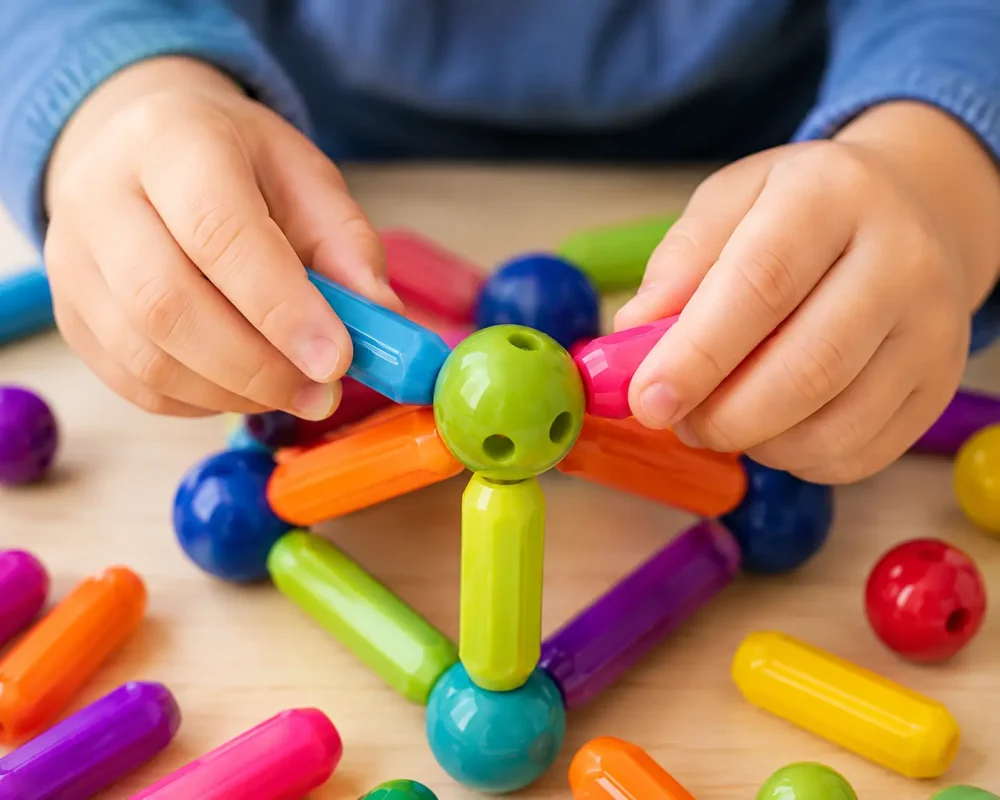
Shape sorters encourage children to recognize different shapes and colors, understand how objects fit together, and keep trying when something does not work the first time. This makes them a useful choice for parents looking for screen-free educational play at home.

At ToyRoots, shape and sorting toys are part of our collection of Montessori-inspired educational toys designed to make learning more interactive and enjoyable.

What Is a Shape Sorting Toy?

A shape sorting toy usually contains different pieces that a child needs to match with the correct opening, slot, or space.

For example, a child may have to find where a circle, triangle, square, star, or other shape belongs.

The activity looks simple, but the child is constantly observing, comparing, testing, and making decisions.

1. Shape Sorters Help Children Recognize Shapes

One of the first concepts children can explore with a sorting toy is shape recognition.

When toddlers repeatedly handle different pieces, they begin noticing that shapes are different from one another.

They may learn to recognize:

Toddler matching circle square triangle and star shapes with a wooden sorting toy
A toddler matches circle, square, triangle, and star shapes while learning through hands-on play.

Repeated hands-on practice can make these concepts easier to understand than simply seeing pictures of shapes in a book.

2. They Introduce Color Recognition

Many color sorting toys combine shapes with different colors.

This gives parents an easy opportunity to introduce simple concepts such as:

β€œCan you find the red piece?”

or

β€œWhich one is blue?”

As children become more comfortable, parents can make the activity more challenging by asking them to match both characteristics:

β€œCan you find the red circle?”

This turns ordinary play into a small learning activity.

Toddler sorting colorful shapes by color with a wooden shape sorting toy
Color sorting helps toddlers learn colors and shapes through hands-on play.

3. Shape Sorting Encourages Problem-Solving

A toddler may pick up a piece and try to put it into the wrong opening.

It doesn’t fit.

Instead of giving up immediately, the child has an opportunity to try another position or another opening.

That process is important.

The child is learning:

Try β†’ Observe β†’ Change β†’ Try Again

This is an early form of problem-solving.

Toddler trying different shapes in a wooden sorting toy to solve a problem
A toddler practices problem-solving by trying different shapes and finding the correct match.

A sorting toy does not simply give children an answer. It gives them an opportunity to discover the answer themselves.
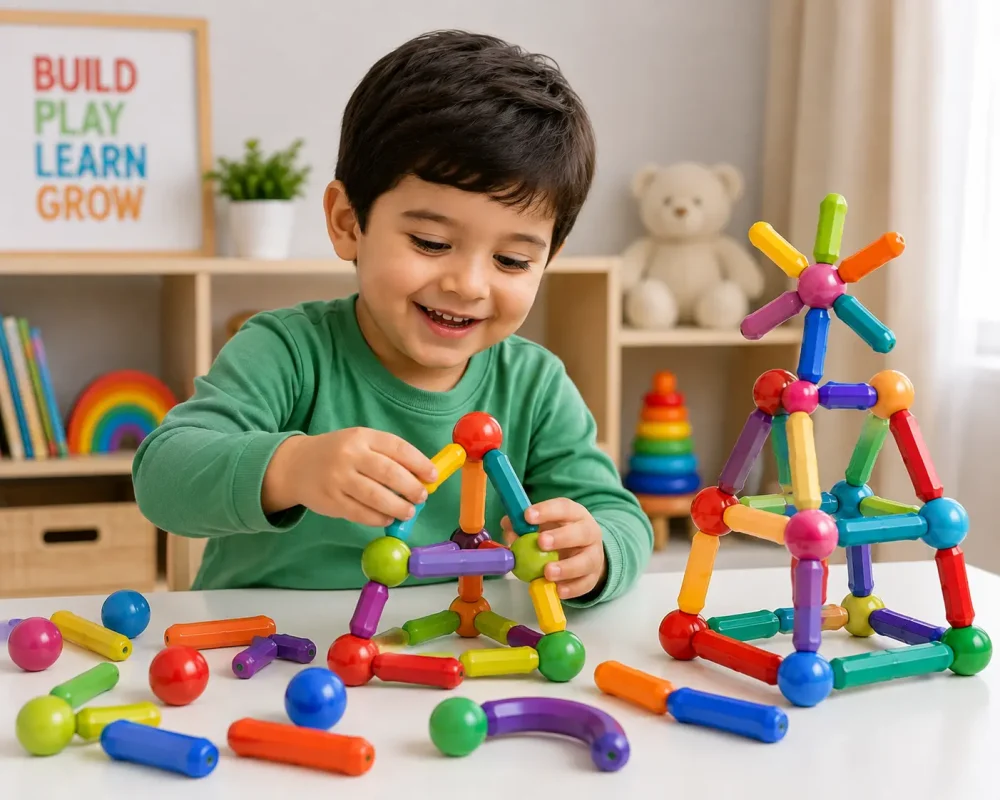
4. It Builds Hand-Eye Coordination

Children need to control their hands while looking at the position of the object.

They may need to:

  • Pick up a piece
  • Rotate it
  • Move it toward an opening
  • Adjust its position
  • Place it correctly

These small movements require coordination between what the child sees and how the hands move.

With repeated play, children get more opportunities to practice these movements.

5. Shape Sorting Can Improve Fine Motor Skills

Holding, moving, rotating, and placing pieces requires controlled hand movements.

This makes shape sorting activities useful for practicing fine motor coordination during everyday play.

The activity is especially valuable because children are developing these skills while working toward a goal rather than simply repeating an exercise.

6. Children Learn Through Trial and Error

One of the best parts of a sorting toy is that mistakes are part of the activity.

A child may try the triangle in the square opening.

It doesn’t work.

The child tries again.

Eventually, they discover the correct match.

This teaches an important early lesson:

Making a mistake is not the end β€” try another way.

Parents can support this process without immediately solving the problem for the child.

Instead of saying, β€œThat piece goes there,” try asking:

β€œDoes it fit there?”

or

β€œCan you find another place for it?”

This allows the child to remain involved in the discovery process.

7. Sorting Toys Can Make Learning More Interactive

Young children can lose interest when learning becomes repetitive or passive.

Sorting changes the experience because children have something to physically do.

They can touch the pieces, compare them, move them around, and test different possibilities.

This is one reason hands-on Montessori-style activities are popular with parents who want learning to feel like play.

8. Parents Can Turn One Toy Into Many Activities

Five fun shape sorting activities for toddlers using colorful educational toys
Five simple shape sorting activities help toddlers learn colors, shapes, and sorting through play.

A sorting toy does not have to be used in only one way.

Once your child understands the basic activity, parents can introduce simple variations.

Activity 1: Find the Color

Place several pieces in front of your child and ask:

β€œCan you find the yellow one?”

Activity 2: Find the Shape

Ask:

β€œWhere is the circle?”

Activity 3: Sort by Color

Place different colored pieces together and ask your child to group similar colors.

Activity 4: Sort by Shape

Ask your child to put similar shapes together.

Activity 5: Shape Hunt

Look around the room and find objects that resemble the shapes in the toy.

For example:

  • A clock β†’ circle
  • A window β†’ square or rectangle
  • A book β†’ rectangle

This helps children connect the toy with the real world.

9. How Parents Can Make Sorting Play More Effective

Parents don’t need to turn playtime into a formal lesson.

Keep the activity simple and enjoyable.

Start with a small number of pieces and let your child explore.

If your child struggles, give a small hint rather than immediately completing the activity.

For example:

β€œTry turning the piece.”

This gives the child another opportunity to solve the problem independently.

As their confidence grows, gradually introduce more shapes, colors, or challenging combinations.

What Age Is Best for Shape Sorting Toys?

Wooden shape sorting toy with colorful circle square triangle and star pieces
A colorful wooden shape sorting toy helps toddlers learn shapes, colors, and matching through hands-on play.

The appropriate age depends on the individual toy and its design.

Parents choosing toys according to their child’s age can also explore our guide to educational toys by age.

For younger toddlers, simple and larger pieces are generally easier to handle. Older children can move toward more complex sorting and geometric activities.

Parents should always follow the age recommendation provided for the specific product and supervise young children during play.

Choosing the Right Shape Sorting Toy

When choosing a sorting toy, parents can consider:

βœ” Age suitability

Choose an activity that matches your child’s developmental stage.

βœ” Piece size

Younger children benefit from pieces that are easy to grasp and handle.

βœ” Number of shapes

Start with simple shapes before moving to more complex combinations.

βœ” Learning objective

Some toys focus mainly on shapes, while others combine shapes, colors, numbers, or logic.

βœ” Material and construction

For wooden toys, look for smooth surfaces and child-friendly construction.

ToyRoots focuses on Montessori and STEM-inspired educational toys, with categories covering areas such as shapes, counting, puzzles, and logical thinking.

Final Thoughts

A shape sorting toy may look simple, but it can provide many opportunities for a toddler to learn.

Through sorting, matching, rotating, and experimenting, children can explore:

  • Shape recognition
  • Color recognition
  • Problem-solving
  • Fine motor coordination
  • Hand-eye coordination
  • Concentration
  • Independent learning

Most importantly, children get to learn by doing.

Instead of simply telling a child what a circle or triangle is, a sorting activity allows them to discover the difference through their own hands and actions.

That is what makes purposeful play so powerful.

Explore Learning Through Play with ToyRoots

Looking for hands-on educational toys for your child?

Explore ToyRoots’ collection of Montessori, STEM, wooden puzzles, sorting toys, counting toys, and other learning-focused activities designed to make play more meaningful.

Best educational toys for kids aged 1 to 6 including Montessori toys, STEM toys, wooden puzzles, building blocks, and learning games by ToyRoots.

Best Educational Toys for 1 to 6 Year Old Kids in Pakistan

Choosing the right toy for your child is about much more than entertainment. During the first six years of life, children develop language, creativity, problem-solving abilities, motor skills, and confidence at an incredible pace. The toys they play with every day can make a meaningful difference in that journey.

At ToyRoots, we believe learning should always be fun. That’s why we carefully select educational toys inspired by Montessori and STEM learning principles, helping children explore, discover, and grow through play. Parents can also explore our Montessori toys and STEM toys collections for more hands-on learning options.


Unlike ordinary toys, educational toys encourage children to think, solve problems, and build important life skills.

Quality learning toys help children:

  • Improve hand-eye coordination
  • Build fine motor skills
  • Learn numbers, letters, and shapes
  • Develop creativity
  • Improve concentration
  • Encourage independent learning
  • Boost confidence through problem solving

Every play session becomes an opportunity to learn something new. For more ideas, see our guide on how to encourage independent play in preschoolers.


Educational Toys by Age

Educational toys for children aged 1 to 6 years
Choose educational toys according to your child’s age.

Ages 1–2 Years

At this age, children begin recognizing colors, shapes, and simple objects.

Recommended toys include:

These toys help improve coordination while introducing early learning concepts. Parents can also explore educational toys for babies under 1 year when choosing a first learning toy for younger children.


Ages 2–3 Years

Toddlers become curious about matching, counting, and identifying everyday objects.

Great choices include:

These activities strengthen memory and early math skills. You can also browse ToyRoots’ educational toys for 2 year olds for more age-appropriate options.


Ages 3–4 Years

Children begin solving simple challenges independently.

Recommended toys:

These toys encourage patience, critical thinking, and spatial awareness. For more ideas about shape-based learning, read our guide on how shape sorting toys help toddlers learn colors, shapes, and problem-solving.


Ages 4–6 Years

Children at this age enjoy building, experimenting, and creating.

Excellent options include:

These toys help prepare children for future learning in science, technology, engineering, and mathematics. You can also explore ToyRoots’ STEM toy collection for additional hands-on learning activities.


Why Parents Love Montessori Toys

Child learning independently with Montessori wooden toys

Montessori toys are designed to encourage independent exploration instead of passive entertainment.

They help children:

  • Learn at their own pace
  • Develop focus
  • Build confidence
  • Improve problem-solving skills
  • Become more independent

Many of ToyRoots’ wooden educational toys follow Montessori learning principles, making learning natural and enjoyable. Explore the full Montessori toys collection to find more options for toddlers and preschoolers.


Why Wooden Toys Are Still the Best Choice

Wooden educational toys including puzzles and stacking toys

Wooden toys remain popular because they are:

  • Durable
  • Safe for children
  • Environmentally friendly
  • Screen-free
  • Long-lasting

Unlike electronic toys, wooden toys encourage imagination and active participation. Parents looking for more hands-on options can explore ToyRoots’ collection of educational wooden puzzles.


STEM Toys Build Future Skills

Children playing with STEM educational building toys
STEM toys help children build creativity and problem-solving skills.

STEM (Science, Technology, Engineering, and Mathematics) toys introduce children to logical thinking through hands-on play.

Popular STEM toys include:

These activities teach children how to experiment, solve problems, and think creatively. For a closer look at one popular option, read how magnetic building blocks help kids learn and play.


Screen-Free Learning for Healthy Development

Modern children spend increasing amounts of time in front of screens.

Educational toys offer a healthier alternative by encouraging:

  • Creative play
  • Family interaction
  • Physical movement
  • Concentration
  • Imagination

Screen-free learning supports balanced development during early childhood. If you are travelling with young children, you can also explore our guide to the best travel toys for toddlers for screen-free activities on the go.


Choosing the Right Educational Toy

When selecting a toy, consider:

  • Your child’s age
  • Skill level
  • Interests
  • Safety
  • Learning goals

The best toy is one that keeps children engaged while helping them learn naturally. For more age-specific ideas, explore ToyRoots’ educational toys collection.


Why Choose ToyRoots?

Explore ToyRoots' collection of educational toys for every stage of learning.
Explore ToyRoots’ collection of educational toys for every stage of learning.

ToyRoots offers a carefully selected range of educational toys designed for children aged 1 to 6 years.

Our collections include:

Each product is chosen to support learning through fun and meaningful play. You can browse all educational toys at ToyRoots to find options suited to different ages and learning stages.


Final Thoughts

The early years of childhood lay the foundation for lifelong learning. Choosing educational toys helps children develop essential skills while enjoying every moment of play.

Whether your child loves puzzles, building blocks, counting games, or creative activities, educational toys can inspire curiosity, confidence, and a love of learning.

Explore ToyRoots’ educational toy collection and give your child the opportunity to learn through play every day.

Colorful Magnetic Building Blocks STEM toy helping children develop creativity, problem-solving, and fine motor skills.

Magnetic Building Blocks: A Fun Way for Kids to Learn and Play


Introduction

Every parent wants toys that are fun, safe, and educational. Magnetic Building Blocks are one of the best choices because they combine learning with creativity. These colorful magnetic rods and balls let children build different shapes, buildings, animals, and many other exciting designs.

Instead of spending hours on screens, kids can enjoy hands-on play that helps them learn new skills while having fun.

Young child playing with colorful Magnetic Building Blocks to improve creativity, STEM learning, and fine motor skills.

What Are Magnetic Building Blocks?

Magnetic Building Blocks are construction toys made with magnetic rods and balls that easily connect together. Children can build both simple and complex models using their imagination.

They can create:

  • Houses
  • Towers
  • Castles
  • Bridges
  • Cubes
  • Pyramids
  • Cars
  • Animals
  • Rockets
  • Many other creative designs

There is no right or wrong way to build, so children can create something new every time they play.

Close-up of colorful Magnetic Building Blocks with magnetic rods and balls connected to form creative geometric structures.

Benefits of Magnetic Building Blocks

1. Boosts Creativity

These building blocks encourage children to think creatively. They can design anything they imagine, making every play session unique and exciting.

Young child building a colorful castle with Magnetic Building Blocks to develop creativity, STEM skills, and problem-solving abilities.

2. Improves Problem-Solving Skills

Sometimes a design doesn’t work the first time. Kids learn to try different ideas until they find the best solution. This improves their logical thinking and confidence.

Young child carefully building a tall tower with colorful Magnetic Building Blocks to improve problem-solving, focus, and STEM skills.

3. Develops Fine Motor Skills

Connecting small magnetic pieces helps children strengthen their hands and fingers.

It also improves:

  • Hand-eye coordination
  • Finger control
  • Fine motor skills

These skills are important for writing, drawing, and everyday tasks.

Close-up of a child's hands connecting colorful Magnetic Building Blocks to improve fine motor skills and hand-eye coordination.

4. Supports STEM Learning

Magnetic Building Blocks introduce children to basic STEM concepts through play.

Kids learn about:

  • Shapes
  • Balance
  • Geometry
  • Engineering
  • Problem-solving

Learning becomes fun because children discover new ideas while building.

Two children building colorful geometric structures with Magnetic Building Blocks to develop STEM skills, creativity, and teamwork.
Two children work together to build colorful geometric structures using Magnetic Building Blocks, encouraging STEM learning, creativity, teamwork, and problem-solving skills.

Children building geometric structures.


5. Improves Focus and Patience

Building a tower or a large structure takes time. Children learn to stay focused and patient until they finish their creations.


6. Encourages Teamwork

These toys are great for playing with family or friends.

Children learn how to:

  • Share ideas
  • Work together
  • Communicate
  • Take turns

This helps improve their social skills.

Two children playing together with colorful magnetic building blocks, creating creative structures using magnetic rods and balls.
Two children working together to build colorful structures with magnetic building blocks, encouraging teamwork, creativity, and STEM learning.

Who Can Play with Magnetic Building Blocks?

Magnetic Building Blocks are ideal for children aged 3 years and above.

They are perfect for:

  • Preschool children
  • Kindergarten students
  • Elementary school kids
  • Montessori learning
  • Homeschool activities

Always choose a set that matches your child’s age.


Why Parents Love Magnetic Building Blocks

Parents choose these toys because they:

  • Reduce screen time
  • Keep children busy for hours
  • Encourage independent play
  • Support healthy brain development
  • Help children learn while having fun

It is a toy that grows with your child’s imagination.


What Can Kids Build?

With Magnetic Building Blocks, children can build almost anything they imagine.

Some popular ideas include:

  • Houses
  • Castles
  • Towers
  • Bridges
  • Ferris Wheels
  • Rockets
  • Cars
  • Animals
  • Flowers
  • Geometric shapes

Every new project helps children become more creative.

  • 🏠 House
  • 🏰 Castle
  • πŸš€ Rocket
  • πŸŒ‰ Bridge
  • πŸ”Ί Pyramid
  • 🧊 Cube
  • πŸš— Car
  • πŸ¦• Animal

Safe and Durable Design

Most high-quality Magnetic Building Block sets are made with child safety in mind.

They usually include:

  • Strong magnets
  • Smooth edges
  • Non-toxic materials
  • Durable plastic
  • Bright, colorful pieces

Always buy from a trusted brand to ensure safety and quality.

Close-up showing smooth edges and strong magnetic connections.


Tips for Choosing the Best Magnetic Building Blocks

Before buying, look for:

  • Strong magnets
  • High-quality materials
  • Safe, rounded edges
  • Plenty of pieces
  • Bright colors
  • Different shapes
  • Age-appropriate design

A larger set gives children more options to build and explore.


Why Every Child Should Have Magnetic Building Blocks

Magnetic Building Blocks are more than just toys. They help children develop important life skills while having fun.

They improve:

  • Creativity
  • Confidence
  • Problem-solving
  • Focus
  • Hand-eye coordination
  • Fine motor skills
  • STEM knowledge
  • Social skills

These are valuable skills that support learning both at home and in school.

Happy child proudly showing a completed Magnetic Building Blocks castle after creative STEM play.

Happy child proudly showing a completed magnetic building project.


Conclusion

Magnetic Building Blocks are a perfect combination of fun and education. They encourage children to build, explore, and learn through creative play. Whether your child wants to build a simple house or a colorful castle, these magnetic toys provide endless opportunities for imagination and discovery.

If you’re looking for an educational toy that keeps children engaged, supports early learning, and reduces screen time, Magnetic Building Blocks are an excellent choice.

Parent and child building colorful magnetic building blocks together in a bright playroom.

Parent and child building together and smiling.


FAQs

Are Magnetic Building Blocks safe for children?

Yes, high-quality magnetic building blocks are made with non-toxic materials and secure magnets. Always choose age-appropriate sets and supervise younger children.

What age are Magnetic Building Blocks suitable for?

Most sets are designed for children aged 3 years and older.

Do Magnetic Building Blocks help with learning?

Yes. They improve creativity, problem-solving, fine motor skills, hand-eye coordination, and introduce basic STEM concepts.

Can children play together?

Absolutely! These toys encourage teamwork, communication, and cooperative play with siblings or friends.