Uncategorized
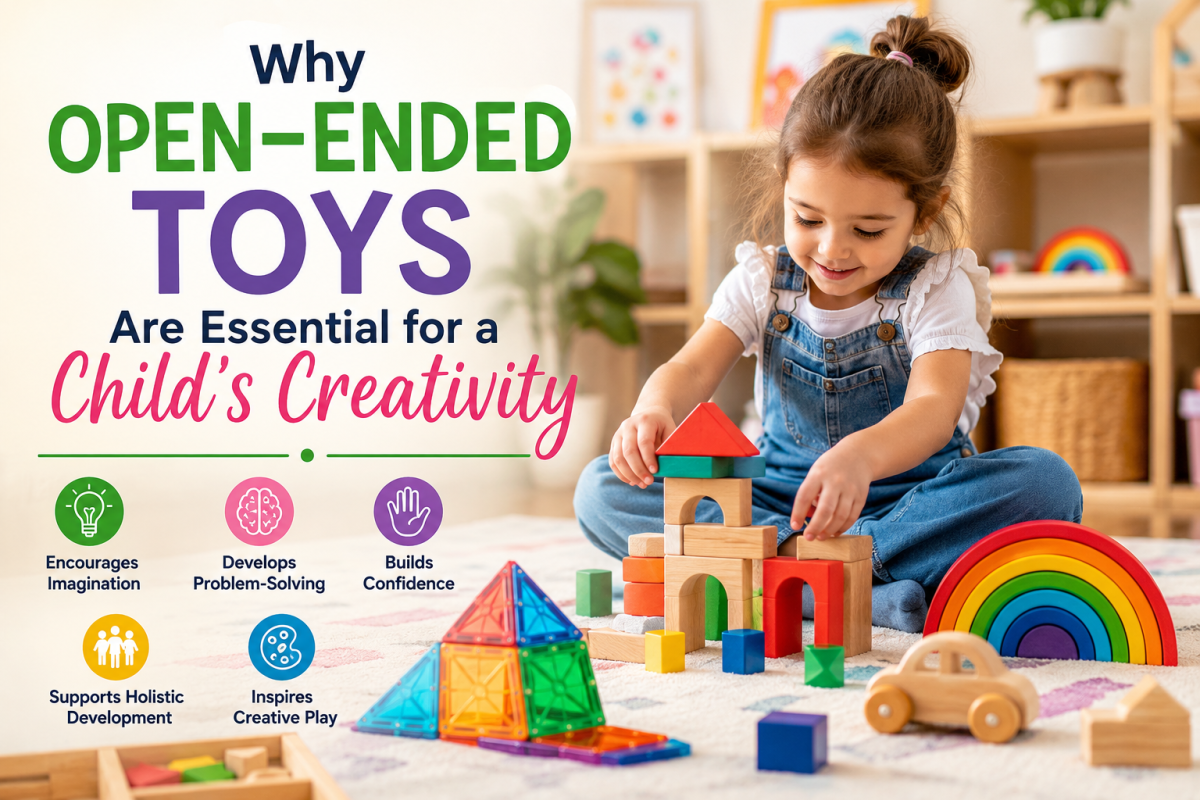
Why Open-Ended Toys Are Essential for a Child’s Creativity
🧸 What Are Open-Ended Toys?
Open-ended toys are toys that can be used in many different ways without a specific set of instructions or a single correct outcome. Unlike toys that perform a fixed function, open-ended toys allow children to decide how they want to play.
Examples of open-ended toys include:
- 🧱 Building blocks
- 🔷 Magnetic tiles
- 🪵 Wooden construction sets
- 🎭 Play silks and scarves
- 🧸 Pretend play accessories
- 🎨 Art and craft materials
Because there are no strict rules, children are free to use their imagination and create their own play experiences.
🎨 How Open-Ended Toys Encourage Creativity
🎭 Inspiring Imaginative Play
A simple set of blocks can become a castle, a spaceship, a bridge, or an entire city. Open-ended toys encourage children to imagine new possibilities and transform ordinary objects into something extraordinary.
This type of imaginative play helps children develop creative thinking skills that can benefit them throughout their lives.
🚀 Allowing Children to Take the Lead
With open-ended toys, children become the creators of their own play experiences. They make decisions, solve problems, and explore ideas without relying on instructions.
This freedom helps children develop confidence in their own abilities and encourages independent learning.
🔄 Supporting Multiple Solutions
Many traditional toys have one intended use, but open-ended toys can be used in countless ways. There is no single right answer, which teaches children that problems can often have multiple solutions.
This flexible thinking helps children become more adaptable and innovative when facing challenges.
🧩 Encouraging Experimentation
Creativity often develops through trial and error. Open-ended toys provide opportunities for children to test ideas, make changes, and try again.
Whether a tower falls over or a design doesn\'t work as planned, children learn valuable lessons about persistence and problem-solving.
Children often learn more from experimenting and making mistakes than from being given the correct answer immediately.
🌟 Additional Developmental Benefits
Beyond creativity, open-ended toys support many important areas of child development, including:
- ✔️ Problem-solving skills
- ✔️ Fine motor development
- ✔️ Communication skills
- ✔️ Social interaction
- ✔️ Emotional expression
- ✔️ Critical thinking
These toys grow with children, offering new challenges and learning opportunities at different stages of development.
✅ Choosing the Right Open-Ended Toys
When selecting open-ended toys, look for products that:
- ✨ Encourage imagination
- ✨ Can be used in multiple ways
- ✨ Are age-appropriate
- ✨ Promote active participation
- ✨ Support independent exploration
Simple toys often provide the greatest opportunities for creative play because they leave room for a child\'s imagination to take over.
👨👩👧 How Parents Can Encourage Creative Play
Parents can support creativity by providing a variety of open-ended materials and allowing children plenty of time for unstructured play.
💭 Try Asking:
❓ What are you building?
❓ What could you make next?
❓ How else could you use these pieces?
These questions encourage children to think more deeply and expand their ideas.
💡 Final Thoughts
Creativity is one of the most valuable skills a child can develop, and open-ended toys provide the perfect environment for creative growth. By allowing children to imagine, experiment, and explore without limits, these toys help build confidence, problem-solving abilities, and a lifelong love of learning.
At ToyRoots, we believe that the best toys are the ones that inspire children to create their own adventures, discover new possibilities, and learn through play every day.
