
No products in the cart.
Uncategorized
How to Teach Counting to Preschoolers Through Everyday Play
Teaching your child to count does not have to mean sitting at a table with worksheets or asking them to repeat numbers again and again. For preschoolers, counting can begin with everyday activities such as sharing snacks, putting toys away, climbing stairs, or helping set the table.
The key is to make numbers meaningful. When children connect number words with real objects, they get opportunities to explore how numbers relate to quantities.
For parents in Pakistan, this can be especially practical because many counting activities require little more than household items, toys, and a few minutes of shared play.
In this guide, you will discover simple ways to teach counting to preschoolers, activities for different learning stages, common mistakes to avoid, and ways to make early maths enjoyable at home.
Why Is Counting Important for Preschoolers?
Counting is one of the foundations of early mathematics. Before children can confidently work with more complex maths, they need opportunities to explore numbers, quantities, comparisons, and patterns.
For example, a child may learn to say “one, two, three, four, five” from memory. However, saying the number sequence is not the same as understanding how many objects there are.
Consider this example: your child counts five toy cars but skips one car while pointing. They may need more practice connecting each number word to one object.
Everyday counting games can help children practise:
- Number recognition: Becoming familiar with written numbers.
- One-to-one correspondence: Matching one number word to one object.
- Quantity awareness: Understanding that the last number counted tells us how many objects there are.
- Comparisons: Exploring which group has more, fewer, or the same number of objects.
- Problem-solving: Working out how many objects are needed or how to divide them fairly.
Children develop at different rates, so these skills should be encouraged through relaxed, age-appropriate experiences rather than pressure to master them by a particular date.
1. Start with Small Numbers
If your child is new to counting, begin with a small group of objects instead of asking them to count everything in the room.
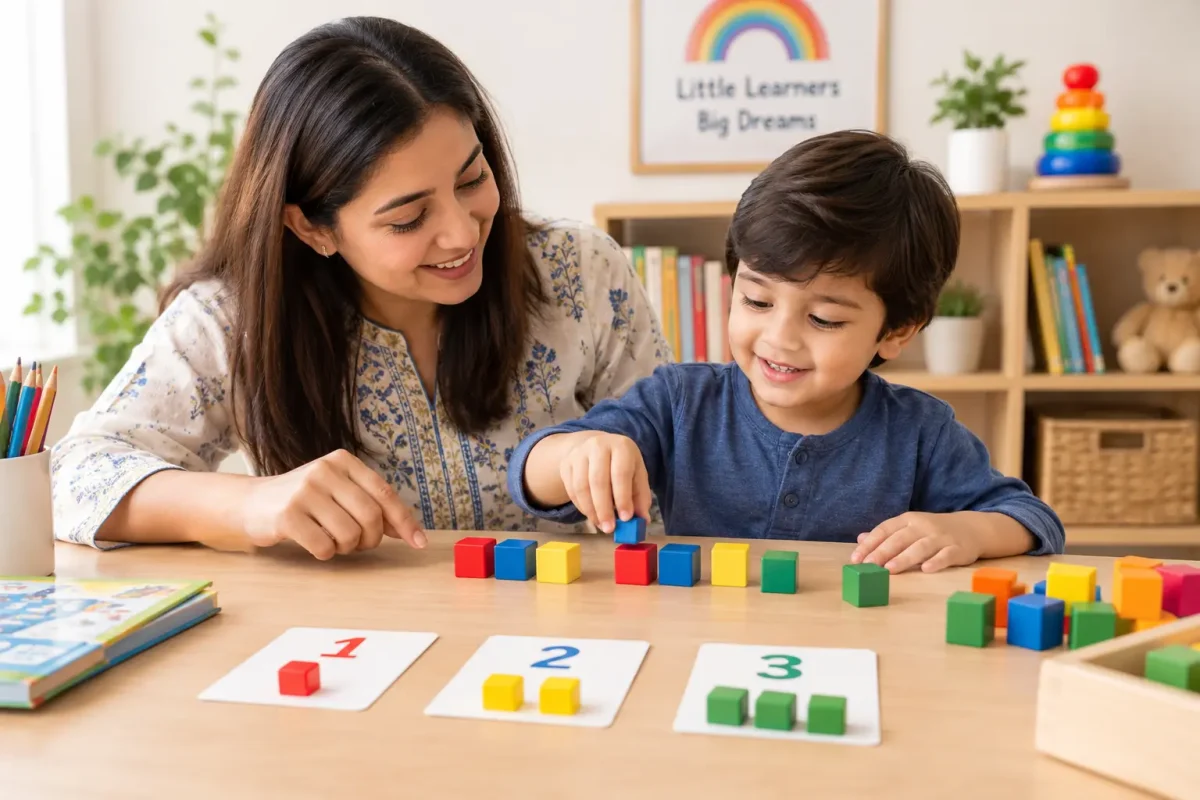
Place three blocks on the floor and count them together.
Say, “One, two, three. We have three blocks.”
Then move the blocks around and invite your child to count them again.
Once your child is comfortable with small groups, gradually introduce more objects. Some children may need repeated practice with one, two, and three before moving on.
Parent tip: Allow your child to touch or move each object as they count. This can make it easier to connect the number word with the object.
2. Count Toys During Playtime
Toys can provide a natural starting point for counting because children already enjoy handling and arranging them.
Try these simple activities:
Count building blocks
Ask your child to bring you three blocks. Count each block as they place it in front of you.
Next, build a small tower together and count the blocks as you stack them.
Count puzzle pieces
Before beginning an age-appropriate puzzle, count a few of its pieces together. When the puzzle is complete, count how many pieces are left outside the board.
Keep small pieces away from children who may put objects in their mouths.
Count toy animals
Arrange three toy animals in a row. Ask your child to count them and then move them into a different arrangement.
This helps you see whether your child can count the objects regardless of their position.
You can also explore educational toys at ToyRoots for hands-on play materials that may suit your child’s interests and stage of development.
3. Make Counting Part of Snack Time
Snack time offers an easy opportunity to talk about numbers without turning a meal into a formal lesson.
For example, place three pieces of suitable fruit on your child’s plate and count them together.
You could ask:
- “How many pieces are on your plate?”
- “Can you give me one?”
- “How many are left?”
- “Do we have more pieces on this plate or that plate?”
Use foods that are safe for your child’s age and prepare them appropriately to reduce choking risks. Never leave young children unsupervised while eating.
You do not need to ask a question every time your child eats. Sometimes simply counting together is enough.
4. Count Everyday Objects at Home
You do not need special learning materials to introduce counting. Everyday household routines can provide plenty of opportunities.
Here are some ideas:
| Daily activity | Counting game |
|---|---|
| Getting dressed | Count pairs of socks or buttons on a garment. |
| Setting the table | Count how many spoons or plates are needed. |
| Tidying up | Put five large toys into a basket, counting each one. |
| Climbing stairs | Count the steps together while holding your child’s hand where needed. |
| Putting away books | Count three books as you return them to the shelf. |
| Preparing for an outing | Count how many people need shoes or water bottles. |
Choose activities that fit naturally into your routine. You do not need to turn every household task into a maths lesson.
5. Play a Number-Hunting Game
A number hunt can turn counting into a simple game.
Choose one number, such as three, and invite your child to find groups of three suitable objects around the room.
They might find:
- Three toy cars.
- Three building blocks.
- Three books.
- Three cushions, with adult help if needed.
After each discovery, count the objects together.
For variety, change the number when your child is ready. You can also ask them to find two objects that are the same colour or three objects of different sizes.
Keep the activity playful. If your child loses interest, stop and try again another day.
6. Introduce Counting Through Songs and Movement
Songs, rhymes, clapping and movement can make number practice more engaging.
Try counting five claps together, taking three steps forward, or jumping a small number of times in an open, safe space.
You can also use familiar counting rhymes and songs. Repeat the number sequence slowly and encourage your child to join in when they feel ready.
For an extra challenge, pause before the final number and let your child fill it in.
Movement activities should be appropriate for the child’s abilities, with enough space to avoid collisions and falls.
7. Use Blocks to Compare Quantities
Counting becomes more meaningful when children begin comparing groups.
Place two blocks in one pile and four blocks in another. Count each group together.
Then ask, “Which pile has more blocks?”
Try another example with equal groups and ask whether both piles have the same number.
You can gradually introduce simple questions such as:
- “What happens if we add one more block?”
- “Can we make both piles equal?”
- “How many blocks do we need to add?”
Do not expect your child to answer every question correctly. Demonstrate the activity and let them explore.
Hands-on construction toys and counting materials can support these activities, but ordinary household objects work just as well.
8. Match Written Numbers with Real Objects
Once your child is becoming familiar with counting small groups, introduce written numbers.
Write the numbers 1, 2, and 3 on separate pieces of paper. Place one block beside the number 1, two blocks beside the number 2, and three blocks beside the number 3.
Invite your child to match each number with its group.
If the task is difficult, count the objects together and demonstrate the matching process.
You can later introduce additional numbers as your child becomes more comfortable. Avoid rushing into large numbers before the basic idea is becoming clear.
9. Adapt Counting Activities to Your Child’s Stage
Every child develops at their own pace. The following are flexible starting points, not strict milestones.
Younger preschoolers
Start with naming small quantities, counting a few objects, and matching spoken numbers with actions. Keep activities brief and offer plenty of help.
Children who are comfortable counting small groups
Practise counting objects in different arrangements, matching numbers to quantities, and identifying which group has more.
Older preschoolers
Introduce simple comparisons, counting forward from a given number, and everyday problems involving small quantities.
For example, ask, “We have two cups on the table. We need three. How many more do we need?”
If your child finds an activity frustrating, make it easier and return to the skill later.
10. Make Counting Fun Instead of a Test
Children may lose interest when every activity becomes a question-and-answer session.
Try these approaches:
- Follow your child’s interests.
- Give them time to answer.
- Demonstrate rather than correcting every mistake.
- Praise effort and curiosity.
- Repeat favourite activities on different days.
- Stop when your child becomes tired or frustrated.
Instead of saying, “No, that’s wrong,” you could say, “Let’s count them together and check.”
The aim is to help your child become comfortable exploring numbers, not to make every interaction a test.
Common Mistakes Parents Should Avoid
Expecting memorised numbers to mean full understanding
A child may recite numbers in order without yet understanding quantities. Give them opportunities to count real objects one by one.
Introducing too many numbers at once
Start with manageable groups and increase the challenge gradually.
Correcting every mistake immediately
Allow your child time to think. If they get stuck, demonstrate the process calmly.
Turning every activity into a lesson
Children also need time for free play. Counting can be a small part of the day rather than a constant expectation.
Comparing children with siblings or classmates
Children learn at different rates. Focus on your child’s progress rather than someone else’s performance.
A Simple 10-Minute Counting Routine
If you want a straightforward starting point, try this flexible routine:
Minutes 1–2: Warm up
Count three familiar objects together.
Minutes 3–5: Play
Build a small tower or count toy animals.
Minutes 6–8: Everyday activity
Ask your child to count a few safe household objects or help prepare the table.
Minutes 9–10: Review
Ask how many objects you counted, then finish with a favourite counting song or game.
You can shorten or extend the routine according to your child’s interest. There is no need to complete it every day or follow the timing exactly.
Frequently Asked Questions
At what age should I start teaching my child to count?
You can introduce number words and quantities through playful interactions from an early age. Formal counting expectations should be appropriate to your child’s development. Preschoolers can gradually explore counting objects, matching quantities, and recognising numbers.
How can I teach counting to a preschooler who loses interest quickly?
Use activities connected to their interests, such as counting cars, blocks, fruit, or steps. Keep the activity brief and let your child choose what to count.
Does my child need educational toys to learn counting?
No. Household objects, books, fingers, and everyday routines can all provide opportunities to explore numbers. Suitable educational toys can add variety, but they are not essential.
What should I do if my child can say numbers but cannot count objects accurately?
Practise with small groups. Encourage your child to touch or move one object for each number word. Count together slowly and repeat the activity on different occasions.
How can I make counting relevant to everyday life in Pakistan?
Use familiar situations such as counting fruit at snack time, helping set the dinner table, arranging shoes, putting toys away, or counting steps while walking with an adult. Everyday examples make numbers easier to connect with real experiences.
Final Thoughts
Teaching counting to preschoolers does not require expensive materials or long lessons. Start with small groups, use everyday routines, and let your child explore numbers through play.
Whether you are counting blocks, sharing fruit, arranging books, or setting the table, simple interactions can create opportunities to practise early maths.
Be patient, celebrate progress, and remember that the goal is to build understanding and curiosity over time.
If you want to introduce more hands-on learning into your child’s play, explore the ToyRoots educational toys collection and choose materials that suit your child’s interests, abilities, and age.
Related reading
All in Uncategorized →

Eidi Gift Ideas for Kids in Pakistan: Thoughtful Gifts Beyond Cash
Eid is a time for family gatherings, delicious food, new clothes, and the excitement of receiving Eidi. For children, opening an envelope…
