
No products in the cart.
Parenting Tips, ToyRoots Life
12-in-1 Magnet Science STEM Kit for Kids: 12 Fun Magnetic Experiments for Young Scientists
What happens when a magnet makes a boat move without an engine? Can magnets make a car roll, lift objects, or create surprising movements? With the right hands-on activity, science can become much more than something children read about in a textbook.
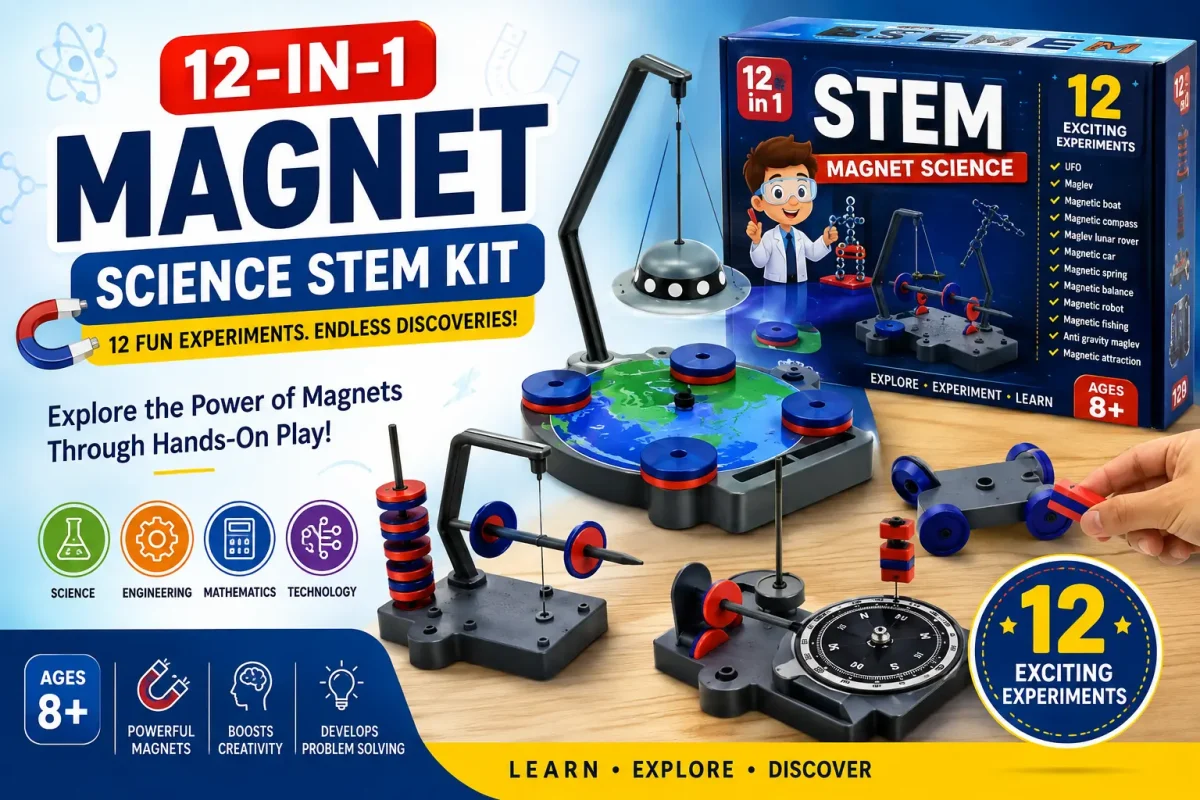
The 12-in-1 Magnet Science STEM Kit for Kids (Ages 8+) gives children an opportunity to explore the fascinating world of magnets through hands-on experiments and activities.
Instead of simply learning that magnets attract or repel certain objects, children can experiment, observe what happens, make predictions, and discover basic scientific principles through play.
For parents looking for an engaging STEM toy for kids, a magnet science kit can be an exciting way to introduce children to science, experimentation, problem-solving, and logical thinking.
What Is the 12-in-1 Magnet Science STEM Kit?
The 12-in-1 Magnet Science STEM Kit is a hands-on science learning kit designed for children aged 8 years and above.
The kit focuses on magnetic experiments and demonstrations that allow children to explore different ways magnets can interact with objects.
The activities included with the kit cover a variety of magnetic concepts and experiment ideas, including:
- UFO-style magnetic experiments
- Maglev experiments
- Magnetic boat
- Magnetic compass
- Maglev lunar rover
- Magnetic car
- Magnetic spring
- Magnetic balance
- Magnetic robot
- Magnetic fishing
- Anti-gravity maglev
- Magnetic attraction
This variety makes the kit more than a single experiment. Children can try different activities and compare the results, making it a useful introduction to experimental learning.
Why Are Magnet Science Experiments Good for Kids?
Magnets are particularly interesting for children because their effects can sometimes seem almost magical.
A child can see two magnets push away from each other or watch an object move because of magnetic force. This creates a natural opportunity to ask questions.
Why did it move?
Why did it stop?
Why did the magnets repel each other?
What happens if we change the position?
These questions encourage children to think like young scientists.
1. Encourages Curiosity
Children naturally want to understand things they cannot immediately explain.
Magnetic experiments provide visible results, which can encourage children to investigate further.
Instead of simply being told how magnets work, children can observe the effect themselves.
2. Introduces Scientific Thinking
Science is not only about memorizing facts. It is also about observing, predicting, testing and learning from results.
A simple magnet experiment can introduce children to this process:
Question → Prediction → Experiment → Observation → Result
This is one of the reasons hands-on STEM toys can be valuable for growing learners.
3. Develops Problem-Solving Skills
Some activities require children to figure out how different components should be positioned or how magnetic forces affect movement.
If the experiment does not work the first time, children have an opportunity to change their approach and try again.
This encourages persistence and problem-solving.
4. Supports Logical Thinking
Magnetic experiments can help children understand relationships between actions and results.
For example, changing the position of a magnet may change how another object moves. This encourages children to think about cause and effect.
5. Makes Science More Engaging
Science can sometimes feel abstract when children only encounter concepts in books.
A hands-on experiment makes the concept visible. Children can touch the materials, perform the activity and see what happens in front of them.
12 Magnetic Experiments Kids Can Explore
One of the most interesting features of this kit is its variety of magnetic activities. Let’s look at the types of experiments children can explore.
1. Magnetic UFO
The UFO activity introduces children to the unusual movement that can be created using magnetic forces.
It is a fun way to get children interested in the idea that magnets can influence objects without ordinary physical contact.
2. Maglev Experiment
Maglev stands for magnetic levitation.
The concept involves using magnetic forces to create movement or reduce physical contact between components.
For an 8+ learner, a simple model can provide an exciting introduction to a concept used in real-world transportation technology.
3. Magnetic Boat
The magnetic boat experiment demonstrates how magnetic force can be used to create movement.
Children can observe the interaction and think about how changing the position of the magnet affects the boat.
4. Magnetic Compass
A compass is one of the most familiar examples of magnetism in everyday life.
Exploring a magnetic compass can help children connect the activity to navigation and the Earth’s magnetic field.
5. Maglev Lunar Rover
This activity combines the excitement of space exploration with magnetic experimentation.
A lunar rover theme can make the experiment more imaginative while introducing children to ideas around movement, engineering and exploration.
6. Magnetic Car
Children generally enjoy anything involving cars.
A magnetic car experiment turns that interest into a science activity where they can observe how magnets influence movement.
It can also encourage children to experiment with positioning and direction.
7. Magnetic Spring
The magnetic spring activity provides another way to explore magnetic forces.
Children can observe how magnets interact and how their positioning affects the movement of the components.
8. Magnetic Balance
The magnetic balance experiment introduces children to the idea that magnetic forces can influence balance and movement.
It provides an opportunity to observe what happens when magnetic forces interact with a physical setup.
9. Magnetic Robot
The robot-themed activity adds an element of creativity to science learning.
Combining a familiar technology-inspired concept with magnetism can make the activity particularly engaging for children interested in robots and machines.
10. Magnetic Fishing
Magnetic fishing is a simple but fun activity that demonstrates magnetic attraction.
Children can experiment with which objects are attracted to the magnet and which are not.
This is also an easy opportunity to introduce the concept that not every material is magnetic.
11. Anti-Gravity Maglev
The anti-gravity-style maglev activity demonstrates an effect that can look surprising to children.
While it is not literally creating anti-gravity, the magnetic interaction can create a levitation-like effect that makes the experiment exciting.
This is a great opportunity for parents to explain the difference between what something looks like and the scientific principle actually causing it.
12. Magnetic Attraction
The magnetic attraction experiment demonstrates one of the fundamental properties of magnets.
Children can explore how magnets attract certain materials and observe the strength and direction of magnetic interaction.
What Can Children Learn from This STEM Kit?
The kit is designed around magnetic science, but the learning can go beyond magnets.
Through repeated experimentation, children can practice several important skills.
Science
Children can learn through observation and experimentation.
Engineering Thinking
Building and testing different setups encourages children to think about how components work together.
Problem-Solving
If something does not work as expected, children can try to identify the problem and change their approach.
Observation
Children need to pay attention to movement, direction, attraction and repulsion.
Logical Reasoning
They can compare results and begin to understand relationships between actions and outcomes.
Creativity
Science experiments can also encourage children to ask, “What else can I try?”
STEM Learning Through Play
STEM stands for:
- Science
- Technology
- Engineering
- Mathematics
STEM learning does not have to begin with complicated robotics or programming.
For an 8-year-old, exploring magnetic forces, building an experiment, observing movement and trying different solutions can be a meaningful introduction to STEM thinking.
This is one reason hands-on STEM toys for kids can be useful for parents who want children to learn while enjoying screen-free activities.
ToyRoots’ STEM toys collection includes science, construction, logic and educational products designed around hands-on learning.
Why Choose a Science Kit Instead of a Regular Toy?
A regular toy can provide entertainment, while a science kit can combine entertainment with experimentation.
That does not mean traditional toys are less valuable. Children need different types of play.
However, a science kit gives parents an opportunity to introduce structured activities where children can:
- Read or understand an activity.
- Set up the experiment.
- Make a prediction.
- Perform the experiment.
- Observe what happens.
- Think about the result.
- Try again or change something.
This process can make play more purposeful.
For children who enjoy building and experimenting, the Magnetic Construction Building Blocks Set can also provide an open-ended way to explore construction, spatial thinking and hands-on STEM concepts.
The set introduces children to building, geometry, magnetism and basic engineering concepts through hands-on play.
A Great Screen-Free Activity for Kids
Many parents are looking for activities that can keep children engaged without depending on phones, tablets or television.
A science experiment provides an alternative because the child has to actively participate.
The 12-in-1 Magnet Science STEM Kit can turn an afternoon at home into a mini science session.
Parents can set aside some time, choose one experiment and allow the child to explore it at their own pace.
There is no need to complete all 12 activities in one sitting.
In fact, spreading the experiments over several sessions can make the kit more interesting because children have another activity to look forward to.
How Parents Can Make the Experiments More Educational
Parents do not need to be science experts to make STEM play more meaningful.
Simply asking questions can encourage deeper thinking.
Before an experiment, ask:
“What do you think will happen?”
During the experiment:
“Why do you think it moved?”
Afterwards:
“What would happen if we changed the position?”
You can also ask children to draw what they observed or explain the result in their own words.
This turns a simple activity into an opportunity for communication, reasoning and scientific thinking.
Tips for Using a Magnet Science Kit
Start with One Experiment
Do not rush through all 12 activities. Choose one experiment and let your child understand what is happening.
Let Children Try
If an experiment does not work immediately, avoid solving everything for them.
Give them time to investigate.
Making mistakes is an important part of experimentation.
Ask Questions
Use open-ended questions instead of immediately giving answers.
This encourages children to think independently.
Connect Experiments to Real Life
Talk about where magnets are used in everyday life.
For example, children may encounter magnets in:
- Compasses
- Speakers
- Motors
- Magnetic closures
- Toys
- Certain tools
- Electrical devices
This helps children understand that science is not limited to a toy kit.
Is the 12-in-1 Magnet Science STEM Kit Suitable for an 8-Year-Old?
Yes. The product is listed for ages 8 and above, making it suitable for children who are ready for more structured science and STEM activities.
At this age, children can often follow instructions, observe results and begin asking more detailed questions about why something happens.
However, parents should always supervise children according to the product instructions and keep small components away from younger children who may not be ready to use them safely.
Is This a Good Gift for a Child Who Loves Science?
A magnet science kit can be a thoughtful gift for children who enjoy:
- Science
- Experiments
- Machines
- Robots
- Cars
- Space
- Building
- Puzzles
- Discovering how things work
It can also be a useful choice when parents want a gift that offers an activity rather than simply another passive entertainment toy.
For birthdays, educational gifts, school-holiday activities or a child who has recently become interested in science, this type of kit can provide plenty of opportunities for exploration.
Who Should Consider Buying This STEM Science Kit?
The 12-in-1 Magnet Science STEM Kit may be a good choice for parents looking for:
A STEM Gift for Kids
It combines science experimentation with hands-on play.
A Science Toy for 8-Year-Olds+
The product is specifically listed for children aged 8 and above.
Screen-Free Learning Activities
The experiments require children to physically interact with the materials.
A Hands-On Educational Toy
Children can learn through observation rather than only reading about scientific concepts.
A Science Experiment Kit
The multiple magnetic activities provide variety instead of a single experiment.
Parents interested in other learning-focused products can also explore the Educational Toys collection at ToyRoots.
12-in-1 Magnet Science STEM Kit vs Ordinary Educational Toys
The main difference is the type of interaction.
A puzzle may challenge a child to find the correct solution.
Building blocks may encourage construction and creativity.
A magnet science kit adds another dimension: experimentation.
Children can make a prediction, change something and observe the outcome.
For children who enjoy logical challenges, the Magnetic Chess Board Game can also provide a screen-free activity focused on strategy, planning and logical thinking.
Other STEM & Educational Toys to Explore
If your child enjoys hands-on science and problem-solving, there are several other types of educational toys that can complement a magnet science kit.
- Magnetic Construction Building Blocks Set – A hands-on building toy that encourages creativity, spatial awareness and early engineering thinking.
- Magnetic Chess Board Game – A portable strategy game that encourages planning, concentration and logical thinking.
- Educational Toys for Kids – Explore ToyRoots’ collection of educational, Montessori and STEM-inspired toys.
- STEM Toys for Kids – Discover more hands-on toys designed to encourage science, technology, engineering and mathematical thinking.
Frequently Asked Questions
What age is the 12-in-1 Magnet Science STEM Kit for?
The kit is listed for children ages 8 and above.
What does the 12-in-1 Magnet Science Kit teach?
It introduces children to magnetic forces through hands-on activities involving attraction, movement, balance, magnetic levitation and other magnetic interactions.
Is this a STEM toy?
Yes. The product is part of ToyRoots’ STEM toys collection and is designed around hands-on science experimentation.
Is this science kit suitable as a gift?
Yes. It can be a good educational gift for children aged 8+ who enjoy science, experiments, building, machines, robots or discovering how things work.
Can parents do the experiments with their children?
Absolutely. Parent-child experimentation can make the activity more engaging and provides opportunities for children to ask questions and discuss what they observe.
Is the kit suitable for younger children?
The product is listed for ages 8+. Younger children should not use it unless the manufacturer/product guidance specifically allows it and appropriate adult supervision is provided.
How many experiments are included?
The product is presented as a 12-in-1 Magnet Science STEM Kit, with 12 different magnetic experiment and activity concepts.
Final Thoughts
The 12-in-1 Magnet Science STEM Kit for Kids (Ages 8+) offers children an exciting way to discover the science of magnetism through hands-on experimentation.
From magnetic cars and boats to compass activities, maglev concepts, magnetic balance and attraction experiments, the variety gives children multiple ways to explore how magnetic forces work.
More importantly, the kit encourages children to do something that is at the heart of scientific learning:
Ask a question, make a prediction, experiment, observe and learn.
For parents searching for a STEM toy for kids, a science experiment kit, or an engaging educational toy for 8-year-olds, this 12-in-1 magnet science kit can turn playtime into an opportunity to explore science in a fun and practical way.
Ready to Explore Magnet Science?
Give your young scientist the opportunity to experiment, discover and learn through hands-on play.
Shop the 12-in-1 Magnet Science STEM Kit
Read More from ToyRoots
If you want to learn more about choosing educational and STEM toys for children, read our guide:
Best Educational Toys for Kids in Pakistan: Age-Wise Guide for Parents
You can also learn more about how educational toys support children’s development:
Why Educational Toys Are Important for Children’s Development
Explore More at ToyRoots
Explore STEM Toys | Explore Educational Toys | Shop Magnet Science STEM Kit
Related reading
All in Parenting Tips →
Best Fine Motor Skills Toys for Kids in Pakistan: An Age-by-Age Guide
Short answer Match the toy to what your child’s hands can already do. At 1, that means large-piece puzzles, stacking toys and…

Best Toys for 6–8 Year Olds in Pakistan: A Practical Guide for Parents
Short answer By 6–8 children can follow rules and multi-step instructions, so the strongest choices are construction sets, logic puzzles, STEM kits,…

How to Choose STEM Toys for Kids in Pakistan: A Parent’s Guide by Age, Skill & Budget
Short answer Start with what your child is already drawn to — building, puzzles, or taking things apart — then match the…
