
No products in the cart.
Parenting Tips, ToyRoots Life
How Independent Play Helps Children Build Confidence and Creativity
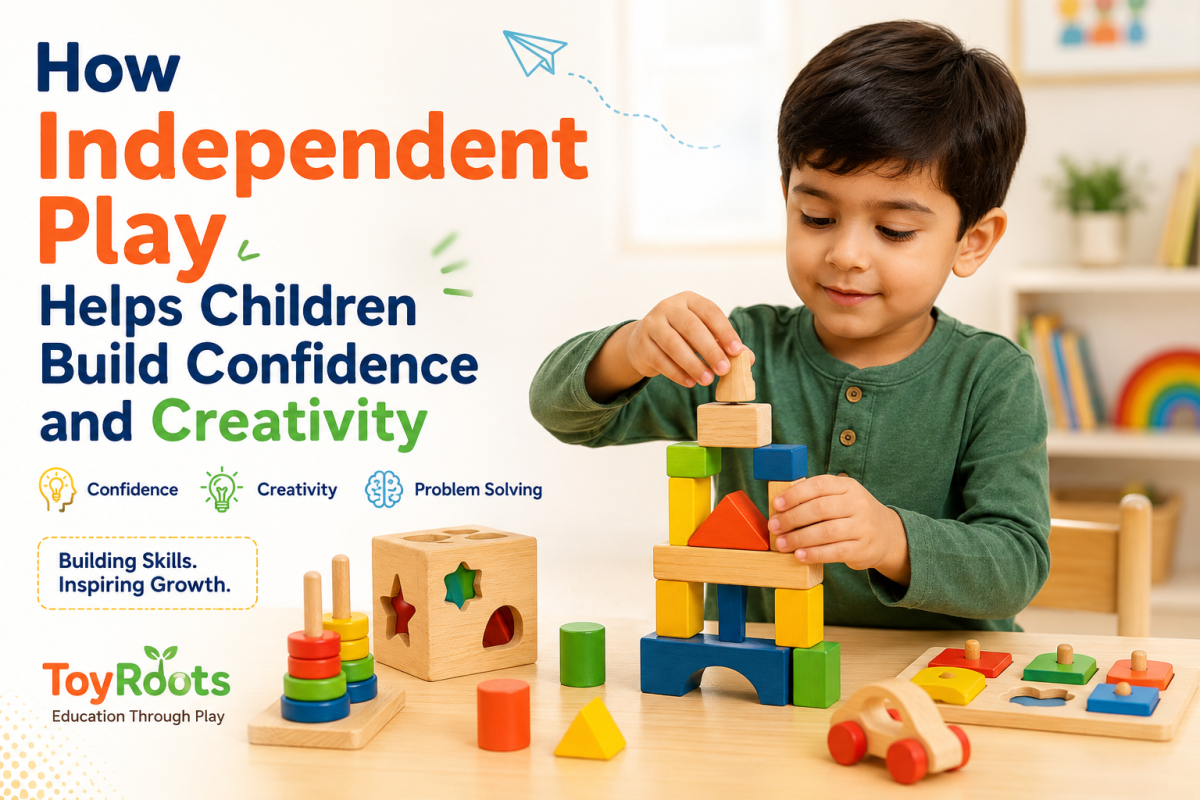
As parents, we naturally want to support our children whenever they face a challenge. Whether they are building a tower, solving a puzzle, or learning how different shapes fit together, our instinct is often to step in and help. While guidance is important, children also benefit greatly from opportunities to explore and learn on their own. This is where independent play becomes one of the most valuable tools for healthy childhood development.
What Is Independent Play?
Independent play refers to the time children spend exploring, creating, and solving problems without constant direction from adults. It does not mean leaving a child unattended. Instead, it involves providing a safe environment and engaging educational toys that encourage children to discover solutions, make decisions, and use their imagination while parents remain nearby for supervision and support when needed.
Why Independent Play Matters for Child Development
Independent play is more than just a way to keep children occupied. It provides valuable opportunities for learning and growth. Through self-directed activities, children develop essential life skills that help them become more confident, creative, and resilient.
Building Confidence Through Self-Discovery
One of the greatest benefits of independent play is the confidence it builds in children. Every time a child successfully completes a puzzle, constructs a stable structure, or discovers a solution to a problem, they experience a sense of achievement. These small victories help children trust their own abilities and develop the confidence needed to tackle new challenges. Over time, this self-belief extends beyond play and positively influences their learning experiences, social interactions, and everyday activities.
Encouraging Creativity and Imagination
Independent play encourages creativity by allowing children to think freely without predetermined outcomes. Open-ended educational toys give children the freedom to invent stories, design structures, and experiment with new ideas. A simple set of building blocks can become a castle one day and a spaceship the next. This type of imaginative play stimulates creative thinking and teaches children that there are often multiple ways to approach a task or solve a problem.
Strengthening Problem-Solving Skills
As children interact with educational toys, they naturally encounter challenges that require careful thinking and experimentation. They learn to analyze situations, test different solutions, and adapt when something does not work as expected. This process helps strengthen logical reasoning and teaches perseverance, both of which are essential skills for future success.
Improving Focus and Patience
Unlike digital entertainment, which often provides instant rewards and constant stimulation, hands-on educational toys encourage children to focus on a single activity for extended periods. Whether they are assembling a puzzle, building a structure, or sorting objects, children learn the value of sustained attention and persistence. These skills contribute to better learning habits and improved concentration in school and daily life.
Independent Play as a Healthy Alternative to Screen Time
In today\’s technology-driven world, independent play offers a healthy alternative to excessive screen time. When children are engaged in meaningful, hands-on activities, they are less likely to rely on digital devices for entertainment. Educational toys capture their attention while promoting active learning, creativity, and physical interaction with their environment. This balance is important for supporting both cognitive and emotional development.
Choosing the Right Toys for Independent Play
The quality of independent play often depends on the toys available to children. Educational toys that encourage exploration and creativity are ideal because they allow children to learn through experience rather than simply following instructions.
Building Blocks
Building blocks inspire creativity, improve spatial awareness, and encourage children to experiment with different designs. They provide endless opportunities for imaginative play while developing problem-solving skills.
Wooden Puzzles
Wooden puzzles help children improve concentration, hand-eye coordination, and logical thinking. They challenge young minds while offering a rewarding sense of accomplishment upon completion.
Shape Sorters and Learning Toys
Shape sorters introduce children to basic concepts such as colors, shapes, and patterns. These toys encourage critical thinking while helping develop fine motor skills and coordination.
Construction and STEM Toys
Construction toys and STEM-based learning sets allow children to explore engineering concepts, creativity, and innovation through hands-on play. They encourage curiosity and inspire a love for learning.
How Parents Can Encourage Independent Play
Parents play an important role in helping children develop healthy independent play habits. Creating a safe and organized play environment can make children feel comfortable exploring on their own. Offering age-appropriate educational toys and allowing children time to experiment without immediate intervention helps build confidence and resilience. Rather than providing solutions right away, parents can encourage children to think through challenges and celebrate their efforts, fostering a growth mindset.
The Long-Term Benefits of Independent Play
The skills children develop through independent play often stay with them throughout life. Confidence, creativity, problem-solving abilities, patience, and self-motivation are qualities that contribute to success in education, relationships, and future careers. By encouraging independent play during childhood, parents help lay the foundation for lifelong learning and personal growth.
Conclusion
Independent play is much more than a way to keep children entertained. It is a powerful tool for developing confidence, creativity, concentration, and critical thinking skills. Through meaningful play experiences, children learn how to think independently, solve problems, and explore the world around them.
At ToyRoots, we believe that the best educational toys inspire curiosity, creativity, and lifelong learning. By encouraging independent play, parents can give their children the opportunity to grow into confident, capable, and imaginative learners while having fun every step of the way.
Related reading
All in Parenting Tips →
Eidi Gift Ideas for Kids in Pakistan: Thoughtful Gifts Beyond Cash
Eid is a time for family gatherings, delicious food, new clothes, and the excitement of receiving Eidi. For children, opening an envelope…
How to Clean and Maintain Kids’ Toys: A Parent’s Guide for Pakistan
Children touch their toys throughout the day. They carry them around the house, play with them on the floor, take them outside,…
How to Choose Wooden Toys for Kids in Pakistan: A Parent’s Guide
Choosing a toy for your child is about more than finding something colourful or entertaining. You want something they will enjoy, use…
