
No products in the cart.
Parenting Tips, ToyRoots Life
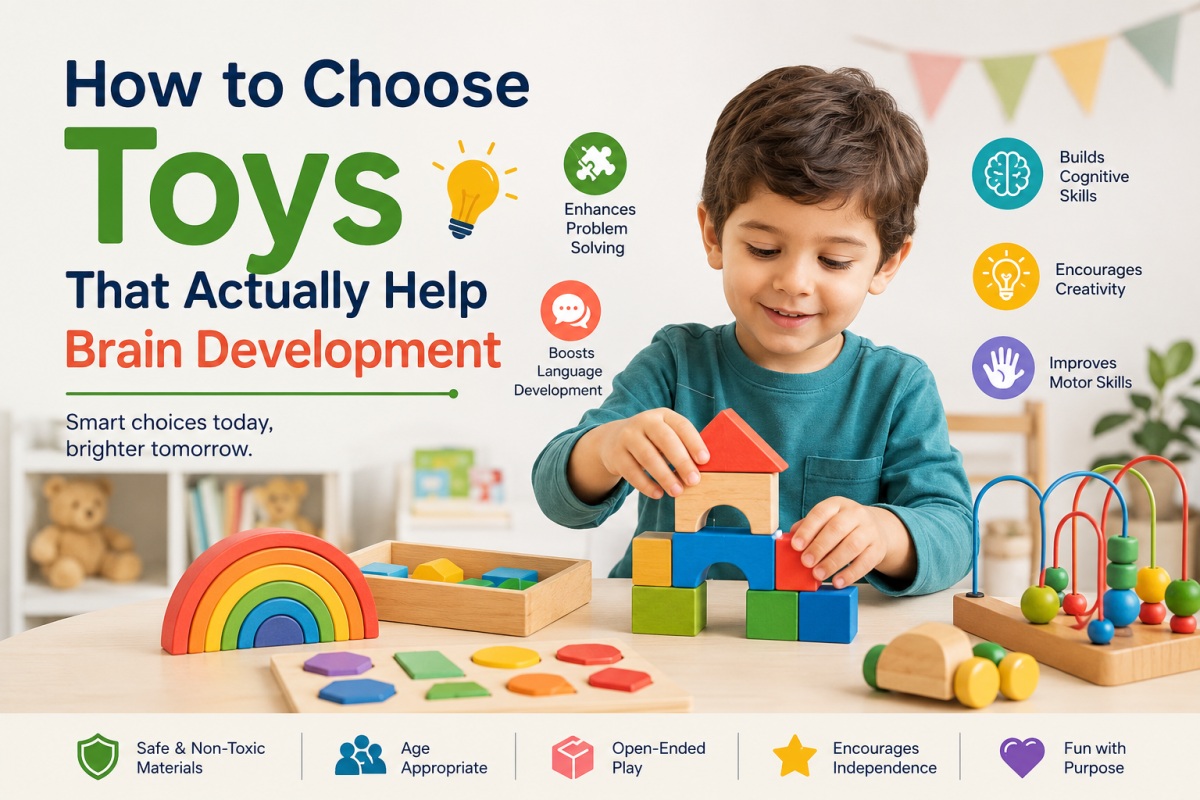
How to Choose Toys That Actually Help Brain Development
Every parent wants to give their child the best possible start in life. While love, attention, and a nurturing environment play the biggest role in healthy development, the right toys can also make a meaningful difference. Toys are much more than objects that keep children busy—they are powerful learning tools that help develop thinking skills, creativity, problem-solving abilities, language, and emotional intelligence.The challenge is that today\’s market is filled with thousands of toys claiming to be \”educational.\” Bright lights, electronic sounds, and flashy packaging often convince parents that a toy is helping their child learn, when in reality many of these toys offer very little opportunity for active thinking. The best brain-development toys are usually the ones that encourage children to explore, imagine, experiment, and solve problems on their own.This guide will help you understand what makes a toy truly beneficial for brain development and how to choose toys that support your child\’s growth at every stage.
Why Toys Matter for Brain Development
During the first few years of life, a child\’s brain develops at an incredible pace. Every new experience forms millions of neural connections that become the foundation for learning, memory, language, and emotional development. The toys children play with can either stimulate these connections or simply entertain without encouraging meaningful thinking.
Well-designed educational toys encourage children to ask questions, make decisions, solve challenges, recognize patterns, improve concentration, and understand cause and effect. These experiences strengthen cognitive abilities while making learning enjoyable and natural.
What Makes a Toy Good for Brain Development?
A truly educational toy encourages active participation instead of passive entertainment. Rather than simply pressing a button to hear music or watch flashing lights, children should be able to build, create, imagine, organize, compare, sort, and experiment.
The best learning toys grow with the child. They can be used in different ways as skills improve, allowing children to discover new possibilities each time they play. This flexibility keeps the brain engaged and encourages continuous learning instead of repetitive actions.
Choose Toys According to Your Child\’s Age
Every stage of childhood requires different types of stimulation. Babies benefit from toys that improve sensory development and hand-eye coordination. Toddlers begin exploring shapes, colors, stacking, and simple problem-solving. Preschoolers enjoy pretend play, puzzles, building blocks, and creative activities that encourage imagination. Older children benefit from STEM kits, construction sets, strategy games, and science experiments that challenge logical thinking.
Selecting age-appropriate toys ensures that children remain interested without becoming frustrated by activities that are too difficult or bored by toys that are too simple.
Look for Open-Ended Toys
Open-ended toys are among the best investments parents can make because they allow children to create their own ways of playing. Instead of having one fixed purpose, these toys encourage endless possibilities and imaginative thinking.
Building blocks can become houses, castles, bridges, cities, or vehicles. Wooden blocks can teach counting, balance, engineering, and creativity all at once. Magnetic tiles allow children to experiment with geometry while creating unique structures. This freedom stimulates creativity and strengthens problem-solving skills far more effectively than toys with only one intended function.
Encourage Problem-Solving Skills
Problem-solving is one of the most valuable abilities children develop through play. Toys that require children to think before acting improve reasoning, patience, and decision-making abilities.
Puzzles, construction sets, shape sorters, maze games, and logic activities teach children how to identify problems, test solutions, and learn from mistakes. Every successful solution builds confidence while strengthening important areas of brain development.
Support Creativity and Imagination
Creative play activates multiple areas of the brain at the same time. When children imagine stories, create characters, or invent games, they improve language skills, emotional intelligence, communication, and flexible thinking.
Art supplies, pretend kitchens, dollhouses, animal figures, doctor kits, and building toys encourage children to express ideas without limitations. These experiences are essential for developing innovation and independent thinking.
Choose Toys That Build Fine Motor Skills
Brain development is closely connected to physical development, especially fine motor control. Activities that require children to grasp, stack, thread, connect, twist, or manipulate small objects strengthen the muscles in the hands while improving coordination between the brain and body.
These skills later support handwriting, drawing, using scissors, dressing independently, and performing many daily tasks with confidence.
Don\’t Be Fooled by Flashing Lights
Many electronic toys promise educational benefits through lights, sounds, and automatic responses. Although these toys may capture attention, they often reduce opportunities for active thinking because the toy performs most of the work instead of the child.
Simple toys frequently provide greater educational value because they require children to imagine, explore, and solve challenges independently. The goal should always be active learning rather than passive entertainment.
Prioritize Safe and High-Quality Materials
Children naturally explore the world by touching, holding, and sometimes placing objects in their mouths. Choosing toys made from durable, non-toxic materials protects children\’s health while ensuring the toys last for years.
Wooden educational toys, BPA-free plastic products, and toys with smooth finishes and strong construction are excellent choices for long-term learning.
Play Together Whenever Possible
Even the best educational toy cannot replace meaningful interaction with parents. Research consistently shows that children learn more when adults participate in play by asking questions, encouraging conversation, introducing new vocabulary, and celebrating discoveries.
Reading instructions together, building structures, solving puzzles, or pretending during imaginative play strengthens emotional bonds while enhancing learning outcomes.
Signs You\’ve Chosen the Right Toy
A quality educational toy keeps children engaged for long periods without requiring constant entertainment. Children return to it repeatedly, discover new ways to play, ask questions, solve problems independently, and proudly share their creations. These are strong indicators that the toy is stimulating healthy brain development rather than providing short-term amusement.
Frequently Asked Questions
Are expensive toys better for brain development?
No. Many simple toys like wooden blocks, puzzles, magnetic tiles, and pretend play sets provide greater educational value than expensive electronic toys. Learning comes from how children interact with the toy rather than its price.
Which toys improve intelligence the most?
There is no single toy that increases intelligence. However, construction toys, STEM kits, puzzles, open-ended building blocks, and creative play materials help develop problem-solving, reasoning, memory, and critical thinking skills.
Can educational toys replace learning at school?
Educational toys are designed to complement learning, not replace it. They reinforce important concepts through hands-on experiences while making learning enjoyable at home.
How many educational toys should a child have?
Quality is more important than quantity. A carefully selected collection of versatile toys encourages deeper learning than a room full of toys that receive little attention.
Final Thoughts
Choosing toys that genuinely support brain development is less about buying the newest or most expensive products and more about selecting toys that encourage curiosity, creativity, exploration, and independent thinking. The best educational toys inspire children to ask questions, solve problems, imagine new ideas, and develop confidence through play.
By focusing on open-ended learning, age-appropriate challenges, quality materials, and meaningful interaction, parents can create an environment where every play session becomes an opportunity for lifelong learning. Investing in thoughtfully designed educational toys today helps build the skills children will use throughout school and beyond.
Related reading
All in Parenting Tips →
Eidi Gift Ideas for Kids in Pakistan: Thoughtful Gifts Beyond Cash
Eid is a time for family gatherings, delicious food, new clothes, and the excitement of receiving Eidi. For children, opening an envelope…
How to Clean and Maintain Kids’ Toys: A Parent’s Guide for Pakistan
Children touch their toys throughout the day. They carry them around the house, play with them on the floor, take them outside,…
How to Choose Wooden Toys for Kids in Pakistan: A Parent’s Guide
Choosing a toy for your child is about more than finding something colourful or entertaining. You want something they will enjoy, use…
