
No products in the cart.
Parenting Tips
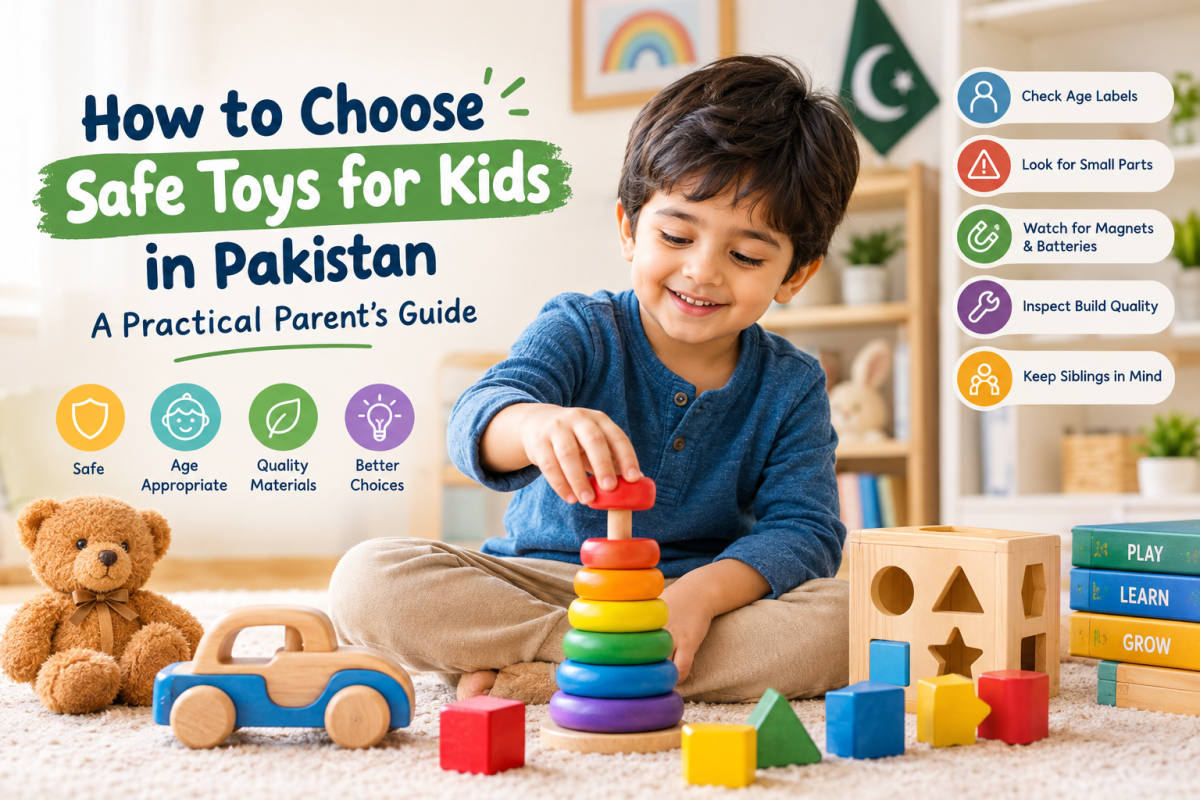
How to Choose Safe Toys for Kids in Pakistan: A Practical Parent’s Guide
Buying a toy for a child should be exciting, but safety should always come before colour, price, or even educational value.
When shopping online, parents in Pakistan can find hundreds of toys that look attractive and are described as educational, Montessori, STEM, wooden, or learning toys. But those labels alone do not tell you whether a particular toy is appropriate for your child.
A safer approach is to look at the age recommendation, size of the pieces, materials, construction, moving parts, magnets, batteries, and the way the child will actually use the toy.
This guide explains the basics of toy safety in Pakistan and gives parents a practical checklist for choosing toys for babies, toddlers, preschoolers, and older children.
The goal is not to find a toy that has zero risk in every situation. It is to choose a toy that is appropriate for the child, understand its potential hazards, and provide supervision when necessary.
Why Toy Safety Matters When Buying for Children
Children explore the world differently from adults.
A toddler may put an unfamiliar object in their mouth. A preschooler may pull, twist, throw, or dismantle a toy. An older child may use a construction set in a way the manufacturer did not originally intend.
That is why a toy that is perfectly suitable for one child may not be suitable for a younger sibling.
Toy safety is therefore about more than asking, “Is this a good toy?”
A better question is:
“Is this toy suitable for this particular child, at this particular age, in the way they are likely to use it?”
This is especially important in homes where brothers and sisters of different ages share toys.
The Most Important Toy Safety Check: Age Recommendation
The first thing parents should check is the manufacturer’s recommended age.
For example, ToyRoots distinguishes between the manufacturer’s safety age and its own recommended learning or interest age on product information. This is useful because a child may be capable of enjoying a toy but the product may still contain pieces that are unsuitable for younger children in the home.
Age recommendations are not simply about whether a child can understand a game.
They can also relate to:
- The size of toy pieces
- Choking hazards
- Complexity
- Physical strength required
- Sharp or moving components
- Magnets or batteries
- Whether adult supervision is needed
Don’t Ignore the Age Label
If a toy says 3+, don’t assume that a younger child can safely use it simply because they seem advanced for their age.
This becomes particularly important with puzzles, building sets, beads, small figures, magnetic toys, and other products containing multiple pieces.
For babies and toddlers, choose products specifically designed for their developmental stage rather than simply choosing a toy because an older sibling enjoys it. You can explore toys for babies under 1 year when looking for age-appropriate options.
Small Parts and Choking Hazards
Small pieces deserve particular attention for young children.
Buttons, beads, tiny puzzle pieces, miniature accessories, small balls, and other detachable components can create choking risks for children who still explore objects with their mouths.
International toy-safety rules give special attention to this issue. For example, the U.S. Consumer Product Safety Commission has specific requirements concerning small parts in products intended for children under three.
For parents, the practical lesson is simple:
If a toy contains small detachable pieces, check the age recommendation carefully and consider who else in the household may have access to it.
A toy purchased for a six-year-old may be fine for that child but inappropriate for a two-year-old sibling.
Keep Older Children’s Toys Away From Younger Siblings
This is one of the easiest safety steps parents can take.
Create separate storage for toys containing smaller components. If older children use construction sets, beads, small puzzle pieces, or other multi-piece toys, teach them to put everything away after playing.
This is particularly useful in homes where children share bedrooms or play areas.
Be Extra Careful With Magnetic Toys
Magnetic toys can be fun and useful for construction and problem-solving, but magnets deserve special attention.
Parents should check the recommended age and product information before purchasing a magnetic toy.
The key issue is not simply whether a toy contains magnets. It is whether the magnets are securely contained and whether the product is appropriate for the child’s age.
For younger children, avoid giving magnetic pieces intended for older children unless the manufacturer specifically states that the product is appropriate.
And if a magnetic toy becomes damaged, stop using it until you can determine whether any components have become loose.
Check the Toy’s Construction and Finish
A toy does not have to be electronic to require a safety check.
Wooden toys, for example, can be excellent choices for hands-on play, but parents should still inspect them.
Before giving a child a wooden toy, look for:
- Rough or splintered surfaces
- Cracked wood
- Loose components
- Sharp corners or edges
- Pieces that detach too easily
- Damaged paint or coating
- Broken strings or cords
ToyRoots offers a range of wooden toys designed for hands-on play. Parents should still inspect any toy when it arrives and discontinue use if it becomes damaged.
Inspect Toys After Delivery
Online shopping means you may not physically inspect a toy before purchasing it.
When your order arrives, take a few minutes to check:
- Does the toy match the product description?
- Are all pieces included?
- Is anything cracked or broken?
- Are there loose parts?
- Does the product have the expected age guidance?
- Are there any unexpected sharp edges?
- Does anything appear damaged during shipping?
A quick inspection can help identify a problem before a child starts playing.
Be Careful With Batteries and Electronic Toys
Electronic toys bring another set of considerations.
If a toy uses batteries, parents should check that the battery compartment is secure and that children cannot easily access the batteries.
Button or coin batteries deserve particular caution because they can be dangerous if swallowed.
Parents should also check battery compartments after the toy has been dropped or damaged.
For younger children, simpler toys with fewer detachable components can sometimes be easier to manage.
That does not mean electronic toys are automatically unsafe. It simply means parents should consider how the toy is constructed and whether the child can access any internal components.
Safety Is More Than the Material
Parents sometimes assume that a wooden toy is automatically safer than a plastic toy.
That is not necessarily true.
The material alone does not determine whether a toy is appropriate.
A well-designed plastic toy can be perfectly suitable for a child, while a poorly constructed wooden toy can have rough edges or loose components.
The better approach is to consider the whole product:
- Age suitability
- Construction quality
- Piece size
- Materials
- Moving parts
- Magnets
- Batteries
- Durability
- Supervision requirements
- How the child is likely to play with it
This is also why the word “Montessori” or “educational” should not replace a proper safety check. You can explore ToyRoots’ Montessori toys while still checking each product’s individual age and safety information.
How to Choose Safe Educational Toys
Educational toys can encourage children to build, sort, count, match, solve problems, draw, create, and experiment.
But educational value and safety should be considered separately.
For example, a puzzle may provide excellent problem-solving practice, but if it contains pieces that are too small for the intended child, it may not be an appropriate choice.
Similarly, a construction toy can encourage creativity and spatial thinking, but parents should check the recommended age and the size of its components.
ToyRoots offers several categories that make it easier to browse according to the type of play, including educational toys, Montessori toys, educational puzzles, building blocks, counting and numbers, geometric shapes, colours and sorting, and logic and problem-solving toys.
Safe Toy Choices by Age
Babies and Very Young Toddlers
For babies and very young toddlers, keep things simple.
Look for toys designed specifically for their age, with large components and no easily detachable small pieces.
Examples can include:
- Simple sensory toys
- Large stacking toys
- Age-appropriate shape activities
- Simple grasping toys
- Large-piece puzzles
Always follow the manufacturer’s age guidance and supervise children according to the product instructions.
Toddlers
Toddlers are becoming more interested in sorting, matching, stacking, building, and exploring cause and effect.
Suitable options may include:
- Large-piece wooden puzzles
- Shape sorters
- Stacking toys
- Colour-sorting activities
- Simple counting toys
- Age-appropriate building activities
ToyRoots’ educational toy collection includes products such as wooden shape-and-colour sorting puzzles and geometric sorting activities, with age information displayed on the relevant product listings.
Preschoolers
Preschool children can usually handle more complex activities, but age suitability still matters.
Depending on the child, parents can consider:
- Wooden puzzles
- Construction toys
- Logic games
- Number activities
- Matching games
- Drawing and creative activities
- Montessori-inspired activities
The important thing is to choose a challenge that is appropriate rather than simply choosing the toy with the most pieces.
Older Children
Older children can often use more complex construction sets, logic games, STEM activities, strategy games, and multi-step challenges.
For example, ToyRoots currently offers products such as magnetic building blocks, logic games, STEM kits, and more advanced puzzles for older children. Parents looking for hands-on learning can explore the STEM toys collection while checking the recommended age for each product.
Even with older children, check the product instructions and make sure younger siblings cannot accidentally access pieces intended for older users.
A Simple 10-Point Toy Safety Checklist
Before buying a toy online in Pakistan, ask these ten questions:
1. Is it appropriate for the child’s age?
Check the manufacturer’s recommended age.
2. Does it contain small pieces?
If yes, consider whether the child is old enough to use them safely.
3. Are there magnets?
Check the product’s age guidance and construction carefully.
4. Does it use batteries?
Make sure the battery compartment is secure.
5. Does it have sharp edges?
Pay particular attention to wooden, metal, or mechanical toys.
6. Is anything loose?
Look for detachable components that should remain securely attached.
7. Is the material information available?
Read the product description rather than relying only on photographs.
8. Does the child need supervision?
Some toys are intended for supervised play even when they are educational.
9. Could a younger sibling access it?
Think about the whole household, not only the child receiving the toy.
10. Will the toy remain safe after repeated use?
Check toys regularly for cracks, loose pieces, broken components, or damaged surfaces.
What Parents Should Look for When Buying Toys Online in Pakistan
Online shopping makes it easy to compare toys, but product photos can hide important details.
Before placing an order, look for clear information about:
- Recommended age
- Dimensions
- Number of pieces
- Materials
- Included accessories
- Supervision requirements
- Safety warnings
- Product condition
- Return or replacement policy
If important information is missing, consider contacting the seller before buying.
A trustworthy toy store should make it reasonably easy for parents to understand what they are purchasing.
ToyRoots provides age information and safety notes on its product pages, which can help parents compare products before ordering.
How to Build a Safer Toy Collection at Home
You do not need to throw away every toy in your child’s room.
Instead, organise toys according to age and use.
Keep toys with small components away from younger children. Store puzzles and construction sets in labelled boxes. Check older toys periodically for damage.
It can also help to avoid buying too many toys at once.
A smaller collection of age-appropriate toys can be easier to supervise, store, and maintain.
For example, a family might keep:
- A few simple toys for independent play
- One or two puzzles
- A construction activity
- A creative activity
- A family game
- A few age-appropriate learning toys
The goal is not to create a perfect toy room. It is to create an environment where children can play safely and meaningfully.
Are Wooden Toys Safer Than Plastic Toys?
Not automatically.
Wooden toys can be durable and excellent for hands-on play, but the safety of a toy depends on its design, construction, finish, components, and suitability for the child.
When buying wooden toys, check for smooth surfaces, secure pieces, appropriate finishes, and age guidance.
Likewise, don’t reject a plastic toy simply because it is plastic. Focus on the specific product rather than the material alone.
Final Thoughts: Choose the Right Toy, Not Just the Most Attractive One
Good toy shopping starts with the child rather than the product.
Before buying, think about the child’s age, abilities, interests, and the environment in which they will use the toy. Then check the product’s age guidance, materials, components, and potential hazards.
For Pakistani parents, this simple approach can make online toy shopping much more confident and practical.
A toy does not need to be expensive, complicated, or packed with features to be valuable. A well-chosen puzzle, sorting activity, building set, wooden toy, Montessori-inspired activity, or STEM challenge can provide hours of hands-on play.
At ToyRoots, parents can browse educational toys by age and category, including Montessori toys, puzzles, building blocks, counting activities, and logic and problem-solving toys. The important step is to match the product to the child and use it according to its safety guidance.
The best toy is not simply the one that looks exciting in a photograph. It is the one that is appropriate, engaging, and safe for the child who will actually use it.
Frequently Asked Questions About Toy Safety in Pakistan
What should I check before buying a toy for my child?
Start with the manufacturer’s age recommendation. Then check the size of the pieces, materials, construction, magnets, batteries, moving parts, and whether supervision is recommended.
Are wooden toys safe for toddlers?
Wooden toys can be suitable for toddlers when they are specifically designed for the child’s age and have appropriate construction. Check for smooth surfaces, secure pieces, suitable finishes, and the manufacturer’s age recommendation.
Are small toy parts dangerous for babies?
Small parts can present choking hazards for young children. If a toy contains small detachable pieces, carefully follow its age guidance and keep it away from children who are too young to use it safely.
Are Montessori toys safe?
“Montessori” describes an educational approach, not a guarantee of safety. Parents should still check the specific product’s age recommendation, construction, materials, piece size, and supervision requirements.
What should I do if a toy breaks?
Stop using the toy until you can determine whether it remains safe. Look for loose, sharp, broken, or detachable components. For toys intended for young children, replacing a damaged toy is often safer than continuing to use it.
How can I make toys safer when siblings are different ages?
Separate toys containing small pieces or other age-specific components. Teach older children to store these toys after use, and keep them in a location younger children cannot easily access.
Should I buy educational toys or regular toys?
A toy does not need to be labelled “educational” to provide meaningful play. Look for toys that encourage children to build, create, solve, sort, imagine, move, or interact with other people. Safety and age suitability should come first.
Related reading
All in Parenting Tips →
Eidi Gift Ideas for Kids in Pakistan: Thoughtful Gifts Beyond Cash
Eid is a time for family gatherings, delicious food, new clothes, and the excitement of receiving Eidi. For children, opening an envelope…
How to Clean and Maintain Kids’ Toys: A Parent’s Guide for Pakistan
Children touch their toys throughout the day. They carry them around the house, play with them on the floor, take them outside,…
How to Choose Wooden Toys for Kids in Pakistan: A Parent’s Guide
Choosing a toy for your child is about more than finding something colourful or entertaining. You want something they will enjoy, use…
