
No products in the cart.
Parenting Tips
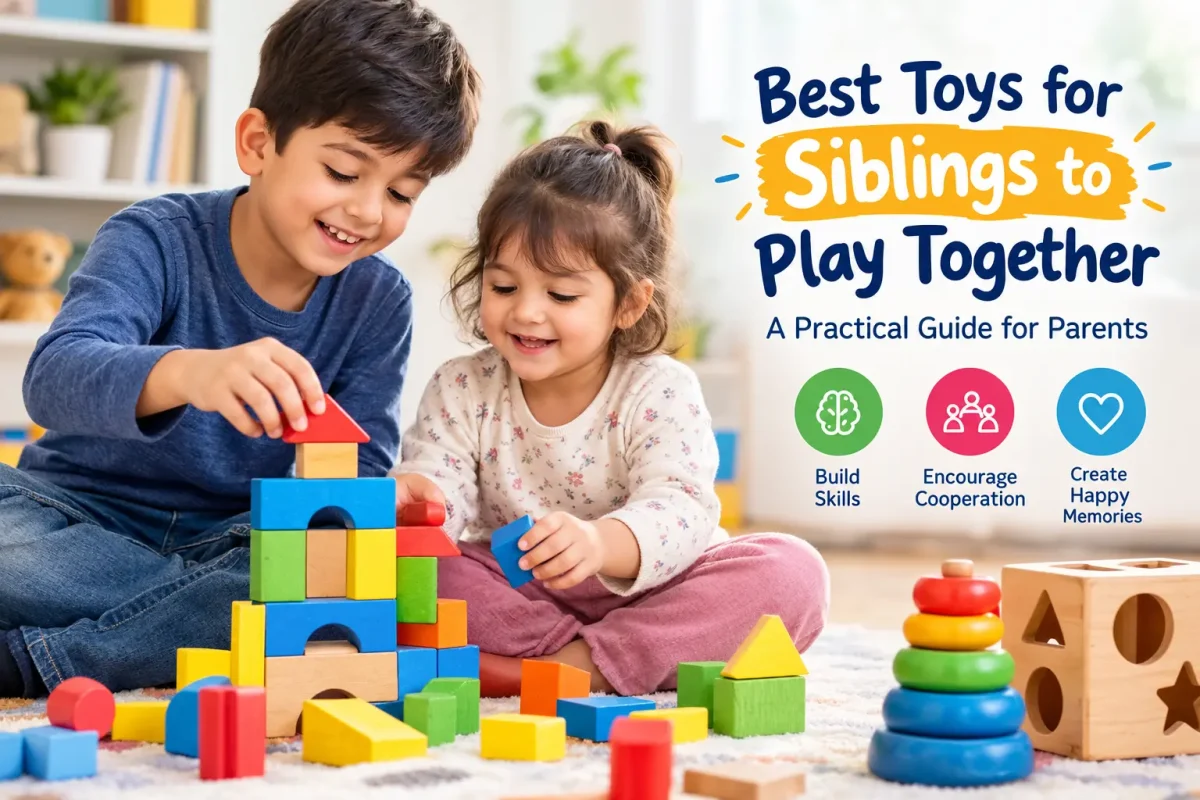
Best Toys for Siblings to Play Together: A Practical Guide for Parents
Finding a toy that keeps one child happy is fairly easy. Finding a toy that a 2-year-old and a 5-year-old can both enjoy without one child getting bored or the other becoming frustrated is much harder.
For families with more than one child, the best toys for siblings to play together are not necessarily the most expensive or complicated ones. They are usually toys that allow children to participate at different levels, encourage cooperation, and give each child something meaningful to do.
This is particularly useful when siblings have an age gap. An older child may want a challenge, while a younger child may be more interested in stacking, sorting, matching or simply exploring.
The goal is not to make siblings play exactly the same way. It is to give them a shared activity where each child can contribute according to their age and ability.
Play itself can support skills such as planning, problem-solving, language, social interaction and self-regulation.
So, how do you choose toys that siblings will actually want to share?
What Makes a Good Toy for Siblings?
Before buying a toy for two or more children, look beyond the age printed on the box.
Ask:
- Can both children participate?
- Can the toy be used in more than one way?
- Does it allow different levels of difficulty?
- Can children take turns or work together?
- Is there enough for both children to do?
- Is it appropriate for the youngest child using it?
- Will the toy still be interesting after the first few uses?
A toy with open-ended possibilities can be particularly useful.
For example, building pieces can become a tower, house, bridge or imaginary vehicle. An older sibling can plan the structure while a younger sibling stacks or sorts pieces.
Both children are playing with the same toy, but they do not have to perform the same task.
1. Building Toys: A Natural Choice for Sibling Play
Building toys are among the easiest categories to adapt for children with different abilities.
One child can build while another chooses pieces. An older sibling can create a more complicated structure while a younger child works on simpler shapes.
This creates natural roles without requiring the parent to organise every part of the activity.
Why building toys work well
Building activities can encourage:
- Creativity
- Spatial thinking
- Problem-solving
- Planning
- Fine motor practice
- Communication
- Experimenting and rebuilding
ToyRoots’ Magnetic Building Blocks are one example of an open-ended construction activity. Instead of having only one finished result, children can create different structures according to their abilities and imagination. Parents can also explore the STEM toys collection for other construction and problem-solving activities.
For a family with siblings, consider giving them a shared building challenge:
“Can you build a house together?”
The older child might design it, while the younger child helps choose and connect pieces.
The important point is that both children have a role.
2. Puzzles for Different Skill Levels
Puzzles can also work well for sibling play, but parents need to choose carefully.
A puzzle that is perfect for a 5-year-old may be too difficult for a 2-year-old. Instead of expecting both children to solve the same puzzle independently, allow them to contribute differently.
For example:
- The younger child can identify colours or shapes.
- The older child can work out where pieces belong.
- One child can sort the pieces.
- The other can complete the more difficult sections.
ToyRoots’ Educational Puzzles for Kids collection includes different styles of puzzle activities, including geometric, number, alphabet, logic and wooden puzzles.
This makes puzzles useful not only as individual learning activities but also as opportunities for siblings to work side by side.
3. Sorting and Matching Toys
Sorting activities are particularly useful for younger children because they are simple to understand while still offering opportunities for older siblings to participate.
A younger child might sort pieces by colour.
An older sibling might introduce a more complicated challenge:
“Can you put all the red shapes together?”
Then:
“Can you find all the pieces with the same shape?”
This turns a basic activity into a shared game.
Wooden shape sorters, colour-matching activities, counting toys and geometric puzzles can all provide this type of flexible play.
ToyRoots’ educational toy collection includes several activities based around shapes, colours, matching, counting and logic.
4. Strategy and Logic Games for Older Siblings
Not every sibling activity needs to be designed for toddlers.
If your children are old enough to understand simple rules, strategy and logic games can create a completely different type of shared play.
These activities can encourage children to:
- Follow rules
- Wait for their turn
- Think ahead
- Make decisions
- Adjust their strategy
- Handle winning and losing
Games can provide opportunities to practise executive-function skills such as working memory, attention, self-control and flexible thinking.
For siblings, however, the game should match the abilities of the children involved.
If one child is significantly younger, consider allowing the younger sibling to participate with a simpler role rather than expecting them to follow every rule independently.
5. STEM Toys That Allow Different Roles
STEM toys can be particularly interesting for sibling play because many activities naturally divide into different jobs.
Imagine a construction activity.
One child can:
- Read the instructions
- Plan the design
- Sort components
- Assemble pieces
- Test the finished model
A younger sibling may not be able to complete the entire project, but they can still sort pieces, hand components to the older child or help with simpler parts.
This turns the activity into a small team project.
ToyRoots’ STEM toys collection includes construction sets, logic puzzles, number challenges and science-oriented activities that can be selected according to age and difficulty.
The key is not to choose a STEM toy simply because it has the word “STEM” on the packaging.
Choose an activity that gives both children something they can realistically do.
6. Wooden Toys for Shared, Screen-Free Play
Wooden toys can be useful for sibling play when they are designed around activities rather than a single fixed outcome.
Blocks, puzzles, stacking games, sorting activities and simple strategy games can give children opportunities to interact without relying on screens.
But remember that wooden does not automatically mean suitable for every age.
A wooden puzzle containing small pieces may still be unsuitable for a younger child.
Always check the manufacturer’s recommended age and consider the youngest child who may have access to the toy.
Parents looking for more hands-on options can explore ToyRoots’ wooden toys collection for age-appropriate puzzles, building activities and other wooden play options.
How to Choose Toys When Siblings Have a Big Age Gap
A large age gap is where toy selection becomes more difficult.
Imagine you have a 2-year-old and a 6-year-old.
The 2-year-old may enjoy:
- Stacking
- Sorting
- Matching
- Simple shapes
- Large building pieces
The 6-year-old may want:
- Rules
- Challenges
- Construction
- Strategy
- Problem-solving
Trying to find a toy that is exactly the same level for both children may not work.
Instead, look for a toy with layers of play.
The younger child explores
They might stack, sort, connect or move pieces.
The older child creates
They might build a specific structure, solve a challenge or invent rules.
Both children participate
They share the same materials and activity, but at different levels.
This is one of the most useful principles when buying toys for siblings of different ages.
Buy for the Overlap, Not Just the Age
Parents sometimes feel they need to buy one completely separate toy for every child.
That can quickly become expensive, especially when children have different interests.
Instead, look for the overlap.
For example:
Child A: loves building
Child B: loves stories
A construction set can become a shared storytelling activity.
Child A: likes numbers
Child B: likes games
A number-based game can turn maths practice into a family activity.
Child A: likes puzzles
Child B: likes vehicles
A vehicle-themed logic puzzle may satisfy both interests.
The aim is not to find a toy that perfectly matches every preference.
It is to find an activity where their interests can meet.
How to Reduce Arguments Over Shared Toys
Even a great toy can cause arguments.
That does not necessarily mean the toy is a bad choice. Children still need to learn how to share, take turns and manage disagreements.
Practical approaches such as turn-taking timers and shared games can help make sibling play more manageable.
Here are some simple strategies parents can try.
Give Each Child a Role
Instead of saying:
“Share the toy.”
Try:
“You build the base and your brother chooses the pieces.”
Clear roles can make shared play easier.
Use a Timer for Turn-Based Toys
For toys where only one child can use a particular component at a time, a simple timer can make turns more predictable.
Five minutes for one child, then five minutes for the other may be easier to understand than repeatedly saying:
“Give it to your brother.”
Choose Toys With Enough Pieces
If two children are expected to build together, a set with only a few essential pieces may create unnecessary conflict.
When possible, choose activities that provide enough components for both children to participate.
Give Them a Shared Goal
Instead of:
“Who can build the biggest tower?”
try:
“Can you build one tower together?”
Changing the goal from competition to cooperation can change the entire activity.
Don’t Forget Toy Safety When Siblings Share
This is especially important in families with children of different ages.
A toy purchased for an older child may eventually be left where a younger sibling can reach it.
Small parts are a particular concern for children under 3. The U.S. Consumer Product Safety Commission’s rules specifically address choking hazards from small parts in products intended for children under 3.
Magnets also deserve special attention. The CPSC warns that swallowed magnets can cause serious internal injuries and recommends keeping small magnets away from young children.
Before allowing siblings to share a toy, check:
- Manufacturer’s age recommendation
- Small parts
- Magnets
- Loose components
- Battery compartments
- Broken or damaged pieces
- Sharp edges
- Whether adult supervision is required
ToyRoots also distinguishes the manufacturer’s safety age from its own learning or interest recommendations. Parents should treat the manufacturer’s safety age as an important safety boundary rather than simply choosing a toy based on what an older sibling can handle.
Best Types of Toys for Siblings at Different Ages
Here is a simple way to think about shared play.
Toddlers + Preschoolers
Consider:
- Large-piece puzzles
- Shape sorters
- Stacking activities
- Large building pieces
- Colour-matching toys
- Simple counting activities
The older child can demonstrate while the younger child explores.
Preschoolers + Early School-Age Children
Consider:
- Building sets
- Wooden puzzles
- Logic games
- Matching games
- Construction toys
- Number activities
- Simple strategy games
These children can often work on shared challenges with less adult involvement.
School-Age Children With Younger Siblings
Consider:
- Open-ended construction
- Family games
- Strategy activities
- STEM projects
- Building challenges
- Story-based play
- Larger puzzle activities
For this age combination, role-based play can be particularly effective.
The older child can take responsibility for planning or explaining, while the younger child contributes through simpler tasks.
ToyRoots Picks for Sibling Play
If you are building a shared toy collection for siblings, several ToyRoots categories are worth exploring.
Magnetic Building Blocks
A useful option for children who enjoy building and experimenting with different structures. You can explore ToyRoots’ STEM toys for more construction and problem-solving options.
Educational Puzzles
Useful for children who enjoy matching, shapes, numbers, logic and problem-solving. Browse the Educational Puzzles for Kids collection for age-appropriate options.
Wooden Toys
A good category to explore when you want hands-on activities without relying on screens. See ToyRoots’ wooden toys collection for more options.
STEM Toys
Suitable for children who enjoy construction, experimentation, logic and more structured challenges. Explore the STEM toys collection for products organised around building, logic, puzzles and hands-on challenges.
Montessori Toys
Useful for parents looking for hands-on activities based around sorting, matching, coordination, concentration and independent exploration. Parents can browse ToyRoots’ Montessori toys collection for Montessori-inspired options.
Parents should still check each individual product’s age recommendation before allowing younger siblings to use it.
A Simple Sibling Toy Checklist
Before buying a shared toy, ask these eight questions:
- Can both children participate?
- Is it safe for the youngest child?
- Does it offer different levels of challenge?
- Can children cooperate rather than only compete?
- Are there enough pieces for meaningful participation?
- Can the toy be used in more than one way?
- Will both children still enjoy it after the novelty wears off?
- Does it match their actual interests?
If you can answer “yes” to most of these questions, the toy is more likely to work as a shared activity.
Frequently Asked Questions
What are the best toys for siblings to play together?
Building toys, open-ended construction sets, puzzles, sorting activities, family games, logic toys and selected STEM activities can work well. The best choice depends on the children’s ages, interests and abilities.
What toys are good for siblings with an age gap?
Open-ended toys are often useful because children can use them at different levels. Building sets, sorting activities, wooden toys, puzzles and imaginative play materials can allow younger and older children to participate differently.
Should siblings share the same toys?
Not necessarily. Some toys are better suited to individual play. Shared toys are most useful when the activity naturally allows cooperation, turn-taking or different roles.
How can I stop siblings fighting over toys?
Try choosing toys with enough components for both children, assigning different roles, using a turn-taking timer and giving them a shared goal. Some disagreements are normal, so the aim is not to eliminate every conflict but to make cooperative play easier.
Are educational toys good for siblings?
They can be, particularly when the activity has flexible difficulty levels. A younger child may sort or match while an older child solves a more complicated challenge using the same materials.
Are Montessori toys suitable for siblings of different ages?
Some Montessori-inspired activities can work well across different ages, but the specific product matters more than the label. Always check the manufacturer’s age recommendation and make sure small components are inaccessible to younger children who should not use them.
Are STEM toys good for siblings?
They can be, especially construction and problem-solving activities where children can take different roles. The activity should still be appropriate for the youngest child who will be using it.
Final Thoughts
The best toys for siblings to play together are not necessarily the toys with the most features.
They are the toys that give children a reason to interact.
A building set can become a shared construction project. A puzzle can become a team challenge. A sorting activity can become a game. A STEM kit can give an older child the chance to plan while a younger sibling helps with simpler tasks.
When choosing a shared toy, think about age, safety, interest, challenge and cooperation.
Most importantly, don’t expect siblings to play in exactly the same way.
A two-year-old and a six-year-old can enjoy the same toy while doing completely different things with it. That difference is often what makes the activity work.
For Pakistani families, a smaller collection of versatile toys can be more practical than buying separate toys for every child and every developmental stage.
Choose toys that bring children into the same activity, give each child a meaningful role and leave enough room for them to create their own way to play.
Related reading
All in Parenting Tips →
Eidi Gift Ideas for Kids in Pakistan: Thoughtful Gifts Beyond Cash
Eid is a time for family gatherings, delicious food, new clothes, and the excitement of receiving Eidi. For children, opening an envelope…
How to Clean and Maintain Kids’ Toys: A Parent’s Guide for Pakistan
Children touch their toys throughout the day. They carry them around the house, play with them on the floor, take them outside,…
How to Choose Wooden Toys for Kids in Pakistan: A Parent’s Guide
Choosing a toy for your child is about more than finding something colourful or entertaining. You want something they will enjoy, use…
