
No products in the cart.
Parenting Tips, ToyRoots Life
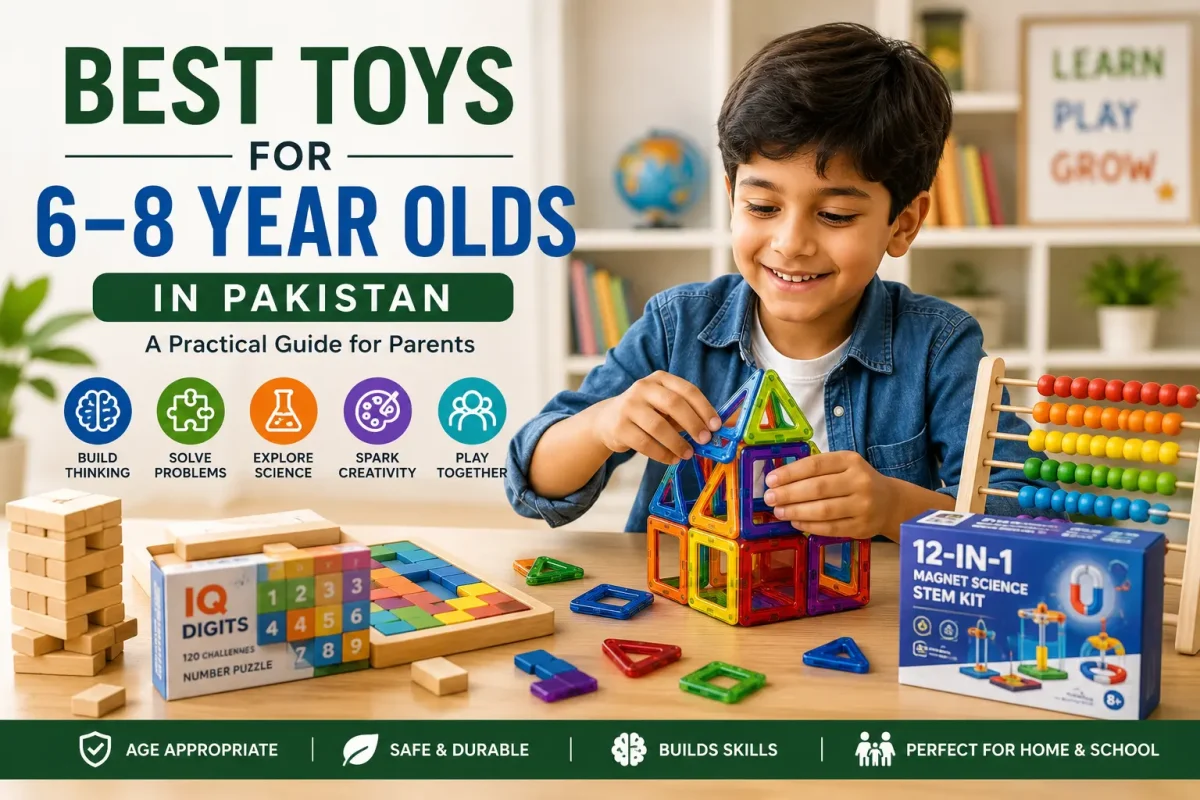
Best Toys for 6–8 Year Olds in Pakistan: A Practical Guide for Parents
Children between 6 and 8 are at an interesting stage. They are old enough to understand rules, follow multi-step activities and solve more challenging problems, but they still learn best when they are actively doing something.
That makes choosing toys a little different from choosing toys for toddlers or preschoolers.
At this age, the best toys for 6–8 year olds are not necessarily the ones with the most lights, sounds or features. A good toy can be surprisingly simple: building pieces, a challenging puzzle, a science activity, a strategy game or a creative project can keep a child engaged while giving them opportunities to think, experiment and make decisions.
For parents and gift buyers in Pakistan, there is another question: Which toy is actually worth buying?
This guide explains what to look for, which types of toys work well for ages 6–8, how to choose according to a child’s interests, and how to make a sensible choice at different budgets.
Why Toys for 6–8 Year Olds Are Different
By the early school years, children are becoming more independent in the way they play.
A six-year-old may enjoy building something by following instructions, while an eight-year-old may want to modify the design or create something completely different.
Children at this age can often enjoy activities involving:
- Problem-solving
- Construction and building
- Basic science concepts
- Numbers and logic
- Strategy
- Creativity
- Reading and language
- Imaginative play
- Family games
- Hands-on experiments
The important thing is not to treat age as a strict formula.
Two children who are both seven may have completely different interests. One may love puzzles, another may spend hours building things, while another may prefer drawing, music or pretend play.
The best toy is usually one that sits at the right level of challenge while matching the child’s interests.
7 Best Types of Toys for 6–8 Year Olds
Instead of looking for one “perfect” toy, it is more useful to understand the different types of play that children at this age can enjoy.
1. Building and Construction Toys
Building toys are a strong choice for children who enjoy making things.
Magnetic construction sets, blocks and model-building kits allow children to turn individual pieces into structures, vehicles or other creations.
They can encourage children to think about:
- Balance
- Shape
- Structure
- Planning
- Spatial relationships
- Trial and error
One advantage of construction toys is that there is rarely only one way to play.
A child might build a tower today, a vehicle tomorrow and an imaginary city the next day.
ToyRoots’ Magnetic Building Blocks for Kids – 3D STEM Construction Set is a useful option for children who enjoy construction and open-ended building.
For older children who enjoy more detailed construction, the 5-in-1 Metal Aircraft Building Kit offers a more structured model-building activity and is listed by ToyRoots for ages 8+.
2. Logic Puzzles and Brain Games
Some children would rather solve a problem than build a tower.
For them, logic puzzles and brain games can be excellent choices.
A good puzzle gives a child a clear challenge without immediately showing them the answer. They have to test ideas, notice patterns and sometimes start again after a mistake.
Look for puzzles involving:
- Spatial reasoning
- Patterns
- Number challenges
- Matching
- Strategy
- Sequencing
- Problem-solving
ToyRoots has a dedicated Educational Puzzles for Kids collection with options ranging from simple wooden puzzles to more challenging logic and number-based activities.
For a child who enjoys numbers, the IQ Digits: 120 Challenges Brain-Boosting Number Puzzle can be a particularly relevant option.
The goal is not to make every play session educational in a school-like sense. The child should still experience the satisfaction of solving a challenge for themselves.
3. STEM and Science Toys
STEM toys can become especially interesting as children get older because they can handle more detailed instructions and multi-step activities.
For ages 6–8, consider activities involving:
- Magnets
- Engineering
- Construction
- Simple machines
- Logic
- Measurement
- Experimentation
- Cause and effect
The important thing is to look beyond the word “STEM” on the packaging.
Ask:
What does the child actually do?
Do they build something?
Do they test an idea?
Do they predict what will happen?
Do they have to solve a problem?
Do they get different results when they change something?
Those questions are more useful than simply choosing a toy because it has “STEM” written on the box.
You can also explore ToyRoots’ STEM Toys collection for building, logic and hands-on science activities.
For an eight-year-old who is particularly interested in science, the 12-in-1 Magnet Science STEM Kit is a more advanced option and is listed for ages 8+.
4. Creative and Art-Based Toys
Not every six- to eight-year-old wants a puzzle or construction set.
Creative toys can be a better match for children who enjoy drawing, designing, making and decorating.
Consider:
- Drawing activities
- Craft kits
- Creative construction
- Model-making
- Writing activities
- Design projects
Creative play gives children an opportunity to make decisions without necessarily having one correct answer.
For example, there is a big difference between asking a child to copy a particular drawing and giving them materials to design their own vehicle, house, character or imaginary world.
The second activity gives them much more ownership over the result.
5. Strategy and Family Games
By age 6–8, many children are ready for games with clearer rules and simple strategy.
These can be especially useful for family play because the activity does not have to be limited to the child.
Depending on the child’s ability, consider:
- Strategy games
- Matching games
- Number games
- Board games
- Building challenges
- Turn-based games
A family game can also introduce concepts such as taking turns, following rules, planning ahead and handling both winning and losing.
ToyRoots’ Wooden Stacking Tower Game is one example of a simple hands-on game that can be played as a challenge rather than simply as a building activity.
6. Number and Maths Toys
Some children naturally enjoy numbers and patterns.
For these children, maths-related toys can make abstract concepts more tangible.
A wooden abacus, for example, allows children to physically move objects while counting and comparing quantities.
ToyRoots’ Classic Wooden Abacus & 100 Counting Sticks Set is an affordable hands-on maths activity, although parents should consider whether its difficulty level matches the individual child.
For a 6–8-year-old, the important thing is not necessarily whether a toy is labelled as a “maths toy.” What matters is whether it gives the child interesting problems to solve.
You can turn a simple counting activity into questions such as:
- Which group has more?
- How many are left?
- Can you make two groups with the same number?
- Can you find another way to make 10?
- What happens if we add three more?
That makes the toy a starting point for conversation and exploration.
7. Toys Connected to the Child’s Interests
Sometimes the smartest buying decision is simply to follow the child.
If a child loves:
Cars and vehicles:
Look for construction sets, vehicle puzzles or model-building activities.
Science:
Consider experiment kits, magnets and STEM activities.
Numbers:
Try logic puzzles, number challenges and counting games.
Building:
Choose magnetic construction sets, blocks or model kits.
Animals and dinosaurs:
Consider themed puzzles, models and educational activities.
Art:
Look for drawing and craft-based activities.
Games:
Choose strategy, logic or family games.
A toy becomes much more valuable when the child actually wants to use it.
How to Choose the Right Toy for a 6-, 7- or 8-Year-Old
Age should be your starting point—not your only criterion.
Before buying, use this simple five-question test.
1. Is It Appropriate for the Child’s Age?
Always check the manufacturer’s recommended age.
A toy that is too difficult can frustrate a child, while one that is far too easy may lose their interest quickly.
Also pay attention to small parts, magnets, tools and any supervision requirements.
2. Is the Difficulty Level Right?
A good toy should provide a challenge without becoming impossible.
Ask yourself:
Can the child understand the basic activity, but still have something to figure out?
That is often the sweet spot.
3. Can the Toy Be Used More Than Once?
A toy that provides only one short activity may have limited long-term appeal.
Open-ended building sets, puzzles, strategy games and creative activities can often be revisited in different ways.
That makes them particularly useful for families trying to avoid buying toys that are exciting for one day and forgotten the next.
4. Does It Match the Child’s Personality?
Think about how the child naturally spends their time.
Do they:
- Sit quietly and solve puzzles?
- Build things?
- Ask questions about how things work?
- Draw constantly?
- Prefer physical activities?
- Like competing?
- Enjoy playing with siblings?
Choose the toy around the child—not simply around the age printed on the box.
5. Will It Fit Your Home and Routine?
This is an underrated consideration for Pakistani families.
Before buying a large toy, think about:
- Storage space
- Number of pieces
- Whether it can be packed away easily
- Whether siblings can use it
- Whether parents need to supervise it
- Whether it is practical for indoor play
A compact puzzle can sometimes get far more use than a large toy that is difficult to store.
Best Toys for 6–8 Year Olds by Budget in Pakistan
Your budget does not have to determine whether a toy is meaningful.
Instead, think about the type of activity you are buying.
Under Rs. 1,000
At this level, look for:
- Simple wooden puzzles
- Small logic games
- Number activities
- Compact strategy games
- Basic creative activities
The important thing is to focus on the quality of the activity rather than the size of the box.
Rs. 1,000–2,500
This range can open up more substantial options such as:
- Building sets
- More advanced puzzles
- Creative learning activities
- Number and logic games
- Smaller STEM toys
For example, ToyRoots currently offers educational puzzles and logic products across a range of prices, including number puzzles, wooden logic games and spatial challenges. Prices and availability can change, so check the individual product page before ordering.
Rs. 2,500 and Above
At a higher budget, you can consider:
- Larger construction sets
- Advanced STEM kits
- Detailed model-building kits
- More challenging logic toys
- Multi-activity science kits
The 12-in-1 Magnet Science STEM Kit is one example of a more structured activity aimed at older children. Always check the current product page for the latest price and age recommendation before purchasing.
Educational Toys vs. “Just Fun” Toys
Parents sometimes feel that a toy must teach letters, numbers or science to be worthwhile.
It does not.
A game that teaches a child to take turns can be valuable.
A building set that encourages creativity can be valuable.
A puzzle that teaches persistence can be valuable.
A pretend-play activity that helps a child create stories can be valuable.
The best toys often combine fun and active thinking rather than looking like schoolwork.
The goal should not be to turn every minute of play into a lesson.
Children need opportunities to explore, make mistakes, invent games and simply enjoy themselves.
How Parents Can Make Toy Time More Valuable
You do not need to constantly teach your child while they play.
Instead, occasionally join them and ask open-ended questions.
During building:
“What are you trying to make?”
During a puzzle:
“Which piece could work here?”
During an experiment:
“What do you think will happen if we change this?”
During creative play:
“What happens next in your story?”
These questions encourage children to explain their thinking instead of simply looking for an adult to provide the answer.
And sometimes, the best thing a parent can do is step back and let the child figure it out.
Common Mistakes When Buying Toys for 6–8 Year Olds
Buying for the Parent Instead of the Child
A toy may look impressive to an adult but hold little interest for the child.
Think about what the child actually enjoys.
Choosing the Most Complicated Toy
More pieces and more features do not automatically mean a better toy.
The child should be able to understand the basic activity and gradually become more skilled at it.
Ignoring the Recommended Age
Always check the individual product’s age recommendation, particularly for toys containing small parts, magnets, tools or advanced components.
Buying Too Many Toys
Children do not necessarily need a large number of toys.
A smaller collection of varied, reusable activities can be easier to manage and may give each toy more attention.
Forgetting About Storage
Before ordering, consider where the toy and its pieces will live after playtime.
This matters particularly with construction sets and multi-piece games.
ToyRoots Picks to Consider
If you are shopping for a child in the 6–8 age range, these ToyRoots options may be worth exploring depending on the child’s interests:
For builders:
Magnetic Building Blocks for Kids – 3D STEM Construction Set
For an older child interested in engineering:
5-in-1 Metal Aircraft Building Kit
For science lovers aged 8+:
12-in-1 Magnet Science STEM Kit
For puzzle lovers:
Educational Puzzles for Kids
For families looking for more learning options:
Educational & Montessori Toys
Product availability, pricing and age guidance can change, so parents should always check the individual product page before ordering.
Frequently Asked Questions
What are the best toys for 6–8 year olds in Pakistan?
The best choice depends on the child’s interests. Building sets, logic puzzles, STEM activities, creative toys, strategy games and number-based activities are all useful options for this age group.
What is a good educational toy for a 6-year-old?
A six-year-old may enjoy building sets, age-appropriate puzzles, creative activities, simple strategy games and hands-on STEM toys. Choose something that provides a manageable challenge rather than something far beyond the child’s current ability.
What should I buy for a 7-year-old who gets bored easily?
Look for open-ended toys that can be used in different ways. Building sets, challenging puzzles, construction kits and strategy games can offer more replay value than toys with only one function.
What is a good STEM gift for an 8-year-old?
A science experiment kit, construction set, engineering activity or challenging logic puzzle can make a good STEM gift. ToyRoots’ 12-in-1 Magnet Science STEM Kit is specifically listed for ages 8+.
Are wooden toys still suitable for older children?
Yes. Wooden toys are not limited to toddlers. More challenging wooden puzzles, stacking games, strategy games and construction activities can also appeal to older children.
How much should I spend on a toy for a 6–8-year-old in Pakistan?
There is no single amount you need to spend. A simple puzzle or logic activity can provide meaningful play at a lower price, while larger construction sets and science kits may cost more. Choose according to the child’s interest, expected use and your budget rather than price alone.
Final Thoughts
Finding the best toys for 6–8 year olds does not mean finding the most expensive or most technologically advanced product.
Start with the child.
What do they enjoy? What challenges them? What do they keep asking questions about? What kind of play makes them lose track of time?
Then look for a toy that gives them something to build, solve, create, experiment with or imagine.
For Pakistani parents, a good toy should also make practical sense: check the recommended age, consider the available space at home, think about how often the toy can be reused and choose something that genuinely matches the child’s interests.
The right toy does more than occupy a child for an afternoon. It can give them a reason to think, try again, create something new and discover what they can do for themselves.
Related reading
All in Parenting Tips →
Eidi Gift Ideas for Kids in Pakistan: Thoughtful Gifts Beyond Cash
Eid is a time for family gatherings, delicious food, new clothes, and the excitement of receiving Eidi. For children, opening an envelope…
How to Clean and Maintain Kids’ Toys: A Parent’s Guide for Pakistan
Children touch their toys throughout the day. They carry them around the house, play with them on the floor, take them outside,…
How to Choose Wooden Toys for Kids in Pakistan: A Parent’s Guide
Choosing a toy for your child is about more than finding something colourful or entertaining. You want something they will enjoy, use…
