
No products in the cart.
Parenting Tips, ToyRoots Life
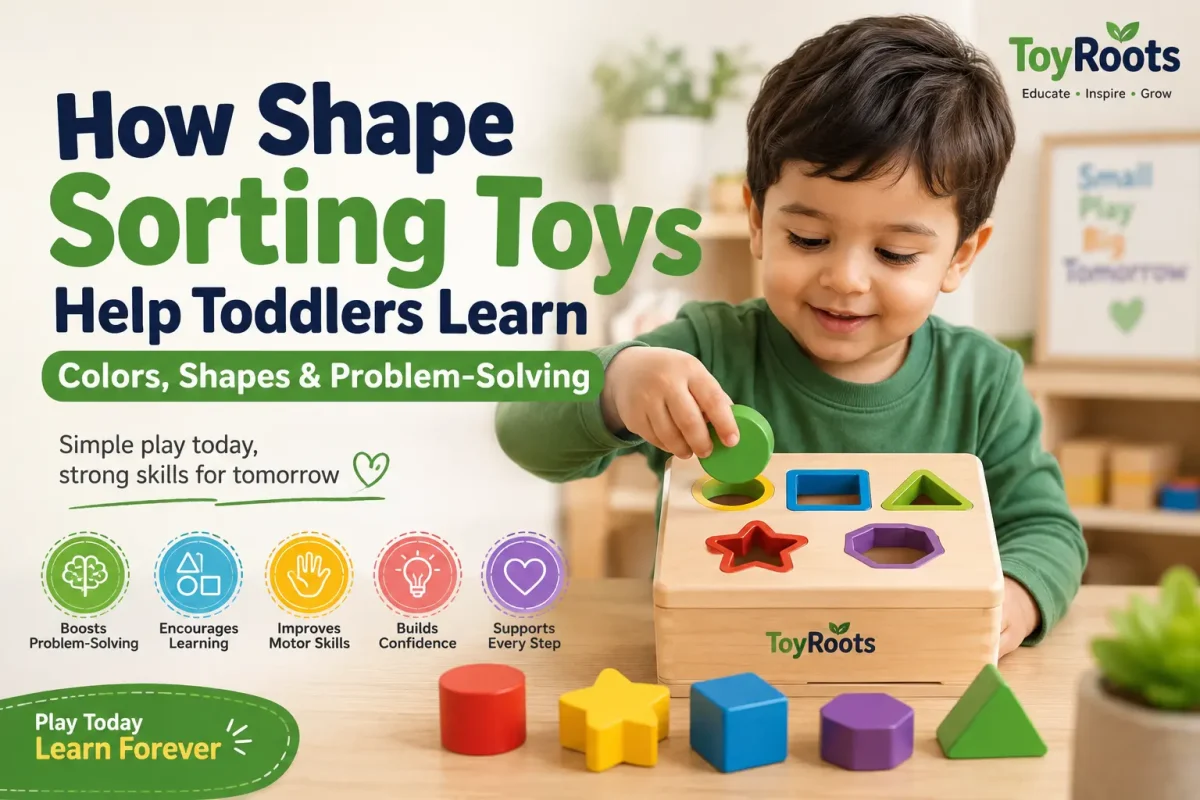
How Shape Sorting Toys Help Toddlers Learn Colors, Shapes & Problem-Solving
Toddlers learn best when they can touch, move, explore, and try things for themselves. A simple shape sorting toy may look like a basic activity, but for a young child, it can become a hands-on learning experience.
Shape sorters encourage children to recognize different shapes and colors, understand how objects fit together, and keep trying when something does not work the first time. This makes them a useful choice for parents looking for screen-free educational play at home.
At ToyRoots, shape and sorting toys are part of our collection of Montessori-inspired educational toys designed to make learning more interactive and enjoyable.
What Is a Shape Sorting Toy?
A shape sorting toy usually contains different pieces that a child needs to match with the correct opening, slot, or space.
For example, a child may have to find where a circle, triangle, square, star, or other shape belongs.
The activity looks simple, but the child is constantly observing, comparing, testing, and making decisions.
1. Shape Sorters Help Children Recognize Shapes
One of the first concepts children can explore with a sorting toy is shape recognition.
When toddlers repeatedly handle different pieces, they begin noticing that shapes are different from one another.
They may learn to recognize:
- Circles
- Squares
- Triangles
- Stars
- Hexagons
- Other basic geometric shapes

Repeated hands-on practice can make these concepts easier to understand than simply seeing pictures of shapes in a book.
2. They Introduce Color Recognition
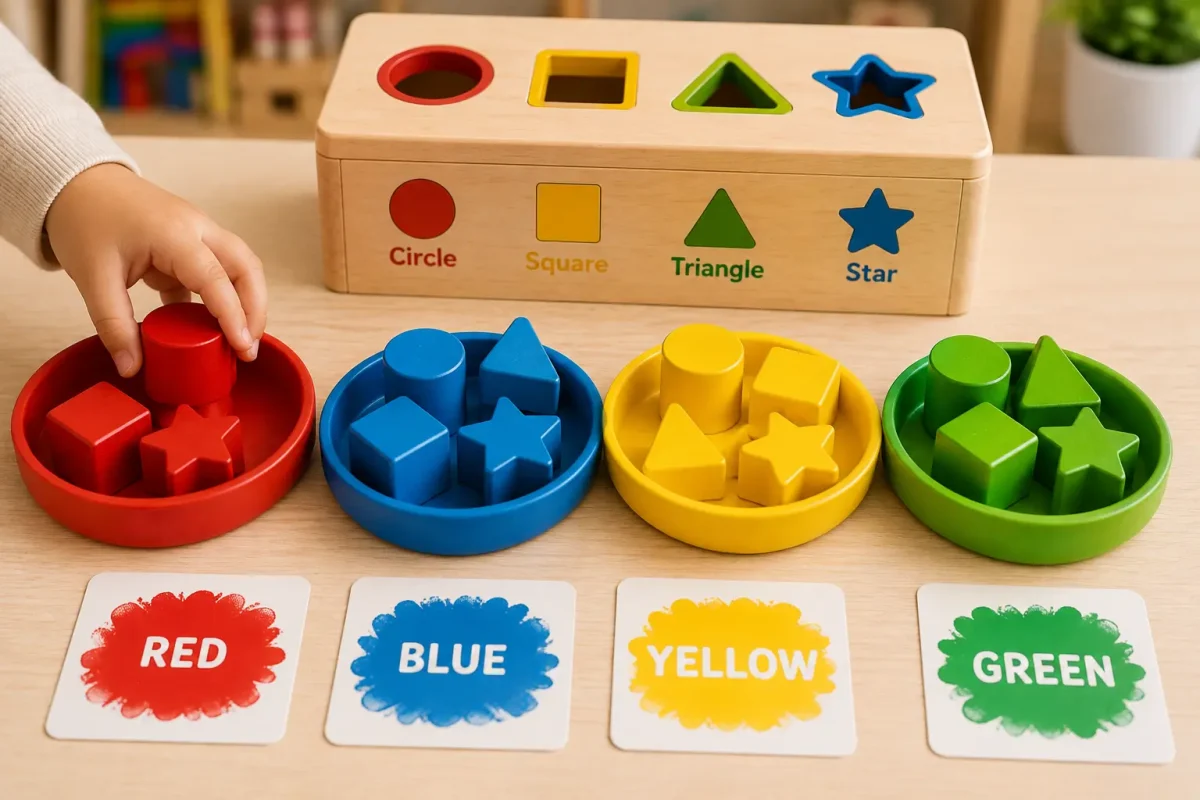
Many color sorting toys combine shapes with different colors.
This gives parents an easy opportunity to introduce simple concepts such as:
“Can you find the red piece?”
or
“Which one is blue?”
As children become more comfortable, parents can make the activity more challenging by asking them to match both characteristics:
“Can you find the red circle?”
This turns ordinary play into a small learning activity.
3. Shape Sorting Encourages Problem-Solving
A toddler may pick up a piece and try to put it into the wrong opening.
It doesn’t fit.
Instead of giving up immediately, the child has an opportunity to try another position or another opening.
That process is important.
The child is learning:
Try → Observe → Change → Try Again
This is an early form of problem-solving.
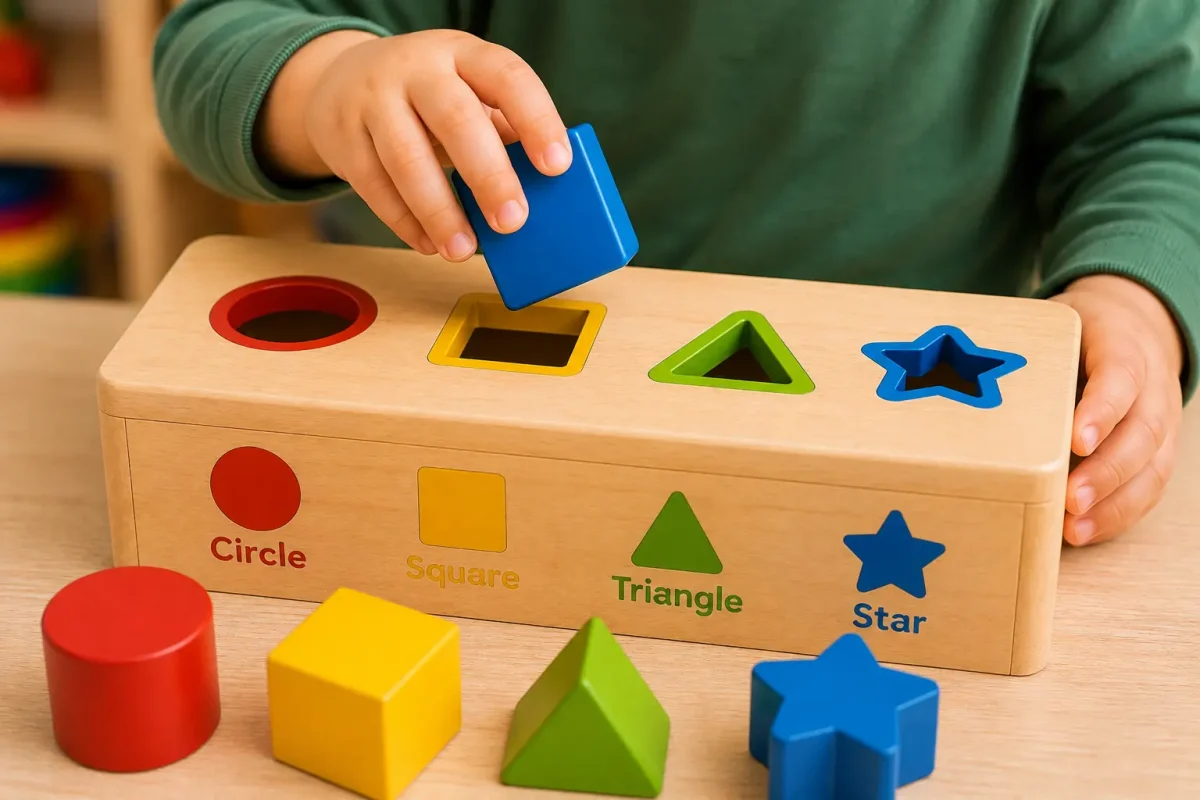
A sorting toy does not simply give children an answer. It gives them an opportunity to discover the answer themselves.
4. It Builds Hand-Eye Coordination
Children need to control their hands while looking at the position of the object.
They may need to:
- Pick up a piece
- Rotate it
- Move it toward an opening
- Adjust its position
- Place it correctly
These small movements require coordination between what the child sees and how the hands move.
With repeated play, children get more opportunities to practice these movements.
5. Shape Sorting Can Improve Fine Motor Skills
Holding, moving, rotating, and placing pieces requires controlled hand movements.
This makes shape sorting activities useful for practicing fine motor coordination during everyday play.
The activity is especially valuable because children are developing these skills while working toward a goal rather than simply repeating an exercise.
6. Children Learn Through Trial and Error
One of the best parts of a sorting toy is that mistakes are part of the activity.
A child may try the triangle in the square opening.
It doesn’t work.
The child tries again.
Eventually, they discover the correct match.
This teaches an important early lesson:
Making a mistake is not the end — try another way.
Parents can support this process without immediately solving the problem for the child.
Instead of saying, “That piece goes there,” try asking:
“Does it fit there?”
or
“Can you find another place for it?”
This allows the child to remain involved in the discovery process.
7. Sorting Toys Can Make Learning More Interactive
Young children can lose interest when learning becomes repetitive or passive.
Sorting changes the experience because children have something to physically do.
They can touch the pieces, compare them, move them around, and test different possibilities.
This is one reason hands-on Montessori-style activities are popular with parents who want learning to feel like play.
8. Parents Can Turn One Toy Into Many Activities
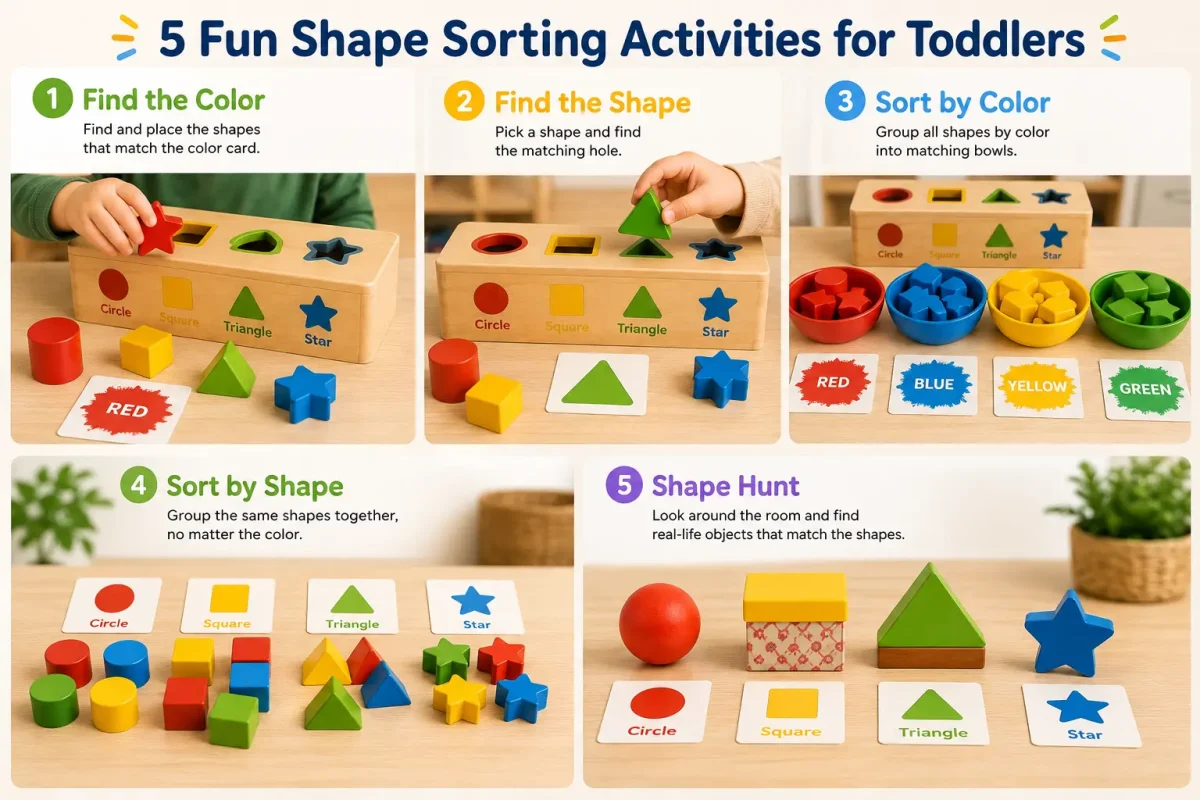
A sorting toy does not have to be used in only one way.
Once your child understands the basic activity, parents can introduce simple variations.
Activity 1: Find the Color
Place several pieces in front of your child and ask:
“Can you find the yellow one?”
Activity 2: Find the Shape
Ask:
“Where is the circle?”
Activity 3: Sort by Color
Place different colored pieces together and ask your child to group similar colors.
Activity 4: Sort by Shape
Ask your child to put similar shapes together.
Activity 5: Shape Hunt
Look around the room and find objects that resemble the shapes in the toy.
For example:
- A clock → circle
- A window → square or rectangle
- A book → rectangle
This helps children connect the toy with the real world.
9. How Parents Can Make Sorting Play More Effective
Parents don’t need to turn playtime into a formal lesson.
Keep the activity simple and enjoyable.
Start with a small number of pieces and let your child explore.
If your child struggles, give a small hint rather than immediately completing the activity.
For example:
“Try turning the piece.”
This gives the child another opportunity to solve the problem independently.
As their confidence grows, gradually introduce more shapes, colors, or challenging combinations.
What Age Is Best for Shape Sorting Toys?

The appropriate age depends on the individual toy and its design.
Parents choosing toys according to their child’s age can also explore our guide to educational toys by age.
For younger toddlers, simple and larger pieces are generally easier to handle. Older children can move toward more complex sorting and geometric activities.
Parents should always follow the age recommendation provided for the specific product and supervise young children during play.
Choosing the Right Shape Sorting Toy
When choosing a sorting toy, parents can consider:
✔ Age suitability
Choose an activity that matches your child’s developmental stage.
✔ Piece size
Younger children benefit from pieces that are easy to grasp and handle.
✔ Number of shapes
Start with simple shapes before moving to more complex combinations.
✔ Learning objective
Some toys focus mainly on shapes, while others combine shapes, colors, numbers, or logic.
✔ Material and construction
For wooden toys, look for smooth surfaces and child-friendly construction.
ToyRoots focuses on Montessori and STEM-inspired educational toys, with categories covering areas such as shapes, counting, puzzles, and logical thinking.
Final Thoughts
A shape sorting toy may look simple, but it can provide many opportunities for a toddler to learn.
Through sorting, matching, rotating, and experimenting, children can explore:
- Shape recognition
- Color recognition
- Problem-solving
- Fine motor coordination
- Hand-eye coordination
- Concentration
- Independent learning
Most importantly, children get to learn by doing.
Instead of simply telling a child what a circle or triangle is, a sorting activity allows them to discover the difference through their own hands and actions.
That is what makes purposeful play so powerful.
Explore Learning Through Play with ToyRoots
Looking for hands-on educational toys for your child?
Explore ToyRoots’ collection of Montessori, STEM, wooden puzzles, sorting toys, counting toys, and other learning-focused activities designed to make play more meaningful.
Related reading
All in Parenting Tips →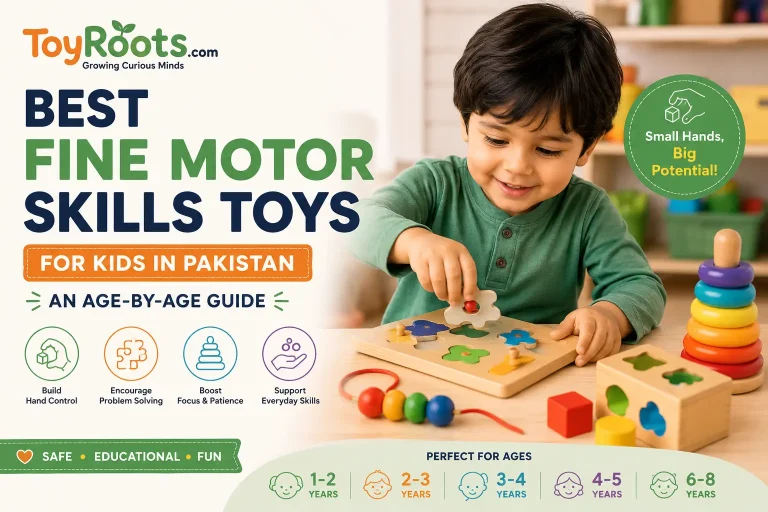
Best Fine Motor Skills Toys for Kids in Pakistan: An Age-by-Age Guide
Short answer Match the toy to what your child’s hands can already do. At 1, that means large-piece puzzles, stacking toys and…
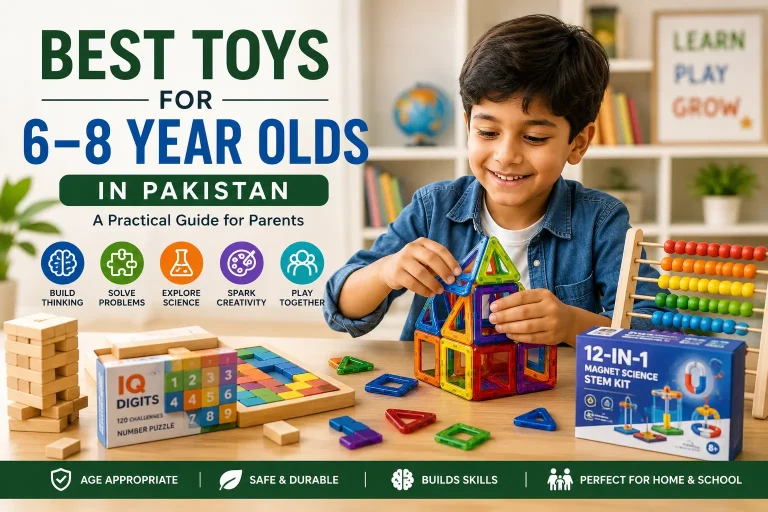
Best Toys for 6–8 Year Olds in Pakistan: A Practical Guide for Parents
Short answer By 6–8 children can follow rules and multi-step instructions, so the strongest choices are construction sets, logic puzzles, STEM kits,…
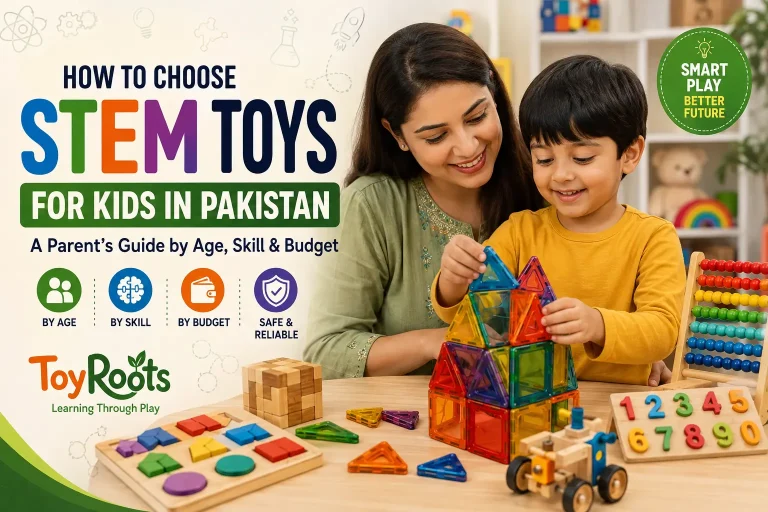
How to Choose STEM Toys for Kids in Pakistan: A Parent’s Guide by Age, Skill & Budget
Short answer Start with what your child is already drawn to — building, puzzles, or taking things apart — then match the…
