No products in the cart.
Parenting Tips
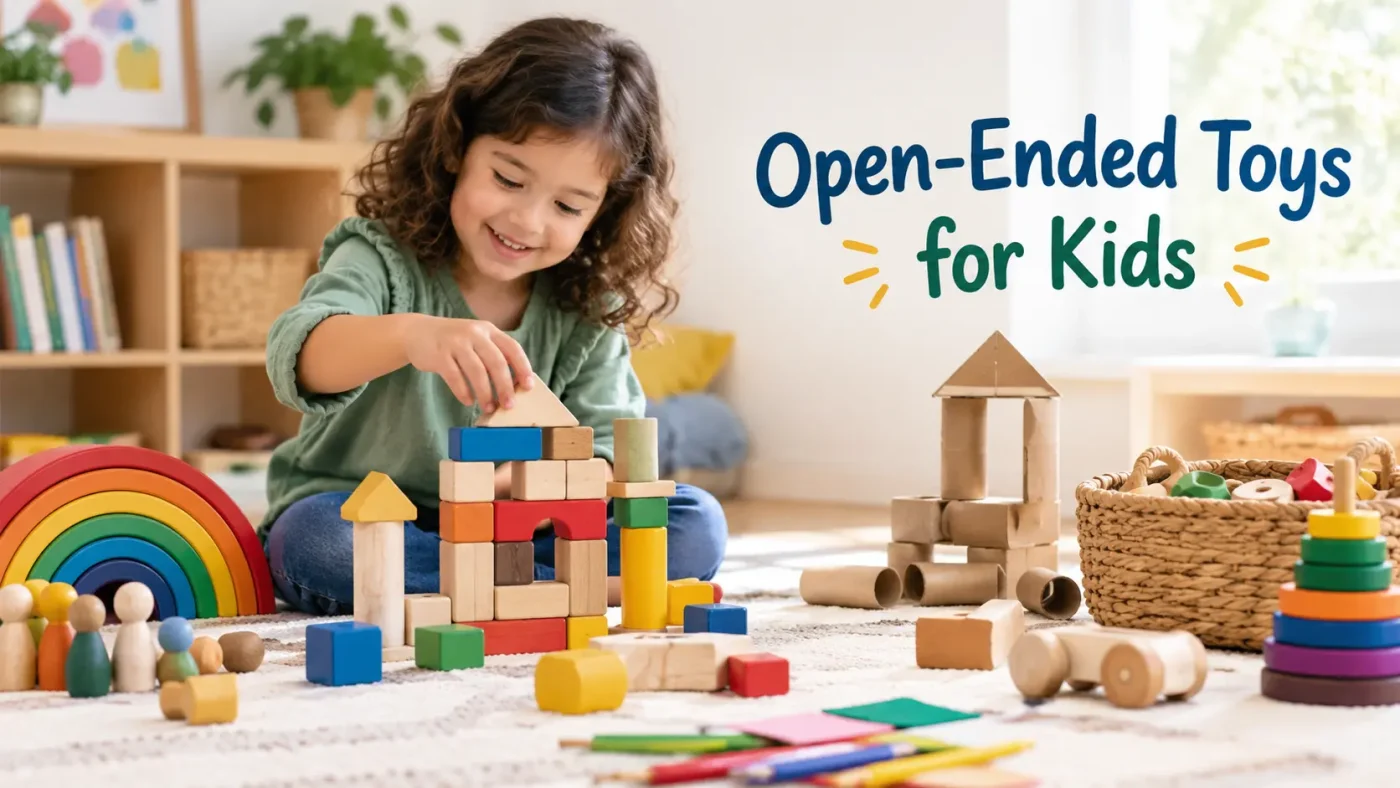
Open-Ended Toys for Kids in Pakistan: How to Choose Toys That Grow With Your Child
Buying toys for children can be surprisingly difficult.
There are educational toys, Montessori toys, STEM toys, puzzles, building sets, wooden toys, drawing toys, games, and hundreds of other options. But with so many choices available, parents often focus on what a toy is supposed to teach rather than what a child can actually do with it.
A useful question to ask before buying a toy is:
“How many different ways can my child play with this?”
That question leads us to open-ended toys for kids.
Open-ended toys are materials or toys that can be used in different ways and do not have only one correct result. A set of building pieces, for example, might become a tower today, a bridge tomorrow, and an imaginary house another day.
For parents in Pakistan, this can be a practical approach to buying toys. Instead of filling a child’s room with toys that each perform one specific function, a few versatile toys can provide many different play possibilities.
What Are Open-Ended Toys?
Open-ended toys are toys that give children freedom to decide how they want to use them.
There is usually no single “right” final result.
For example, a child using building pieces might create:
- A tower
- A house
- A bridge
- A vehicle
- A robot
- A geometric shape
- A pretend city
- Something completely different
The child decides what to build, changes the design, starts again, and experiments with new ideas.
This is different from a toy where the child is expected to complete one specific activity in one particular way.
That does not mean structured toys are bad.
Puzzles, matching games, number activities and logic games can all be valuable. They simply provide a different type of play.
A balanced toy collection can include both structured learning activities and open-ended toys.
Why Are Open-Ended Toys Useful for Children?
The main advantage of an open-ended toy is flexibility.
The same toy can support different types of play as the child develops.
1. They Encourage Creativity
When there is no single correct answer, children have to make decisions themselves.
Instead of being told exactly what to make, they can decide:
“What should I build?”
“What happens if I change this?”
“Can I make it taller?”
“Can I build something that can stand by itself?”
This gives children opportunities to experiment rather than simply follow instructions.
2. They Can Grow With the Child
One of the biggest advantages of versatile toys is that the child’s use of the toy can change over time.
A younger child may simply stack or connect pieces.
A preschooler may start making simple structures.
An older child may create more complicated designs, invent challenges, or combine construction with storytelling.
The toy has not necessarily changed.
The child’s way of using it has changed.
That is one reason open-ended toys can be a useful choice for parents who want more long-term play value from their purchases.
3. They Support Child-Led Play
Open-ended play gives children more control over the activity.
Instead of an adult constantly saying what to do next, the child can decide what happens.
For example, a parent can put building pieces on the floor and simply ask:
“What would you like to make?”
The child can then choose the project.
Parents can still help when needed, but the activity does not depend entirely on adult direction.
For more ideas about helping children become comfortable with self-directed play, see ToyRoots’ guide to independent play and creativity.
4. They Can Encourage Problem-Solving
Open-ended construction naturally creates small problems for children to solve.
A tower falls down.
A bridge is not strong enough.
Two pieces do not fit the way the child expected.
A structure keeps leaning to one side.
Instead of immediately giving the answer, parents can ask:
“What could we change?”
That simple question can turn a failed attempt into another opportunity to experiment.
Open-Ended Toys vs. Closed-Ended Toys
It is helpful to understand the difference between open-ended and closed-ended play.
| Open-Ended Toys | Closed-Ended Toys |
|---|---|
| Multiple possible outcomes | Usually one expected outcome |
| Child decides how to play | Activity often has defined instructions |
| Can be reused in different ways | Usually designed for a specific task |
| Encourages experimentation | Useful for practising specific skills |
| Building pieces are a common example | A traditional puzzle is a common example |
Neither type is automatically better.
A child may use a puzzle to practise matching and problem-solving, then move to building blocks and use imagination to create something completely new.
Both experiences can be valuable.
The important thing is to give children opportunities for different kinds of play.
What Are Some Examples of Open-Ended Toys?
There are many types of toys that can support open-ended play.
Building Blocks and Construction Toys
Construction toys are among the clearest examples.
Children can use the same pieces to create different structures and then take them apart and rebuild them.
For example, ToyRoots Magnetic Building Blocks allow children to create different 2D and 3D structures rather than following one fixed final design.
Depending on the child’s age and ability, the same type of construction activity can involve simple connecting, sorting and stacking or more complicated building projects.
Wooden Toys
Wooden toys can also provide open-ended play, depending on their design.
Wooden blocks, stacking materials, construction pieces and certain sorting activities can be used in different ways.
However, “wooden” does not automatically mean “open-ended.”
A wooden toy designed for one specific task may still be a structured toy.
Look at the actual play possibilities rather than the material alone. Parents can explore the ToyRoots wooden toys collection and evaluate each product based on its intended play, age recommendation and safety information.
Drawing and Creative Toys
Drawing is naturally open-ended.
Give a child a blank drawing surface and there is no single correct picture.
Today they may draw a house.
Tomorrow it might be a dinosaur.
The next day it could be a completely imaginary machine.
Creative activities can therefore provide children with freedom to decide what they want to make.
Pretend-Play Materials
Some toys become more open-ended when children use them in imaginative play.
A collection of building pieces might become a house.
A toy house might become part of a story.
A cardboard box might become a car, shop, rocket or hiding place.
The important part is not necessarily the product itself.
It is the child’s ability to give the materials a new purpose.
How to Choose Open-Ended Toys for Kids
Not every toy advertised as “creative” or “educational” is genuinely open-ended.
Before buying, ask a few simple questions.
Can My Child Use It in Different Ways?
If the toy has several possible uses, it has greater open-ended potential.
For example, construction pieces can be used for buildings, vehicles, patterns and imaginary creations.
Is There Only One Correct Answer?
If a toy always requires the child to reach exactly one result, it is more structured.
That is not necessarily a problem.
But if you specifically want open-ended play, look for toys where different results are possible.
Can the Toy Become More Challenging?
Think about how the toy might be used six months from now.
Will your child still be able to do something new with it?
A toy that can become more complicated as the child’s abilities develop can provide better long-term play value.
Can It Be Combined With Other Toys?
This is an often-overlooked quality.
Building pieces can become a garage for toy cars.
A construction set can become part of a pretend city.
A drawing activity can become part of a storytelling game.
The more easily a toy connects with other play materials, the more possibilities it may offer.
Choosing Open-Ended Toys by Age
The right open-ended toy still needs to be age-appropriate.
A toy that is interesting for a six-year-old may be too complicated—or potentially unsafe—for a toddler.
Always check the manufacturer’s recommended age and product-specific safety information.
Toddlers
For toddlers, simple open-ended play might involve:
- Stacking
- Sorting
- Connecting
- Large-piece building
- Simple shape exploration
- Moving and arranging objects
The activity does not need to be complicated.
A toddler repeatedly stacking and knocking down blocks is already exploring how objects behave.
Preschoolers
Preschool children can usually handle more possibilities.
They may:
- Build houses
- Create towers
- Make roads
- Sort pieces by colour
- Create patterns
- Invent stories
- Combine different toys
- Build structures for pretend play
This is a particularly useful age for construction and creative materials.
School-Age Children
Older children can turn open-ended materials into more challenging projects.
They may:
- Design their own structures
- Create engineering challenges
- Invent games
- Build models
- Test different designs
- Combine construction with storytelling
- Create projects for siblings or parents
At this stage, the best toy may be one that does not become “too easy” quickly.
Open-Ended Toys for Siblings
Open-ended toys can also be useful for families with children of different ages.
Imagine a family with a 3-year-old and a 6-year-old.
The younger child may sort, stack and connect pieces.
The older child may plan a structure or create a more complicated design.
They are using the same toy, but they do not have to play at exactly the same level.
This is one reason construction toys can work well for sibling play.
The goal is not to make both children do exactly the same thing.
Instead, look for different roles within the same activity.
For example:
- Younger child chooses pieces.
- Older child plans the structure.
- Both children build together.
- Older child creates a challenge.
- Younger child tests the finished structure.
This approach can make shared play more realistic when there is an age gap. For more ideas, see our guide to choosing toys for siblings to play together.
Are Montessori Toys Open-Ended?
Not automatically.
Montessori and open-ended are not the same thing.
A Montessori-inspired toy may have a very specific learning purpose.
For example, a sorting activity can help a child focus on matching colours or shapes.
That does not necessarily make it an open-ended toy.
On the other hand, certain Montessori-inspired wooden materials may allow children to explore, combine, sort or use the materials in different ways.
So rather than choosing a toy simply because the product is labelled “Montessori,” look at what the child will actually do with it.
Parents interested in hands-on Montessori-inspired activities can explore the ToyRoots Montessori toys collection.
Ask:
“After the first activity, what else can my child do with this?”
That is a more useful question.
Can STEM Toys Be Open-Ended?
Yes, some STEM toys can provide open-ended play.
Construction activities are a good example.
A child might build a structure, discover that it falls, change the design and try again.
They might experiment with:
- Balance
- Shapes
- Structure
- Size
- Connections
- Spatial relationships
- Different designs
But not every STEM toy is open-ended.
Some STEM activities are designed around a specific experiment or challenge.
Again, the important thing is to look at the actual play experience rather than the label.
ToyRoots’ STEM toys collection includes construction, logic, puzzle and hands-on learning options, so parents can choose between more structured challenges and more flexible building activities.
Open-Ended Toys Can Be Useful for Small Homes Too
Families do not need a huge playroom to give children varied play opportunities.
In fact, versatile toys can be particularly useful when storage space is limited.
Instead of buying five toys that each perform one activity, a single construction set might provide:
- Building
- Sorting
- Shape exploration
- Creative design
- Problem-solving
- Pretend play
This does not mean one toy should replace everything.
It simply means that play value matters more than the number of toys on the shelf.
Parents can also use toy rotation to keep a smaller collection interesting.
Keep some toys available and put others away for a while. When they return, familiar materials may feel interesting again because the child approaches them with new ideas or skills.
For families dealing with limited storage space, ToyRoots also has a guide to choosing toys for small homes in Pakistan.
How to Get More Open-Ended Play From a Toy
Parents do not always need to buy another product.
Sometimes a small change in how you present an existing toy is enough.
Try Asking Questions
Instead of:
“Build a tower.”
Try:
“What can you build?”
Instead of:
“Make this shape.”
Try:
“Can you make something that stands?”
Instead of solving every problem, ask:
“What could we try differently?”
These questions give children more ownership of the activity.
Add a Simple Challenge
Once a child is comfortable with a toy, introduce a challenge.
For example:
- Can you build the tallest tower?
- Can you make a bridge?
- Can you build something using only five pieces?
- Can you make a house for a toy figure?
- Can you create something that can stand without falling?
The challenge creates a new reason to use the same toy.
Safety Still Matters
Open-ended does not mean risk-free.
Parents should always consider the child’s age and how the toy is likely to be used.
Before giving a toy to a child, check:
- Manufacturer’s recommended age
- Small pieces
- Magnets
- Detachable parts
- Materials
- Moving parts
- Battery compartments where applicable
- Whether supervision is recommended
This becomes particularly important when younger siblings are in the same home.
A toy purchased for an older child may still be accessible to a toddler.
So think about the youngest child who may come into contact with the toy, not only the child for whom it was purchased.
ToyRoots also recommends considering age and safety alongside the learning or interest level of a product. Parents should always check the individual product information before purchase.
A Simple Checklist Before Buying an Open-Ended Toy
Before adding a new toy to your child’s collection, ask:
Play Value
- Can my child use it in several ways?
- Can it be used again and again?
- Can it be combined with other toys?
Age
- Is it appropriate for my child’s age?
- Is the difficulty suitable for their current ability?
Interest
- Does my child enjoy building?
- Do they like drawing?
- Do they enjoy sorting?
- Are they interested in pretend play?
- Do they like solving problems?
Practicality
- Is it easy to store?
- Does it contain too many pieces?
- Will it realistically be used in our home?
Safety
- Have I checked the manufacturer’s age recommendation?
- Are there small parts or magnets?
- Could a younger sibling access the toy?
If a toy passes these basic checks, it may be a strong addition to your child’s play collection.
Frequently Asked Questions
What are open-ended toys for kids?
Open-ended toys are toys that can be used in multiple ways and do not have only one fixed outcome. Building blocks, construction pieces, drawing materials and certain creative toys are common examples.
What is the best open-ended toy for kids?
There is no single best open-ended toy for every child. Building and construction toys are a popular choice because children can create many different structures, but the right choice depends on the child’s age, interests and abilities.
Are open-ended toys better than educational toys?
Not necessarily. They support different types of play. Structured educational toys can help children practise specific skills, while open-ended toys provide greater freedom for creativity, experimentation and child-led play.
Are wooden toys open-ended?
Some wooden toys are open-ended, particularly blocks, stacking materials and certain construction toys. However, being made from wood does not automatically make a toy open-ended.
Are Montessori toys open-ended?
Some Montessori-inspired toys can support open-ended exploration, but Montessori and open-ended are different concepts. Parents should evaluate the actual play possibilities of each product.
Are open-ended toys good for siblings?
They can be particularly useful when siblings have different ages or abilities. One child can perform a simpler part of the activity while an older child takes on a more challenging role.
Can open-ended toys help independent play?
They can give children more freedom to decide what they want to make, explore or try. Parents can support this by providing an age-appropriate environment and allowing children time to experiment before stepping in.
Are STEM toys open-ended?
Some are and some are not. Construction-based STEM toys often allow multiple designs and experiments, while other STEM products may focus on a specific experiment or challenge.
Final Thoughts
Choosing a toy does not always have to start with the question:
“What does this toy teach?”
Try asking another question:
“What can my child do with it?”
That small change can make a big difference.
A good open-ended toy does not tell a child exactly what the final result should look like. It gives them materials, possibilities and room to make decisions.
A set of building pieces can become a tower today, a bridge tomorrow and an imaginary city next week.
A drawing surface can become a picture, a map, a story or an invention.
And the same toy can become more interesting as the child becomes more capable.
For Pakistani parents, open-ended toys can therefore be a practical part of a balanced toy collection. They can sit alongside puzzles, number activities, logic games, Montessori-inspired materials and STEM toys rather than replacing them.
The goal is not to buy more toys.
The goal is to choose toys that give children more ways to play, create, think and explore.
When you are choosing your child’s next toy, don’t only ask how exciting it looks in the box.
Ask what your child might be able to create once the box is opened.
Related reading
All in Parenting Tips →
Eidi Gift Ideas for Kids in Pakistan: Thoughtful Gifts Beyond Cash
Eid is a time for family gatherings, delicious food, new clothes, and the excitement of receiving Eidi. For children, opening an envelope…
How to Clean and Maintain Kids’ Toys: A Parent’s Guide for Pakistan
Children touch their toys throughout the day. They carry them around the house, play with them on the floor, take them outside,…
How to Choose Wooden Toys for Kids in Pakistan: A Parent’s Guide
Choosing a toy for your child is about more than finding something colourful or entertaining. You want something they will enjoy, use…
