No products in the cart.
Parenting Tips
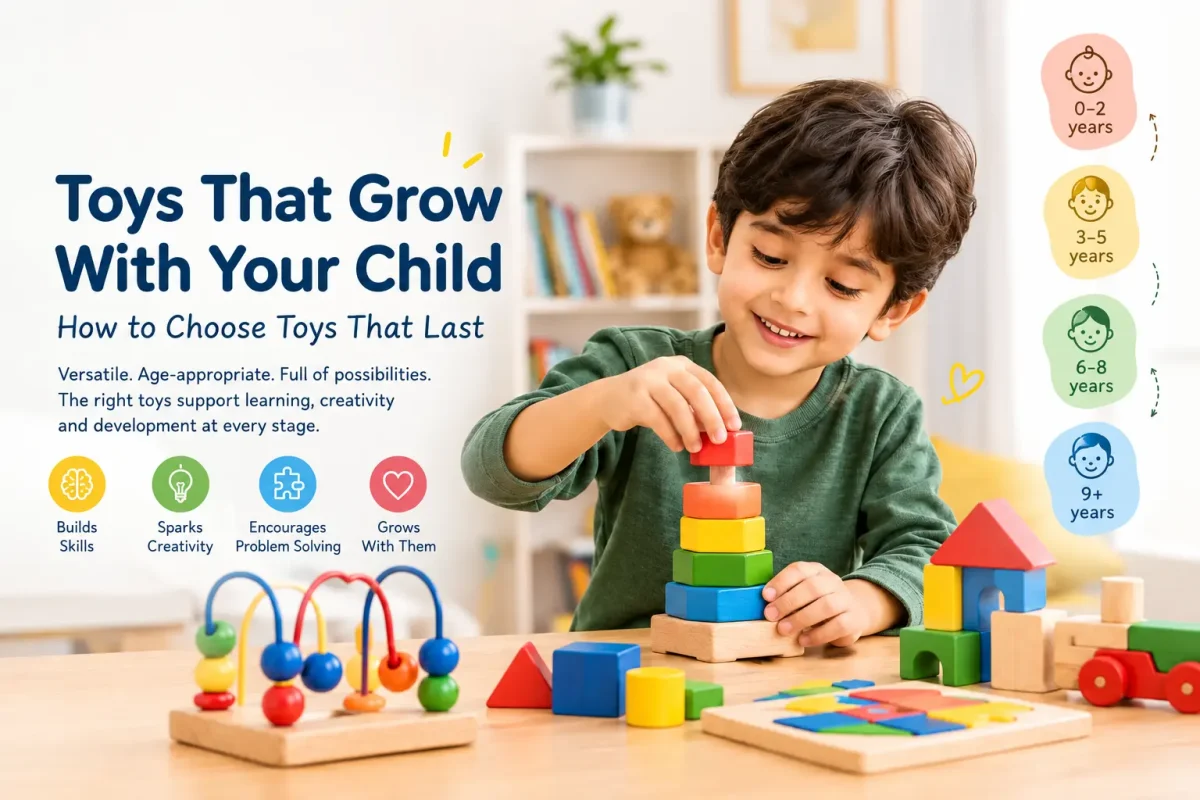
Toys That Grow With Your Child: How to Choose Toys That Last
Buying toys for children can become surprisingly expensive.
A toy may look exciting when it arrives, only for your child to lose interest after a few days. Then they outgrow it, move on to something more challenging, or simply discover that there is only one way to play with it.
For parents in Pakistan, this can be especially frustrating. You want toys that are fun, useful, safe and worth the money—not products that fill the toy box for a few weeks and then sit untouched.
One useful way to think about toy shopping is to look for toys that grow with your child.
These are toys that can be used in different ways as a child’s abilities, interests and imagination develop. A younger child may explore the basic features of a toy, while an older child can use the same materials for more complex building, problem-solving, storytelling or creative play.
The goal is not to find one magical toy that works for every age.
Instead, look for toys that offer more than one level of play.
What Does “Toys That Grow With Your Child” Mean?
A toy that grows with your child is one that remains useful as the child develops new skills.
For example, a building set might first be used by a young child for stacking and connecting pieces. Later, the same child may use it to build houses, vehicles, bridges or more complicated structures.
The physical toy has not changed.
The child’s way of using it has.
This is one reason simple toys can remain interesting for longer than toys with lots of lights, sounds or buttons. The American Academy of Pediatrics recommends choosing toys that match a child’s current abilities while also encouraging new skills. It also highlights traditional toys such as blocks, shapes and puzzles as useful tools for problem-solving, fine-motor development and early learning.
A toy does not necessarily need more features to provide more learning.
Sometimes it needs more possibilities.
Why Toys That Grow With Children Can Be a Better Choice
1. Children can use them at different skill levels
A child does not suddenly become a completely different player on their birthday.
Skills develop gradually.
A puzzle that feels difficult today may become easy a few months later. A building activity that once required help may eventually become something your child completes independently.
A versatile toy gives children room to improve.
Instead of replacing the toy every time the child develops a new skill, you can introduce a new challenge using the same materials.
2. They encourage repeated play
A toy with only one obvious purpose can become predictable quickly.
For example, if a toy always performs the same action when a child presses the same button, there may be little reason to explore it differently.
A construction set, puzzle, sorting activity or creative material can work differently.
Today your child might build a tower.
Tomorrow they might create a bridge.
Later they may invent a whole pretend city.
This type of repeated exploration is one reason educators often value simple, open-ended materials. NAEYC notes that basic materials such as blocks can support creative thinking because children can use them in many different ways.
3. They can offer better value for money
The most expensive toy is not necessarily the toy that provides the most value.
A better question is:
How many different ways can my child use this toy?
A reasonably priced building set that gets used regularly for months may provide more value than a more expensive toy that is exciting for one afternoon.
This is particularly useful for families shopping on a budget.
Instead of buying a separate toy for every developmental skill, consider whether one versatile toy can support several types of play.
4. They leave room for imagination
Children do not always play with toys in the way adults expect.
A collection of blocks can become a house.
Then it becomes a garage.
Then a zoo.
Then something completely different.
That freedom is valuable because children are making decisions about what to create rather than simply following a predetermined sequence.
HealthyChildren.org also recommends giving preschool-age children access to open-ended toys and everyday objects that can be used in different ways, allowing them to exercise imagination and creativity.
What Makes a Toy Grow With a Child?
Not every toy needs to be completely open-ended to remain useful.
When shopping, look for several of these qualities.
1. Multiple ways to play
The strongest sign is versatility.
Ask:
- Can my child use it in more than one way?
- Can the activity become more difficult over time?
- Can my child create something different each time?
- Can the toy be combined with other toys?
Building blocks are a good example because the same pieces can support simple construction, pattern-making, engineering challenges and imaginative play.
2. Increasing difficulty
A toy becomes more valuable when your child can gradually move from simple to more challenging activities.
For example:
Early stage:
Stacking, sorting and exploring.
Next stage:
Copying simple patterns or building basic structures.
Later stage:
Following a design, solving a problem or creating something independently.
The toy stays the same, but the challenge changes.
3. Room for creativity
A good toy does not always tell a child exactly what the final result should look like.
Give children materials and let them make decisions.
NAEYC describes this type of playful exploration as valuable because children can experiment, solve problems and make choices while remaining active participants in the process.
4. The ability to combine it with other toys
Think beyond the toy itself.
Can your child combine building pieces with toy cars?
Can a puzzle lead to a storytelling game?
Can sorting pieces become part of a pretend shop?
Can a construction set become the setting for imaginative play?
The more easily a toy connects with other activities, the more possibilities it can offer.
5. Age-appropriate safety
“Toys that grow with your child” does not mean ignoring the manufacturer’s age recommendation.
Safety comes first.
Age recommendations help parents judge whether a toy is suitable for a child’s developmental abilities and whether features such as small parts may present a risk. For more practical guidance, read ToyRoots’ Toy Safety in Pakistan: A Parent’s Guide.
A toy may remain interesting for an older child, but that does not automatically mean it is appropriate for a younger sibling.
Always check the recommended age, especially when toys contain small pieces, magnets or other components that require careful supervision.
Best Types of Toys That Can Grow With Your Child
You do not need to search for one particular product category.
Several traditional toy types can provide different levels of play as children develop.
Building Blocks and Construction Toys
Construction toys are among the clearest examples of toys that can grow with a child.
A younger child can start by:
- Connecting pieces
- Stacking pieces
- Exploring shapes
- Making simple structures
As their skills improve, they can:
- Build larger structures
- Copy patterns
- Experiment with balance
- Design vehicles or buildings
- Solve construction challenges
- Create imaginative worlds
ToyRoots’ Magnetic Building Blocks are a natural example of this type of play. Rather than having one fixed outcome, children can use the pieces to create different 2D and 3D structures.
The important point is not simply that the toy is labelled “educational.”
It is that the child can keep finding new things to do with it.
Puzzles
Puzzles can also develop with the child.
A young child may start with a simple puzzle involving large pieces, shapes or familiar objects.
Later, they can move toward:
- More pieces
- More complicated pictures
- Pattern puzzles
- Logic challenges
- Problem-solving games
- 3D or spatial puzzles
ToyRoots’ educational puzzles for kids include different types of hands-on challenges that can become more demanding as children develop their skills.
The important thing is to increase the challenge gradually.
If a puzzle is far beyond the child’s current ability, it may create frustration rather than enjoyable learning.
Sorting and Matching Toys
Sorting activities may appear simple, but they can become more challenging as children learn new concepts.
A younger child might sort by:
- Colour
- Shape
- Size
Later, you can introduce:
- Multiple categories
- Patterns
- Counting
- Matching rules
- Timed challenges
- Simple problem-solving
ToyRoots offers educational toys including sorting, geometric and hands-on learning activities that can work well for this kind of exploration.
Creative and Drawing Toys
Drawing materials are another category that can change with a child’s abilities.
A young child may simply make marks on paper.
Later, those marks can become:
- Shapes
- Pictures
- Letters
- Stories
- Diagrams
- Creative projects
The material has not necessarily changed.
The child’s ability to use it has.
This is an important reminder that parents do not always need to buy increasingly complicated toys. Sometimes the same simple material becomes more valuable as the child grows.
Logic and Strategy Games
Older preschoolers and school-age children can benefit from toys that introduce rules, planning and problem-solving.
These might include:
- Logic puzzles
- Matching challenges
- Strategy games
- Construction challenges
- STEM activities
Parents looking for more advanced hands-on challenges can explore ToyRoots’ STEM toys for kids, where construction, logic, science and problem-solving activities offer different levels of challenge.
The key is to match the difficulty to the child.
A challenge should make them think without making them feel that they cannot succeed.
How to Choose a Toy for Different Ages
Instead of asking only “What toy is right for a 3-year-old?”, ask:
“How could this child use this toy now, and how might they use it later?”
For Younger Toddlers
Look for:
- Large, easy-to-handle pieces
- Simple stacking activities
- Basic sorting
- Shape exploration
- Simple puzzles
- Safe sensory exploration
At this stage, the child is often discovering what objects do.
Around Ages 2–3
Children can begin using toys more intentionally.
Look for activities involving:
- Matching
- Sorting
- Simple construction
- Basic puzzles
- Colours and shapes
- Early counting
- Simple pretend play
Do not worry if the child does not use the toy “correctly.”
Exploration is part of learning.
Around Ages 3–5
Children can often handle more complex activities.
Consider:
- Building sets
- More challenging puzzles
- Pattern activities
- Logic games
- Creative materials
- Pretend-play accessories
- Simple STEM activities
At this stage, children may begin creating their own challenges rather than simply completing the ones provided.
Ages 5–8
Older children may be ready for:
- More complicated construction
- Strategy games
- Advanced puzzles
- STEM kits
- Multi-step challenges
- Detailed creative projects
A toy that once supported basic construction may now become the starting point for engineering or problem-solving.
How to Know If Your Child Is Ready for the Next Level
You do not necessarily need to wait for a specific birthday.
Watch what your child is already doing.
Your child may be ready for a greater challenge when they:
- Complete the activity easily
- Ask for something harder
- Create their own variations
- Use the toy in unexpected ways
- Finish quickly and immediately want another challenge
- Explain their own strategy
- Combine the toy with other materials
For example, if your child can easily complete a familiar puzzle, you might introduce a puzzle with more pieces or a different type of problem.
If they are building simple towers confidently, introduce a challenge such as:
“Can you build a bridge that connects these two objects?”
The goal is to increase the thinking—not simply increase the number of pieces.
Don’t Buy a Toy Only Because It Says “Educational”
The word educational can make a product sound automatically valuable.
But the label itself tells you very little.
Ask what the child actually does with the toy.
Does the child:
- Make decisions?
- Solve problems?
- Build something?
- Experiment?
- Create?
- Communicate?
- Practise a physical skill?
- Try again after something fails?
The American Academy of Pediatrics cautions parents not to assume that the word “educational” automatically means a toy provides everything a child needs for development. It emphasises the importance of creative, flexible and social play as well.
A simple set of blocks can sometimes offer more meaningful hands-on play than a complicated electronic toy.
A Simple Toy-Buying Rule for Pakistani Parents
Before buying a new toy, ask these five questions:
1. Will my child actually enjoy using it?
Interest matters.
2. Can they use it in more than one way?
More possibilities usually mean more opportunities for repeated play.
3. Can the challenge increase as they improve?
A toy does not have to become physically different to become more challenging.
4. Is it safe and age-appropriate?
Always check the manufacturer’s age recommendation and any relevant safety information.
5. Will it add something different to the toys we already have?
If your child already owns three similar puzzles, another puzzle may not add much value.
Sometimes the better purchase is a construction toy, creative activity or logic game that introduces a completely different type of play.
A Smaller Toy Collection Can Be More Useful
You do not need a room full of toys to give your child rich play opportunities.
A practical collection might include:
One construction toy
For building and experimenting.
One or two puzzles
For focused problem-solving.
One sorting or counting activity
For early concepts and hands-on learning.
Creative materials
For drawing and making.
One logic or strategy activity
For children who are ready for structured challenges.
A favourite pretend-play item
For imagination and storytelling.
This type of collection can provide variety without constantly buying new toys.
And when a child seems bored, you can sometimes change how the toy is presented rather than immediately buying something new.
How Parents Can Make One Toy More Challenging
You can often extend a toy without purchasing additional accessories.
For a building set, try:
Challenge 1: Build the tallest tower you can.
Challenge 2: Build a bridge.
Challenge 3: Make something that can hold a small toy.
Challenge 4: Build a house with a door and windows.
Challenge 5: Create something and explain what it does.
For a sorting toy:
Challenge 1: Sort by colour.
Challenge 2: Sort by shape.
Challenge 3: Sort by size.
Challenge 4: Create a repeating pattern.
Challenge 5: Ask the child to invent their own sorting rule.
The same physical toy can therefore provide very different experiences.
What About Toys That Children Outgrow?
Some toys are naturally designed for a particular developmental stage, and that is perfectly fine.
You should not feel that every toy needs to last for years.
A rattle, early shape sorter or first puzzle may have a relatively short useful period.
The goal is not to avoid these toys.
Instead, try to balance them with a few versatile toys that can stay interesting for longer.
Think of your toy collection as a mixture of:
- Stage-specific toys for a particular skill or age
- Growing toys that become more challenging over time
- Favourite toys that your child simply enjoys
There is value in all three.
Final Thoughts: Buy for the Next Stage, Not Just Today
The best toy is not necessarily the newest, biggest or most expensive one.
It is the toy that your child wants to pick up again.
A good toy that grows with your child gives them room to explore what they can do today while leaving possibilities for tomorrow.
A building set can become more complex.
A puzzle can become more challenging.
A sorting activity can become a pattern or counting game.
A drawing tablet or creative material can move from simple marks to pictures, letters and stories.
And as children grow, the most valuable change may not be in the toy at all.
It may be in the child using it.
When shopping for educational toys in Pakistan, look beyond the box and the marketing label. Consider your child’s current interests, abilities, safety needs and the different ways they could use the toy over time.
At ToyRoots, the aim is simple: choose toys that give children a reason to come back, explore, build, solve and create.
Because a toy does not need to teach everything.
Sometimes, it just needs to give a child enough possibilities to discover something new each time they play.
Related reading
All in Parenting Tips →
Eidi Gift Ideas for Kids in Pakistan: Thoughtful Gifts Beyond Cash
Eid is a time for family gatherings, delicious food, new clothes, and the excitement of receiving Eidi. For children, opening an envelope…
How to Clean and Maintain Kids’ Toys: A Parent’s Guide for Pakistan
Children touch their toys throughout the day. They carry them around the house, play with them on the floor, take them outside,…
How to Choose Wooden Toys for Kids in Pakistan: A Parent’s Guide
Choosing a toy for your child is about more than finding something colourful or entertaining. You want something they will enjoy, use…
