No products in the cart.
Parenting Tips
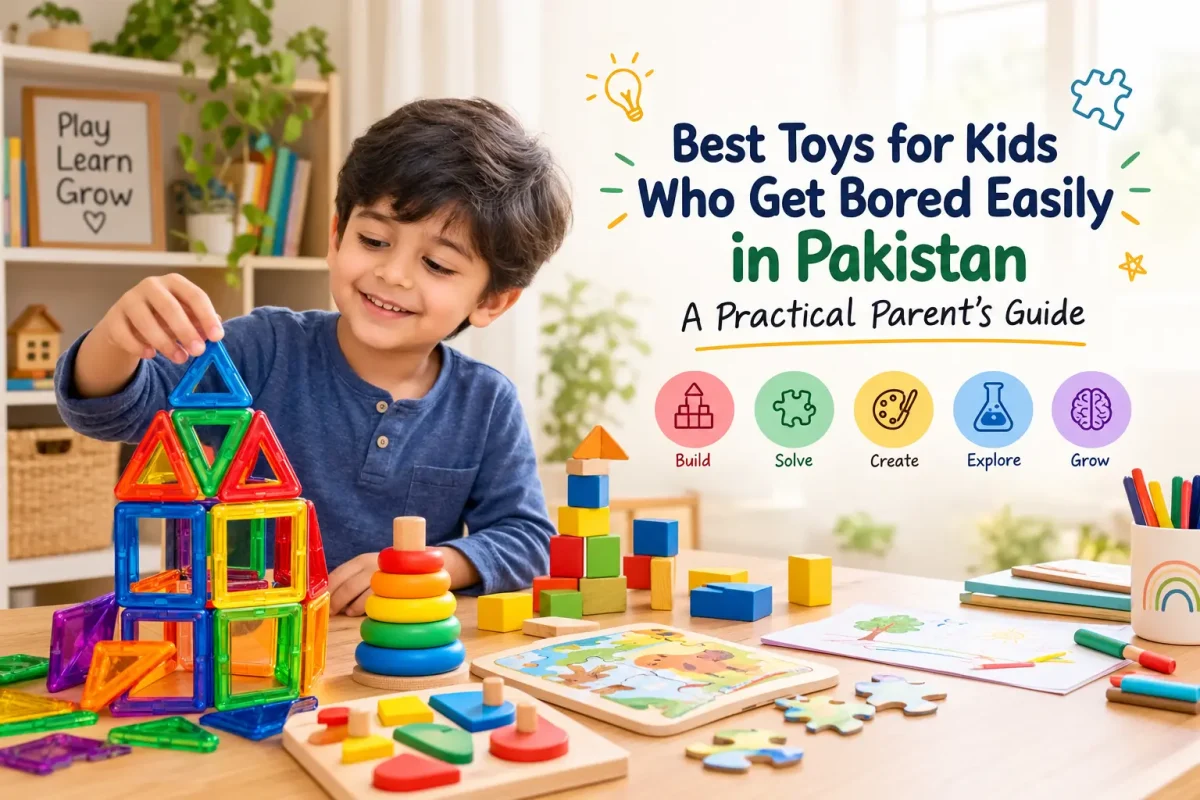
Best Toys for Kids Who Get Bored Easily in Pakistan: A Practical Parent’s Guide
“Ammi, I’m bored.”
Many parents hear this even when the house is already full of toys.
There may be puzzles, blocks, drawing supplies, games and educational toys sitting on shelves, yet a child can lose interest after only a few minutes. This does not necessarily mean that the child needs more toys. Often, the bigger question is whether the toys they have give them enough ways to play.
The best toys for kids who get bored easily are not necessarily the biggest, newest or most expensive ones. They are usually toys that can be used in different ways, provide an appropriate challenge, and allow children to make their own choices.
For Pakistani parents, this also means thinking about value. A toy that costs more but is used repeatedly may be more useful than several inexpensive toys that quickly end up forgotten.
This guide explains what to look for when choosing a toy for a child who gets bored quickly, which types of toys offer more replay value, and how to build a smaller but more useful toy collection.
Why Do Some Kids Get Bored With Toys So Quickly?
Not every child plays in the same way.
One child may spend an hour building a tower. Another may complete a puzzle once and immediately move on. A third may want to draw, experiment or invent a game instead.
Getting bored with a particular toy does not automatically mean that the child has a short attention span. Sometimes the toy simply does not match their interests or current level of ability.
A toy can also become boring when:
- There is only one obvious way to use it
- The activity is too easy
- The activity is far too difficult
- An adult has to direct every step
- The child has already completed the same activity many times
- The toy does not match the child’s interests
- Too many toys are available at once
This is why buying more toys is not always the answer.
Instead, look for toys that give children something new to discover. You can also try a simple toy rotation system to make better use of toys you already have.
What Makes a Toy More Interesting Over Time?
Before buying a toy, ask one simple question:
“What else can my child do with this after the first activity?”
That question can reveal a lot.
A toy with only one fixed outcome may be exciting initially but offer little reason to return to it. By contrast, an open-ended toy such as a building set can become a tower today, a bridge tomorrow and a pretend city later.
This does not mean every toy needs to be completely open-ended. Structured toys such as puzzles and logic games can also provide excellent replay value when they offer increasing levels of difficulty or encourage children to solve problems in different ways.
When choosing toys for kids who get bored easily, look for a balance of:
- Challenge
- Choice
- Creativity
- Problem-solving
- Hands-on activity
- Repeat play
1. Building Toys for Children Who Love to Create
Some children naturally want to build.
They stack objects, connect pieces, make towers or turn random objects into houses, roads and vehicles.
For these children, construction toys can offer considerably more possibilities than a toy with one fixed function.
Magnetic building blocks
Magnetic building blocks are one example of a toy that can change as the child’s ideas change.
A child might begin by making a simple tower. Later, they may experiment with houses, geometric structures, bridges or imaginative creations.
The same pieces can therefore support different kinds of play.
ToyRoots’ Magnetic Building Blocks for Kids are particularly relevant for families looking for hands-on construction play. Parents should always check the individual product’s age and safety guidance before buying, especially when younger siblings may have access to the pieces.
Wooden building and construction toys
Wooden construction activities can provide another simple alternative.
They do not need batteries, apps or complicated instructions. The child creates the activity by deciding what to build.
For a child who gets bored quickly, that freedom can be valuable. You can also explore ToyRoots’ wooden toys for more hands-on options.
2. Puzzles for Kids Who Like Problems to Solve
Some children do not want to build. They want to figure things out.
These children may enjoy puzzles, matching games, logic activities and challenges that have a problem to solve.
A puzzle can be particularly useful because the child has a clear goal without necessarily being given every step.
For younger children, that might mean matching:
- Shapes
- Colours
- Animals
- Letters
- Numbers
As children become more capable, the challenge can increase through multi-piece puzzles, logic games and spatial challenges.
ToyRoots’ Educational Puzzles for Kids collection includes different types of hands-on puzzle activities, making it useful when parents want to choose according to the child’s ability rather than simply buying another general toy.
A useful rule
If your child finishes a puzzle immediately and never wants to touch it again, the problem may not be the puzzle category.
It may simply be the difficulty level.
Try to find something that is challenging enough to require thought but not so difficult that the child gives up immediately.
3. Sorting and Matching Toys for Younger Children
For toddlers, boredom can sometimes come from toys that are too complicated.
A younger child may get more enjoyment from an activity that allows them to repeatedly practise a simple skill.
Sorting and matching toys can provide this type of play.
A child might:
- Match colours
- Sort shapes
- Group similar objects
- Match pictures
- Arrange pieces
- Experiment with where objects fit
These activities can also change as the child becomes more confident.
At first, the goal may simply be getting the correct piece into the correct place. Later, parents can introduce simple challenges such as:
“Can you find all the red pieces?”
“Which shape is bigger?”
“Can you make three groups?”
This turns a familiar toy into a new activity without needing to buy another product.
ToyRoots’ Wooden Shape & Color Sorting Puzzle is an example of this type of hands-on activity.
4. STEM Toys for Children Who Like Experiments
Some children constantly ask:
“Why?”
“What happens if…?”
“What if I change this?”
For these children, STEM toys can be especially engaging.
A STEM toy does not have to involve a screen or complicated electronics. Building, magnets, numbers, logic and simple experiments can all create opportunities for children to test ideas.
For example, a child using a construction toy may discover that a particular structure collapses unless its base is changed.
That creates a natural experiment:
Try → observe → change → try again.
This is one reason ToyRoots’ STEM collection includes construction toys, logic games, number activities and science-related kits rather than treating STEM as one single type of product.
For older children, a more advanced science or magnet kit may provide a better challenge than a basic building activity.
5. Creative Toys for Children Who Keep Changing Activities
Some children do not want to solve the same problem twice.
They want to make something new.
For these children, creative activities can provide more freedom.
Drawing and writing toys, modelling activities and creative construction can allow a child to start with one idea and change it halfway through.
For example:
“I’m drawing a house.”
can become:
“Now it’s a shop.”
Then:
“Now there’s a road and a car outside.”
The activity changes because the child’s imagination changes.
This is different from a toy where the child simply presses a button and waits for something to happen.
ToyRoots’ drawing and writing options can be useful for children who enjoy creating rather than following a fixed sequence. Parents can explore the ToyRoots educational toys collection for creative, hands-on options.
6. Strategy and Logic Games for Older Children
As children grow, they may become bored with toys that are too predictable.
Older preschoolers and school-age children can often enjoy activities that involve:
- Planning
- Rules
- Memory
- Strategy
- Pattern recognition
- Decision-making
- Problem-solving
A simple strategy game can be more replayable than a toy that has only one activity because the result can change from one game to another.
ToyRoots’ wooden strategy games and logic puzzles can be considered for children who enjoy challenges and prefer thinking games over construction or creative activities. The Educational Puzzles collection includes several logic and problem-solving options.
The key is to choose an activity that matches the child’s current ability.
A game that is too difficult may be abandoned just as quickly as a game that is too easy.
7. Don’t Underestimate Simple Toys
It is easy to assume that a child who gets bored quickly needs something more complicated.
Sometimes the opposite is true.
A simple set of blocks can provide more possibilities than a highly programmed toy because the child has to decide what happens next.
The same principle applies to puzzles, sorting toys and drawing activities.
A toy does not need dozens of features to provide meaningful play.
Ask:
Does the child have to do something with the toy?
If the answer is yes, there may be more play value than the packaging suggests.
Parents who want to encourage children to explore toys on their own can also read How to Encourage Independent Play in Preschoolers.
Related reading
All in Parenting Tips →
Eidi Gift Ideas for Kids in Pakistan: Thoughtful Gifts Beyond Cash
Eid is a time for family gatherings, delicious food, new clothes, and the excitement of receiving Eidi. For children, opening an envelope…
How to Clean and Maintain Kids’ Toys: A Parent’s Guide for Pakistan
Children touch their toys throughout the day. They carry them around the house, play with them on the floor, take them outside,…
How to Choose Wooden Toys for Kids in Pakistan: A Parent’s Guide
Choosing a toy for your child is about more than finding something colourful or entertaining. You want something they will enjoy, use…
