
No products in the cart.
Parenting Tips
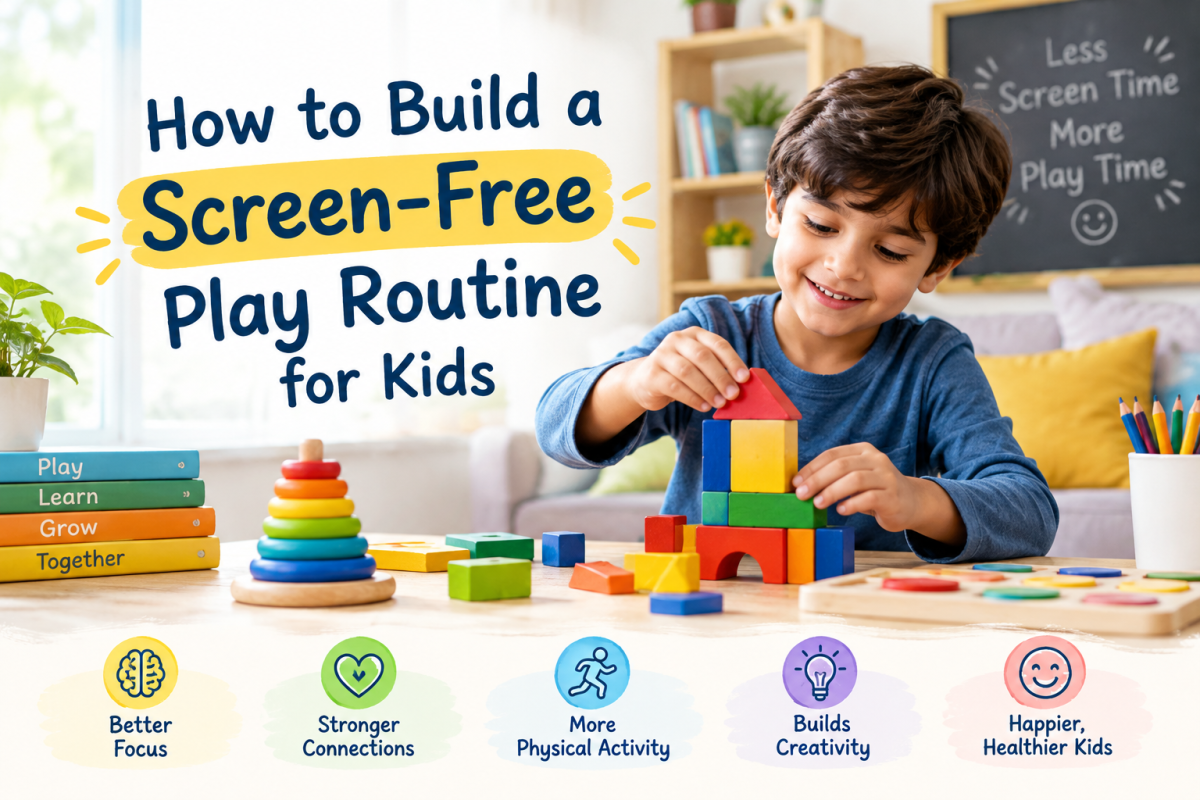
How to Build a Screen-Free Play Routine for Kids
“Can I have the phone?”
For many parents, this question can appear almost automatically—after school, during meals, while waiting for dinner, or whenever a child says, “I’m bored.”
The goal doesn’t have to be eliminating screens completely.
Instead, parents can create a daily routine where screen-free play has a regular and enjoyable place alongside school, family time, outdoor activity, reading, rest, and appropriate digital media.
The American Academy of Pediatrics recommends that families create media plans that fit their individual routines and values. It also suggests creating screen-free times and places, such as during meals and before bed, while making room for sleep, physical activity, homework, reading, play, and family connection.
For parents in Pakistan, this does not require a perfect playroom or expensive collection of toys.
A few carefully chosen activities, a predictable routine, and a little consistency can be enough to get started.
This guide explains how to build a screen-free play routine for kids that works around real family schedules.
What Is a Screen-Free Play Routine?
A screen-free play routine is simply a regular part of the day when children know that phones, tablets, television, and other entertainment screens are put aside and they have time to play, create, explore, read, build, or interact with family members.
It doesn’t have to mean several hours of completely screen-free living.
For example, a family might have:
- 30 minutes of screen-free play after school
- Screen-free family meals
- A short building or puzzle activity before dinner
- Screen-free time before bedtime
- Longer periods of hands-on play on weekends
The exact routine depends on the child’s age, school schedule, family responsibilities, and existing media habits.
The important part is consistency.
When children know what normally happens next, it becomes easier to move from one activity to another.
Why Create a Screen-Free Play Routine?
The purpose isn’t to make screens the enemy.
Digital media can be used for entertainment, communication, learning, and creativity. The American Academy of Pediatrics’ current guidance emphasizes balance and an individualized approach rather than a single rule that works for every child.
The bigger question is:
What is screen use replacing?
If a tablet regularly replaces play, sleep, family meals, movement, reading, homework, or face-to-face interaction, it may be useful to rethink the family’s routine.
The AAP describes this idea as avoiding media “crowding out” other important parts of children’s lives.
A screen-free play routine gives those activities a predictable place in the day.
Start With One Screen-Free Period
One of the easiest mistakes parents can make is trying to change everything at once.
If your child currently spends a lot of free time on screens, suddenly announcing:
“From today, there are no screens!”
may create unnecessary conflict.
Instead, choose one part of the day.
For example:
4:30–5:00 PM: Screen-free play
During this period, your child can choose from a small selection of activities.
After the routine becomes familiar, you can add another screen-free period.
This makes the change feel like a new family habit rather than a punishment.
Choose the Right Time of Day
A screen-free routine works better when it fits naturally into your family’s schedule.
Here are some practical options.
After School
After school can be a useful time for a short screen-free activity.
Children may need a snack and some downtime before beginning homework, so the activity doesn’t need to be academically demanding.
Good choices include:
- Building blocks
- Simple puzzles
- Drawing
- Sorting activities
- Creative construction
- Wooden toys
- Reading
- Quiet independent play
The goal is to give children something to do without immediately reaching for a device. Parents looking for hands-on options can explore educational toys that can fit naturally into a screen-free play routine.
Before Dinner
A short hands-on activity can fill the gap between homework and dinner.
This might be:
- A puzzle
- Building activity
- Board or strategy game
- Drawing
- Counting activity
- Family game
Because this period is usually short, choose something that can be started and stopped easily.
Before Bed
The hour before bedtime can be especially useful as a screen-free period.
The AAP recommends creating screen-free spaces and times around bedtime, and its current guidance specifically highlights keeping bedrooms and bedtime routines free from screens.
Choose calm activities rather than exciting competitive games.
Good options can include:
- Reading
- Simple puzzles
- Drawing
- Quiet construction
- Wooden activities
- Storytelling
- Looking through books together
The purpose is not to “tire the child out.”
It’s to create a predictable transition from active daytime routines toward bedtime.
Create a Screen-Free Play Basket
You don’t need an entire room full of toys.
Create one small basket, shelf, or tray containing activities your child can start easily.
For example:
Screen-Free Play Basket
- One puzzle
- One building activity
- One creative activity
- One sorting or matching activity
- One book
- One simple game
Keep the selection small enough that your child can actually decide what to do.
ToyRoots’ existing toy-rotation guidance similarly recommends keeping a manageable selection of different types of activities visible rather than displaying every toy at once.
Choose Toys That Are Easy to Start
Think about what happens when your child finishes screen time.
If the alternative requires:
- Finding missing pieces
- Setting up complicated equipment
- Reading a long instruction manual
- Waiting for an adult
- Searching through a cupboard
the screen may win simply because it is easier.
Make the alternative easy.
A child should be able to look at the play area and think:
“I know what I can do.”
This is one reason wooden toys, building blocks, puzzles, drawing materials, sorting activities, and other hands-on toys can work well as part of a screen-free routine.
Use Different Types of Play
Don’t make every screen-free activity educational.
Children need different kinds of play.
A balanced routine can include:
Building Play
Building blocks and construction toys allow children to create structures, experiment with designs, and use their imagination.
A child might build a tower today and a bridge or vehicle tomorrow.
For children who enjoy construction, parents can also explore STEM toys and building activities that encourage hands-on exploration.
Puzzle Play
Puzzles provide a quieter activity that can involve matching, spatial thinking, patterns, or problem-solving.
ToyRoots offers educational puzzles in different formats, including geometric, number, wooden, and logic-based activities.
Creative Play
Drawing, writing, modelling, and other creative activities give children an opportunity to make their own choices.
There doesn’t always need to be a correct answer.
Sorting and Matching
Younger children can explore colours, shapes, sizes, and categories through hands-on sorting activities.
These can be particularly useful for short periods of independent play.
Strategy and Logic Play
Older children may enjoy activities that involve planning, rules, patterns, and problem-solving.
The important thing is to match the difficulty to the child’s ability.
Build the Routine Around Your Child’s Age
A screen-free routine should change as children grow.
For Toddlers
Keep activities simple and supervised.
Try:
- Stacking
- Shape sorting
- Large-piece puzzles
- Simple matching
- Sensory play
- Books
Parents can explore age-appropriate toys for younger children while always following the manufacturer’s age and safety recommendations.
For Preschoolers
You can introduce more structured choices:
- Building blocks
- Wooden puzzles
- Counting activities
- Colour sorting
- Creative activities
- Simple pretend play
- Matching games
At this age, children may still need an adult nearby.
For School-Age Children
Older children can usually handle more complex activities.
Try:
- Construction sets
- Logic puzzles
- STEM activities
- Strategy games
- More advanced puzzles
- Creative projects
- Science experiments
- Independent reading
The key is not simply making the activity “educational.”
It should be interesting enough that the child actually wants to do it.
Don’t Make Every Activity a Lesson
This is an important part of creating a sustainable screen-free routine.
If every activity begins with:
“Today we’re going to learn about shapes.”
or:
“This toy will improve your problem-solving skills.”
children may start to see play as another form of schoolwork.
Sometimes the best thing to say is:
“What would you like to make?”
or:
“Which one do you want to try?”
Let children explore.
A building set doesn’t need to become a mathematics lesson every time.
A puzzle doesn’t need a lecture about cognitive development.
A drawing activity doesn’t need a finished product.
Play can simply be play.
What to Do When Your Child Says, “I’m Bored”
This is probably one of the hardest parts of reducing screen dependence.
When your child says:
“I’m bored.”
you don’t necessarily need to immediately provide entertainment.
You can give them a few choices.
For example:
“You can build something, do this puzzle, or draw.”
Then give them some time.
They may initially reject all three.
That’s okay.
Boredom can sometimes be the beginning of deciding what to do independently.
ToyRoots’ guidance on independent play similarly recommends starting small and giving children opportunities to choose activities themselves rather than expecting long periods of independent play immediately.
Use the “Two Choices” Method
Too many choices can be overwhelming.
Instead of asking:
“What do you want to do?”
try:
“Do you want to build or do a puzzle?”
Or:
“Do you want to draw or play a game?”
Two or three choices are often enough.
Once the child starts playing independently, you can gradually give them more freedom.
Make Screen-Free Play Easy to See
Children are naturally attracted to things that are visible and accessible.
If puzzles are hidden in a cupboard while the tablet is sitting on the table, the tablet has an obvious advantage.
Try keeping the current selection:
- On a low shelf
- In an accessible basket
- On a small activity table
- In labelled containers
- In a visible play corner
You don’t need to display every toy.
A small selection can be enough.
Rotate Activities Instead of Constantly Buying New Toys
If your child loses interest, don’t immediately assume you need to buy another toy.
You may already have enough.
Put some toys away and bring them back later.
For example:
This week
- Magnetic building activity
- Puzzle
- Drawing activity
- Counting toy
Next week
- Wooden construction activity
- Logic game
- Sorting activity
- Different creative activity
Toy rotation can make familiar toys feel different simply because the child hasn’t seen them for a while. ToyRoots already recommends this approach as a practical way to reduce clutter and make better use of an existing collection.
Create a Screen-Free Zone at Home
You don’t necessarily need to make the entire house screen-free.
Choose one or two locations.
For example:
Dining Table
No phones or entertainment screens during family meals.
Play Area
Use this space for toys, books, puzzles, and creative activities.
Bedroom
Keep entertainment screens out of the child’s sleeping space where practical.
The AAP recommends screen-free zones such as bedrooms and mealtimes and encourages families to establish rules that fit their own routines.
Parents Need a Screen-Free Routine Too
Children notice what adults do.
If a parent says:
“Put your tablet away.”
while checking their phone every few minutes, the message becomes confusing.
You don’t have to stop using your phone.
Instead, choose a few moments when the whole family puts devices aside.
For example:
- Dinner
- Family game time
- Story time
- Weekend breakfast
- Before bedtime
The AAP also recommends that parents model healthy digital habits and put their own phones down during meals and bedtime routines.
A Simple Daily Screen-Free Routine
Here’s an example that Pakistani families can adapt.
Morning
10–15 minutes
- Getting dressed
- Breakfast
- Short book
- Simple independent play
No entertainment screen is necessary.
After School
30–45 minutes
- Snack
- Rest
- Building
- Puzzle
- Drawing
- Outdoor play
Homework Period
Keep entertainment screens away if possible so that they do not become a distraction.
Evening
30–60 minutes
- Family meal
- Family game
- Construction activity
- Creative activity
- Reading
Before Bed
30–60 minutes
- Bath
- Story
- Quiet puzzle
- Reading
- Conversation
- Bedtime
This is only an example.
Some families will have very different schedules because of school timings, tuition, work, siblings, weather, or available space.
The best routine is one that your family can realistically maintain.
A Weekend Screen-Free Routine
Weekends provide more opportunities for longer activities.
Instead of trying to keep children occupied all day, divide the day into different types of experiences.
Morning
Outdoor play, cycling, walking, or another physical activity.
Late Morning
Building, puzzles, crafts, or STEM activities.
Afternoon
Family time, reading, rest, or imaginative play.
Evening
A board game, strategy game, drawing activity, or family conversation.
You don’t need to schedule every minute.
Leave some unplanned time too.
Children should have opportunities to decide what they want to do.
What If Your Child Wants a Screen During Play Time?
Avoid turning every request into an argument.
You can acknowledge the request and remind the child of the routine.
For example:
“You can use the tablet later. Right now it’s play time. You can choose the blocks or the puzzle.”
The goal is consistency rather than constant negotiation.
If the family has agreed on a routine, try to follow it calmly.
Don’t Use Toys as a Punishment
A screen-free routine should not become:
“You were naughty, so you have to play with your toys.”
That can make offline play feel like a punishment.
Instead, present it as a normal part of the day.
Just as children have time for homework, meals, sleep, and outdoor activity, they can also have time for hands-on play.
What Types of Toys Work Best for Screen-Free Play?
There is no single perfect screen-free toy.
The best choice depends on the child’s age, interests, abilities, and the amount of adult help required.
Some useful categories include:
| Type of play | Examples |
|---|---|
| Building | Magnetic blocks, construction sets |
| Problem-solving | Logic games, puzzles |
| Early maths | Counting and number activities |
| Sorting | Colour and shape activities |
| Creativity | Drawing, modelling, craft activities |
| STEM | Science and construction kits |
| Quiet play | Wooden puzzles, books |
| Social play | Family and strategy games |
Parents can explore ToyRoots’ collections of educational toys, STEM toys, wooden toys, educational puzzles, and Montessori toys when choosing activities for a screen-free routine.
Safety Still Matters
Screen-free does not automatically mean risk-free.
Before adding a toy to your child’s routine, check:
- Recommended age
- Small parts
- Magnets
- Batteries
- Material and construction
- Number of pieces
- Whether supervision is required
- Whether younger siblings can access the toy
This is particularly important in families with children of different ages.
A puzzle suitable for an older child may contain pieces that are not appropriate for a younger sibling.
Always follow the manufacturer’s safety instructions and product-specific age recommendations.
A 7-Day Starter Plan
If you’re not sure where to begin, try this simple plan.
Day 1: Build
Give your child a construction activity.
Don’t tell them what to make.
Day 2: Puzzle
Offer a puzzle that is appropriate for their age and ability.
Let them work through it rather than immediately showing the answer.
Day 3: Create
Provide paper, drawing materials, modelling materials, or another creative activity.
Day 4: Sort
Try colours, shapes, numbers, matching, or classification activities.
Day 5: Play Together
Choose a game or activity that you can do as a family.
Day 6: Explore
Try a STEM activity, experiment, or construction challenge.
Day 7: Child’s Choice
Let your child choose the activity.
Pay attention to what they select.
That information can help you decide what to keep in the regular routine.
How to Know If the Routine Is Working
Don’t judge success by asking:
“Did my child avoid screens all day?”
Instead, look for smaller signs.
Is your child:
- Starting play without immediately asking for a device?
- Returning to the same toy voluntarily?
- Playing independently for slightly longer?
- Asking to build or create something?
- Choosing activities without your help?
- Playing with siblings?
- Accepting the screen-free transition more easily?
These are more useful signs that the routine is becoming part of everyday life.
What If the Routine Doesn’t Work?
Change it.
Maybe 45 minutes is too long.
Try 15 or 20 minutes.
Maybe puzzles aren’t interesting.
Try construction.
Maybe your child doesn’t want independent play after school.
Try family play first.
Maybe evenings are too busy.
Move the screen-free activity to the morning or weekend.
There is no requirement to follow one perfect schedule.
The AAP’s current approach to family media planning also emphasizes personalization—families should create routines that fit their children’s needs and their own circumstances.
The Goal Is Balance, Not Perfection
A screen-free play routine isn’t about creating a childhood completely disconnected from technology.
Screens are part of modern family life.
Children may use them for school, communication, entertainment, creativity, or learning.
The goal is to make sure screens don’t become the automatic answer to every quiet moment.
Give children regular opportunities to:
Build.
Create.
Move.
Read.
Solve.
Imagine.
Talk.
Explore.
Sometimes that means a puzzle on the table.
Sometimes it means building a tower from blocks.
Sometimes it means drawing something completely unexpected.
And sometimes it simply means letting a child sit for a while and figure out what they want to do.
Final Thoughts
Building a screen-free play routine doesn’t require expensive toys or a complicated timetable.
Start with one predictable period of the day.
Choose a small selection of activities.
Keep them visible and easy to access.
Offer choices instead of constantly directing your child.
Rotate toys when interest drops.
And most importantly, give the routine time to become familiar.
The aim isn’t to make children dislike screens.
It’s to make offline play a normal and enjoyable part of everyday family life.
A few building blocks, a puzzle, a drawing activity, a book, or a simple family game can sometimes be all you need to create a meaningful alternative.
And when children learn that “I’m bored” doesn’t automatically mean “give me a screen,” they gradually get more opportunities to discover something important:
They can create their own fun.
Frequently Asked Questions
How do I start a screen-free routine for my child?
Start with one predictable period, such as 20–30 minutes after school or before dinner. Offer two or three activities and gradually build the routine as your child becomes comfortable with it.
What can kids do instead of screens?
Children can build, draw, read, solve puzzles, play games, sort objects, create crafts, experiment with STEM activities, play outdoors, or simply engage in imaginative play.
What are the best toys for screen-free play?
It depends on the child’s age and interests. Building blocks and wooden toys, puzzles, creative activities, sorting toys, logic games, and STEM activities can all work well.
Should I completely remove screens from my child’s life?
Not necessarily. Current AAP guidance focuses on a personalized and balanced approach to media use rather than one identical rule for every family. The important question is whether media use is interfering with sleep, physical activity, school, family interaction, play, or other important activities.
How long should screen-free play last?
There is no single duration that works for every child. Start with an amount your child can realistically manage and increase it gradually if they enjoy it.
What should children do before bedtime instead of using screens?
Try reading, quiet puzzles, drawing, storytelling, simple wooden activities, or calm conversations. The AAP recommends creating screen-free time around bedtime and keeping screens out of bedrooms where practical.
What if my child says they are bored?
Give them a small number of choices rather than immediately entertaining them. For example: “Would you like to build something or do a puzzle?” Give them time to decide and explore.
Do I need to buy new toys to reduce screen time?
No. Start with what you already have. Toy rotation can help bring less-used toys back into the child’s attention without constantly purchasing new ones.
How can parents make screen-free play easier?
Keep a small selection of toys visible and accessible, choose activities that can be started easily, create predictable screen-free periods, and make the whole family part of the routine.
Related reading
All in Parenting Tips →
Eidi Gift Ideas for Kids in Pakistan: Thoughtful Gifts Beyond Cash
Eid is a time for family gatherings, delicious food, new clothes, and the excitement of receiving Eidi. For children, opening an envelope…
How to Clean and Maintain Kids’ Toys: A Parent’s Guide for Pakistan
Children touch their toys throughout the day. They carry them around the house, play with them on the floor, take them outside,…
How to Choose Wooden Toys for Kids in Pakistan: A Parent’s Guide
Choosing a toy for your child is about more than finding something colourful or entertaining. You want something they will enjoy, use…
