
No products in the cart.
Parenting Tips, ToyRoots Life
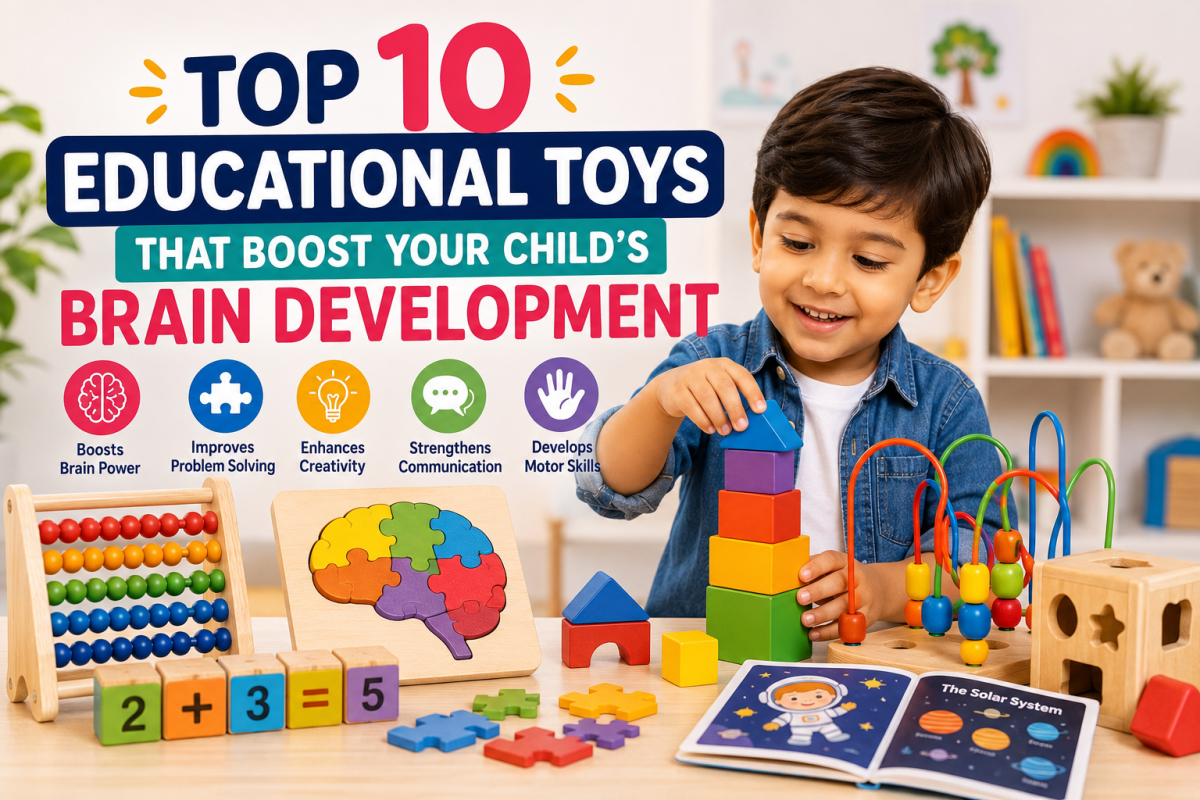
Top 10 Educational Toys That Boost Your Child’s Brain Development
Every parent wants to help their child grow into a confident, curious, and capable learner. During the first few years of life, a child\’s brain develops at an incredible pace, making this the ideal time to introduce activities that encourage learning through play. Educational toys are specially designed to support this development by combining fun with valuable learning experiences.
Unlike ordinary toys that simply entertain, educational toys encourage children to think, explore, solve problems, and develop new skills. Whether it\’s building with blocks, completing puzzles, experimenting with STEM kits, or engaging in imaginative role play, these toys help strengthen cognitive abilities while making playtime exciting. By choosing age-appropriate educational toys, parents can support their child\’s intellectual, emotional, social, and physical development in a natural and enjoyable way.
What Are Educational Toys?
Educational toys are toys that promote learning while children play. They are carefully designed to develop important skills such as critical thinking, creativity, communication, memory, concentration, and fine motor coordination. Instead of providing passive entertainment, educational toys actively involve children in solving problems, making decisions, exploring new ideas, and expressing their imagination.
These toys are available in many forms, including puzzles, building blocks, Montessori activities, STEM learning kits, pretend play sets, musical instruments, art supplies, and memory games. Each type focuses on different areas of development, helping children gain confidence while learning through hands-on experiences. The greatest advantage of educational toys is that they make learning enjoyable, encouraging children to stay curious and engaged every day.
1. Building Blocks
Building blocks remain one of the most effective educational toys for children of all ages. As children stack, arrange, and construct different structures, they naturally develop spatial awareness, logical thinking, creativity, and problem-solving skills. Every tower they build teaches them about balance, shapes, and basic engineering concepts while strengthening hand-eye coordination and fine motor skills. Building blocks also encourage independent thinking because children constantly experiment with new designs and learn from their mistakes. Whether playing alone or with friends, these simple toys help develop patience, confidence, and imagination.
2. Wooden Puzzles
Wooden puzzles are excellent tools for improving concentration and memory. Children learn to recognize shapes, colors, and patterns while figuring out where each piece belongs. Completing puzzles strengthens visual perception, logical reasoning, and attention to detail. As children solve increasingly difficult puzzles, they also learn patience and perseverance. Every completed puzzle gives children a sense of achievement that builds confidence while encouraging them to tackle more complex challenges in the future.
3. STEM Learning Kits
STEM learning kits introduce children to science, technology, engineering, and mathematics through exciting hands-on activities. These educational toys encourage children to ask questions, conduct experiments, and discover how things work. Whether building simple machines, creating circuits, or performing science experiments, children develop analytical thinking, creativity, and problem-solving skills. STEM toys also prepare young learners for future academic success by making complex subjects fun and accessible from an early age.
4. Montessori Learning Toys
Montessori toys are designed to promote independent learning and self-discovery. They encourage children to complete practical activities using their own curiosity rather than relying on constant adult guidance. Toys such as stacking rings, sensory boards, sorting trays, and practical life activities help improve concentration, coordination, and decision-making. Because Montessori toys focus on one skill at a time, children develop confidence while mastering each activity at their own pace, making learning enjoyable and stress-free.
5. Magnetic Building Tiles
Magnetic building tiles inspire creativity while introducing children to basic engineering and architectural concepts. Kids can construct houses, bridges, vehicles, towers, and countless imaginative creations using colorful magnetic pieces. This type of open-ended play strengthens spatial reasoning, planning skills, and creativity while encouraging experimentation. Magnetic tiles also support teamwork and communication when children collaborate on larger building projects with friends or family members.
6. Shape Sorters
Shape sorters are ideal educational toys for babies and toddlers who are learning to recognize different shapes and colors. As children identify and match each shape with the correct opening, they strengthen problem-solving abilities, logical reasoning, and hand-eye coordination. These activities also develop fine motor skills and improve concentration. Shape sorting introduces children to early mathematical concepts while encouraging persistence as they learn through trial and error.
7. Pretend Play Sets
Pretend play toys, including kitchen sets, doctor kits, supermarkets, and tool benches, allow children to explore real-life situations through imaginative role play. This type of play develops language skills, communication, creativity, empathy, and emotional intelligence. As children create stories and interact with others, they build confidence while learning cooperation, sharing, and problem-solving. Pretend play also helps children understand the world around them in a safe and enjoyable environment.
8. Musical Toys and Instruments
Musical toys stimulate multiple areas of the brain simultaneously, making them valuable tools for early childhood development. Playing drums, keyboards, xylophones, or other child-friendly instruments improves listening skills, rhythm, memory, and coordination. Music also supports language development because children learn to recognize sounds, patterns, and sequences. Singing songs and playing instruments encourages creativity while helping children express their emotions in healthy and enjoyable ways.
9. Memory Matching Games
Memory games challenge children to remember the location of matching cards, helping strengthen short-term memory, concentration, and attention span. As children practice recalling information, they improve cognitive flexibility and observation skills. These games also teach patience and strategic thinking because children must carefully remember previous turns to find matching pairs. Regular memory games can significantly improve a child\’s ability to focus and retain information.
10. Art and Craft Kits
Art and craft activities provide children with endless opportunities to express their creativity while developing fine motor skills. Drawing, painting, coloring, cutting, and creating different projects strengthen hand muscles needed for writing and other everyday tasks. Creative activities also encourage independent thinking, imagination, and emotional expression. Every completed artwork gives children a sense of accomplishment while inspiring them to continue exploring new ideas through creative play.
Why These Toys Improve Brain Development
A child\’s brain develops through active experiences rather than passive observation. Educational toys encourage children to explore, experiment, compare, remember, create, and communicate, helping strengthen the neural connections responsible for learning and memory. Every time children solve a puzzle, build a structure, complete a sorting activity, or imagine a new story, they exercise different areas of the brain that support reasoning, language, creativity, and emotional intelligence.
Hands-on learning is particularly effective because children remain actively engaged throughout the process. Unlike screen-based entertainment, educational toys require children to make decisions, solve challenges, and think independently. These meaningful experiences build stronger cognitive abilities while helping children develop confidence, curiosity, and a lifelong love of learning.
How to Choose the Right Educational Toy
Selecting the right educational toy begins with understanding your child\’s age, interests, and developmental stage. A toy should be challenging enough to encourage learning while remaining enjoyable and achievable. Age-appropriate toys help children develop new abilities without becoming frustrated, allowing them to gain confidence as they master each new skill.
Parents should also focus on safety and quality when choosing educational toys. Toys made from durable, non-toxic materials provide a safe learning environment while lasting through years of regular play. High-quality educational toys often become favorite learning companions that children return to again and again.
Open-ended toys offer exceptional long-term value because they can be used in many different ways as children grow. Building blocks, magnetic tiles, pretend play sets, and art materials encourage creativity and problem-solving while adapting to a child\’s changing abilities. These versatile toys continue to inspire learning long after they are first introduced.
Most importantly, choose toys that encourage active participation rather than passive entertainment. Educational toys should inspire children to build, explore, imagine, ask questions, and discover new ideas. The more children interact with their toys, the greater the benefits for brain development and lifelong learning.
Frequently Asked Questions
What age should children start using educational toys?Children can begin using educational toys from infancy. Babies benefit from sensory toys, rattles, and soft stacking toys, while toddlers enjoy shape sorters and simple puzzles. As children grow older, building blocks, STEM kits, Montessori activities, educational board games, and creative art supplies become excellent choices for continued learning and development.
Are educational toys better than regular toys?
Educational toys are designed with learning objectives in mind, but many traditional toys can also support healthy development. The best toys are those that encourage children to think, create, move, communicate, and explore rather than simply providing passive entertainment. A balanced collection of engaging toys offers the greatest developmental benefits.
How many educational toys does a child need?
Children do not need a large number of educational toys to learn effectively. A carefully selected collection of high-quality toys often provides more meaningful experiences than an overwhelming number of options. Rotating toys regularly also helps maintain interest while encouraging children to explore different skills over time.
Final Thoughts
Educational toys are one of the most valuable investments parents can make in their child\’s future. They transform everyday play into opportunities for learning, helping children develop creativity, memory, communication, confidence, and problem-solving skills in a fun and natural way. Every puzzle solved, tower built, melody played, or imaginative story created strengthens important brain connections that support lifelong learning.
At Toyroots, we believe every child deserves toys that inspire curiosity and creativity. Our carefully selected collection of educational toys is designed to support every stage of childhood development while making learning exciting and enjoyable. By choosing thoughtful, age-appropriate educational toys, parents can create an environment where children grow into confident, creative, and lifelong learners.
Related reading
All in Parenting Tips →
Eidi Gift Ideas for Kids in Pakistan: Thoughtful Gifts Beyond Cash
Eid is a time for family gatherings, delicious food, new clothes, and the excitement of receiving Eidi. For children, opening an envelope…
How to Clean and Maintain Kids’ Toys: A Parent’s Guide for Pakistan
Children touch their toys throughout the day. They carry them around the house, play with them on the floor, take them outside,…
How to Choose Wooden Toys for Kids in Pakistan: A Parent’s Guide
Choosing a toy for your child is about more than finding something colourful or entertaining. You want something they will enjoy, use…
